
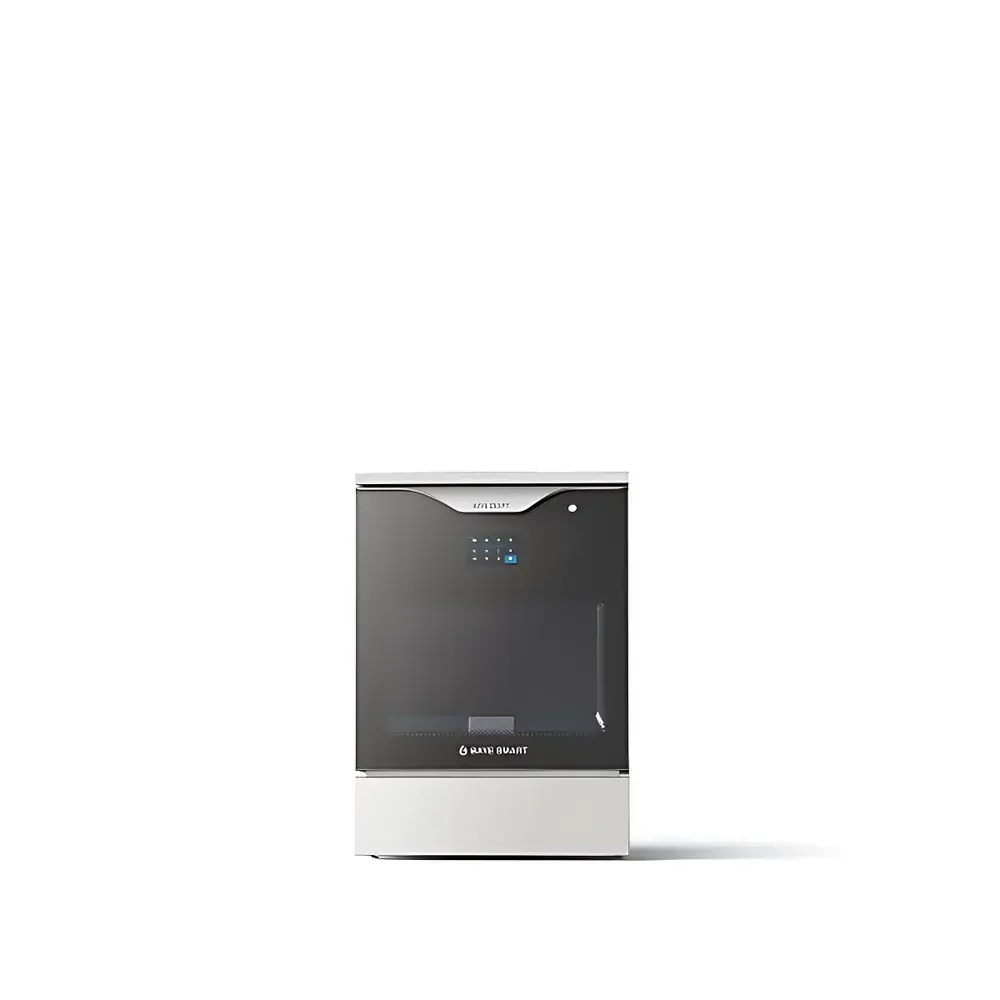
BAYE SMART BS280 Fully Automated Laboratory Bottle Washer
| Brand | BAYE SMART |
|---|---|
| Origin | Shanghai, China |
| Manufacturer Type | Authorized Distributor |
| Country of Origin | China |
| Model | BS280 |
| Quotation | Upon Request |
| External Dimensions (L×W×H) | 620 × 710 × 875 mm (845 mm with control panel extension) |
| Cabinet Material | Black explosion-proof tempered glass + brushed stainless steel (AISI 304) |
| Chamber Material | Electropolished SUS 316L mirror-finish stainless steel |
| Chamber Construction | Laser-welded seamless cavity |
| Surface Roughness | Ra ≤ 0.2 µm (large-area), Ra ≤ 0.4 µm (localized features) |
| Capacity | Up to 280 × 25 mL volumetric flasks per cycle |
| Basket Configuration | 2-tier modular rack system with configurable positioning |
| Load Flexibility | Validated partial-load operation (down to 20% nominal capacity) |
| Washing Method | High-precision multi-directional spray arm system with dynamic pressure modulation |
| Control System | Embedded microcomputer with 7-inch capacitive touch HMI |
| Circulation Pump | Variable-speed centrifugal pump, max. flow rate 600 L/min |
| Conductivity Monitoring | Integrated real-time conductivity sensor (0–20 mS/cm, ±0.02 mS/cm accuracy) |
| Data Logging | Full-cycle traceability including temperature, pressure, conductivity, time, and detergent dosage |
| Connectivity | Industrial-grade IoT module supporting MQTT/HTTPS protocols for remote monitoring and firmware OTA updates |
| Compliance | EN ISO 15883-1:2009 & EN ISO 15883-2:2009 (washer-disinfectors for heat-labile medical devices), FDA 21 CFR Part 11 (electronic records & signatures), China GMP Annex I (Sterile Pharmaceutical Production, 2003 Edition), China Pharmaceutical Industry EHS Guidelines (2020) |
Overview
The BAYE SMART BS280 Fully Automated Laboratory Bottle Washer is an engineered solution for high-integrity cleaning and thermal disinfection of precision laboratory glassware—including volumetric flasks, burettes, pipettes, and reaction vessels—within regulated environments such as pharmaceutical QC labs, contract testing organizations (CTOs), and GLP-compliant research facilities. Operating on the principle of validated thermodynamic cleaning, the BS280 delivers reproducible contaminant removal through controlled thermal cycles (50–93°C), precisely modulated spray dynamics, and real-time electrochemical verification via integrated conductivity monitoring. Its chamber design adheres to fluid-dynamic optimization principles: laser-welded SUS 316L construction eliminates crevices, while electropolished surfaces (Ra ≤ 0.2 µm over >90% of internal area) minimize biofilm adhesion and facilitate visual and tactile inspection. Unlike generic lab washers, the BS280 is purpose-built for trace-level residue validation—supporting residue limits down to 1 ppm for active pharmaceutical ingredients (APIs) and excipients under ICH Q5C and Q7 guidance.
Key Features
- Laser-welded, electropolished SUS 316L chamber with surface roughness Ra ≤ 0.2 µm (major surfaces) and Ra ≤ 0.4 µm (complex geometries), certified per ASTM A967 and ISO 15730
- Two-tier modular basket system enabling customizable load configuration for heterogeneous vessel types and sizes (e.g., simultaneous washing of 25 mL flasks and 100 mL graduated cylinders)
- Variable-speed circulation pump (0–600 L/min) with adaptive pressure feedback control to maintain uniform spray impact across all rack positions
- Real-time conductivity monitoring (0–20 mS/cm, ±0.02 mS/cm) integrated into rinse phases to objectively verify detergent removal and water purity compliance
- 7-inch industrial-grade capacitive touch HMI with multilingual UI (English, German, Chinese), audit-trail-enabled user authentication, and role-based access control (RBAC)
- Full-cycle electronic record generation compliant with FDA 21 CFR Part 11: digitally signed, tamper-evident logs include timestamps, operator ID, parameter setpoints, actual values, and alarm history
Sample Compatibility & Compliance
The BS280 accommodates standard ISO/IEC 68-2-30 compliant glassware up to 300 mm in height and 120 mm in diameter. Its validated cleaning performance covers Class A volumetric glassware (DIN EN ISO 1042), borosilicate Type I tubing, and polypropylene centrifuge tubes (up to 50 mL). Cleaning efficacy has been verified per EN ISO 15883-2:2009 Annex C using ATP bioluminescence and protein residue assays (BCA method). Regulatory alignment includes full traceability to EU MDR Annex I essential requirements, China NMPA GMP Annex I (2003), and WHO TRS 986 Annex 5. All software modules undergo annual revalidation per GAMP 5 guidelines; IQ/OQ/PQ documentation packages are available upon request.
Software & Data Management
The embedded firmware supports automated data export via USB 3.0 or secure HTTPS API to LIMS or MES platforms. Cycle logs are stored locally for ≥12 months and encrypted at rest (AES-256). The IoT interface enables remote diagnostics, predictive maintenance alerts (e.g., filter clogging, pump efficiency drift), and over-the-air firmware updates with cryptographic signature verification. Electronic signatures meet ALCOA+ criteria: attributable, legible, contemporaneous, original, accurate, and complete—with immutable audit trails preserving all user actions, parameter modifications, and system events.
Applications
- Residue clearance validation for API manufacturing equipment swab samples and rinse waters
- Pre-sterilization cleaning of vials and syringes prior to depyrogenation in pharmaceutical fill-finish lines
- High-reproducibility cleaning of analytical reference standards containers in QC laboratories
- Decontamination of cytotoxic drug handling tools in oncology research units
- Automated cleaning protocol execution under GLP/GCP study protocols requiring full data integrity
FAQ
Does the BS280 support installation in cleanroom environments (ISO Class 5–8)?
Yes—the unit meets ISO 14644-1 particle emission limits when operated with HEPA-filtered exhaust ducting and can be configured with VHP-compatible seals.
Can cleaning programs be exported and imported between multiple BS280 units?
Yes—validated cycle files (.bwp format) are digitally signed and portable across units running firmware v2.4.0 or later.
Is third-party validation support provided?
BAYE SMART offers IQ/OQ protocol templates aligned with ASTM E2500 and provides on-site PQ support through authorized service partners.
What is the maximum allowable deviation for temperature and conductivity during a validated cycle?
Per EN ISO 15883-1:2009 Clause 7.3.2, temperature tolerance is ±2°C; conductivity deviation must remain within ±0.05 mS/cm of setpoint during final rinse.
How is cybersecurity managed for IoT-connected units?
All communications use TLS 1.2+, device authentication employs X.509 certificates, and firmware updates require dual-signature authorization from both manufacturer and site administrator.



