
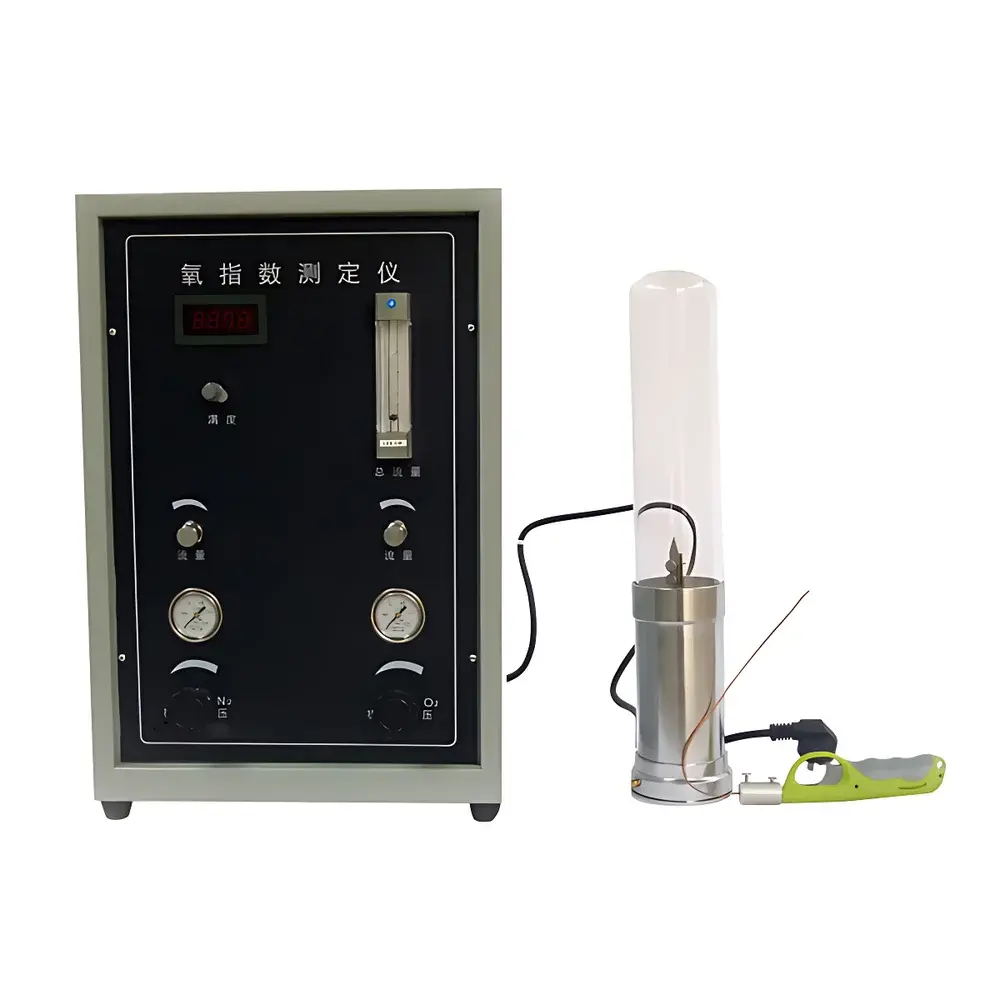
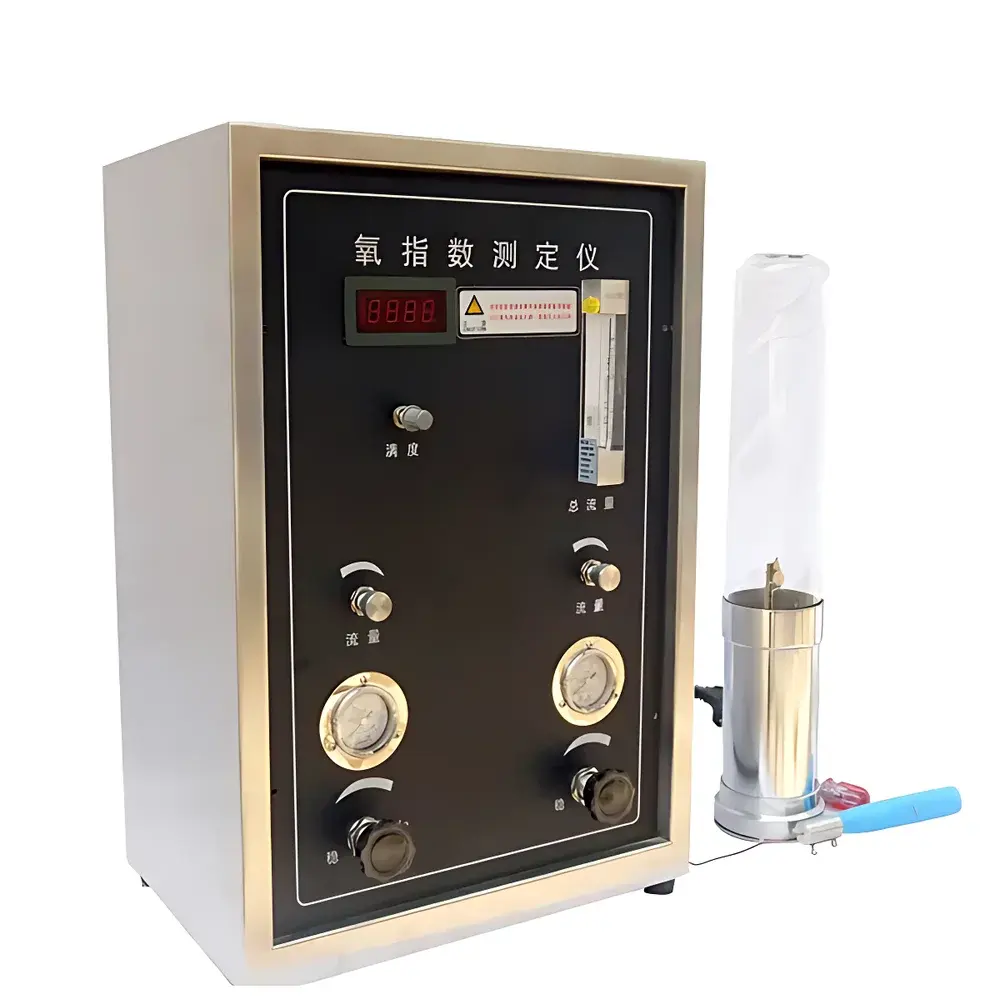
North Guang JF-3 Digital Oxygen Index Tester
| Brand | North Guang Precision Instrument |
|---|---|
| Origin | Beijing, China |
| Manufacturer Type | Manufacturer |
| Model | JF-3 |
| Price Range | USD 700 – 1,400 (FOB) |
| Oxygen Measurement Range | 0–100 vol% |
| Resolution | ±0.1% O₂ |
| Overall Accuracy | Class 0.2 |
| Gas Flow Control | 0–10 L/min (60–600 L/h), adjustable via dual needle valves |
| Response Time | <5 s |
| Combustion Column | Quartz glass tube, ID ≥75 mm, height 300 mm, total height 450 mm |
| Gas Linear Velocity in Column | 40 ±2 mm/s |
| Pressure Regulation | Inlet pressure 0.2–0.3 MPa |
| working pressure for O₂/N₂ | 0.05–0.15 MPa each |
| Ignition Source | Propane/butane torch with flame length 5–60 mm (standard ignition flame: 16 ±4 mm) |
| Sample Holders | Dual-configurable—self-supporting vertical clamp & non-self-supporting frame-type fixture |
| Power Supply | AC 220 V ±10%, 50 Hz, max. 50 W |
| Compliance | GB/T 2406.1–2008, GB/T 2406.2–2009, ASTM D2863, ISO 4589-2, IEC 61144, NES 714 |
Overview
The North Guang JF-3 Digital Oxygen Index Tester is a precision benchtop instrument engineered for the quantitative determination of the limiting oxygen index (LOI) of solid polymeric materials under controlled combustion conditions. Based on the standardized upward candle-flame method, it measures the minimum volume percentage of oxygen in an oxygen–nitrogen mixture required to support candle-like combustion of a vertically oriented specimen for at least 3 minutes or until the flame front advances 50 mm. The instrument operates on the principle of controlled gas mixing, laminar flow dynamics within a calibrated quartz combustion column, and real-time electrochemical oxygen sensing—enabling direct digital readout without manual calculation. Designed for compliance with international fire safety testing protocols, the JF-3 delivers high reproducibility across diverse material classes including thermoplastics, elastomers, foams, textiles, composites, and coated substrates.
Key Features
- High-stability imported electrochemical oxygen sensor with digital display (0–100 vol%), resolution ±0.1% O₂, and certified Class 0.2 overall measurement accuracy per GB/T 7755.
- Quartz combustion column (ID ≥75 mm, height 300 mm, total assembly height 450 mm) ensures thermal stability, optical clarity, and resistance to chemical degradation during repeated exposure to combustion byproducts.
- Precisely regulated gas flow system featuring dual independent needle valves, stainless steel pressure regulators, inline particulate filters, and a glass-bead diffusion mixer (φ4.5 mm beads, 95 mm bed height) for homogeneous O₂/N₂ blending.
- Adjustable propane/butane ignition source with fine-tuned flame length control (5–60 mm); standard test flame maintained at 16 ±4 mm using a calibrated metal tube nozzle (ID φ2 ±1 mm).
- Dual sample holder configuration: self-supporting vertical clamp for rigid specimens (e.g., plastics, rigid foams) and frame-mounted non-self-supporting fixture for flexible films, fabrics, and soft sheets—both positioned coaxially within the combustion column.
- Modular mechanical architecture separates control electronics from the combustion zone; CNC-machined steel enclosure with epoxy-powder coating provides EMI shielding and long-term corrosion resistance.
- Integrated safety features include upstream pressure monitoring (0.01 MPa resolution), over-pressure relief pathways, and fail-safe gas shutoff logic upon power interruption or abnormal sensor drift.
Sample Compatibility & Compliance
The JF-3 accommodates specimens conforming to ISO 4589-2 and ASTM D2863 dimensional requirements: 150 mm × 6.5 mm × 3.0–10.0 mm (thickness dependent on material class). It supports both self-igniting and non-self-supporting geometries—including films, nonwovens, laminates, and intumescent coatings—via interchangeable fixtures. All structural components meet RoHS Directive 2011/65/EU material restrictions. The system is validated for use in GLP-compliant laboratories and satisfies documentation traceability requirements under ISO/IEC 17025:2017 for calibration records, gas certification logs, and environmental condition monitoring (ambient temperature 23 ±2 °C, RH ≤70%). Gas supply must utilize industrial-grade O₂ and N₂ (≥99.0% purity), certified per ISO 8573-1:2010 Class 2 for particulate and moisture content.
Software & Data Management
While the JF-3 operates as a standalone analog-digital hybrid instrument without embedded PC software, its modular signal architecture supports external data acquisition via 0–5 V analog output (O₂ concentration) and TTL-level digital triggers (flame detection, test start/stop). Users may integrate the unit into LIMS or custom QA/QC workflows using third-party DAQ systems compliant with IEEE 1451.2 transducer standards. All calibration certificates, gas cylinder lot traceability documents, and environmental logs are retained per FDA 21 CFR Part 11 Annex 11 principles when deployed in regulated pharmaceutical or aerospace material qualification environments. Firmware updates (if applicable) follow IEC 62443-3-3 security guidelines for industrial control devices.
Applications
The JF-3 serves as a primary screening tool in polymer formulation labs evaluating flame-retardant additive efficacy (e.g., phosphinates, melamine derivatives, metal hydroxides). It supports R&D validation for UL 94 HB classification pre-screening, automotive interior material compliance (FMVSS 302, GB 8410), rail vehicle fire safety (EN 45545-2, TB/T 2919), and cable jacket flammability assessment (IEC 60332-1). Academic researchers employ it for structure–flammability correlation studies in bio-based polymers and nanocomposites. Quality assurance teams deploy it for incoming raw material verification against contractual LOI thresholds (e.g., ≥28% for V-0 grade engineering resins).
FAQ
What gases are required for operation?
Industrial-grade oxygen and nitrogen (≥99.0% purity) are mandatory. Cylinders must be equipped with dual-stage pressure regulators and filtered inlet lines meeting ISO 8573-1 Class 2 specifications.
Is the instrument compatible with automated data logging?
Yes—the analog O₂ output (0–5 V DC) and digital status signals allow integration with commercial DAQ platforms or PLC-based test cells.
How often must the oxygen sensor be calibrated?
Initial calibration is performed at factory using NIST-traceable gas standards; field recalibration is recommended every 6 months or after 200 test cycles, using certified 21% O₂ in N₂ reference gas.
Can the JF-3 test coated or multi-layered substrates?
Yes—provided the composite specimen meets dimensional tolerances and exhibits cohesive integrity during vertical mounting; delamination during testing invalidates the LOI result per ISO 4589-2 Clause 8.2.
Does the system include audit trail functionality for regulatory submissions?
No native electronic audit trail exists; however, paper-based test records—including operator ID, ambient conditions, gas batch numbers, and raw sensor outputs—meet GLP Annex 1 and ISO/IEC 17025 documentation requirements when maintained in bound logbooks with controlled access.



