
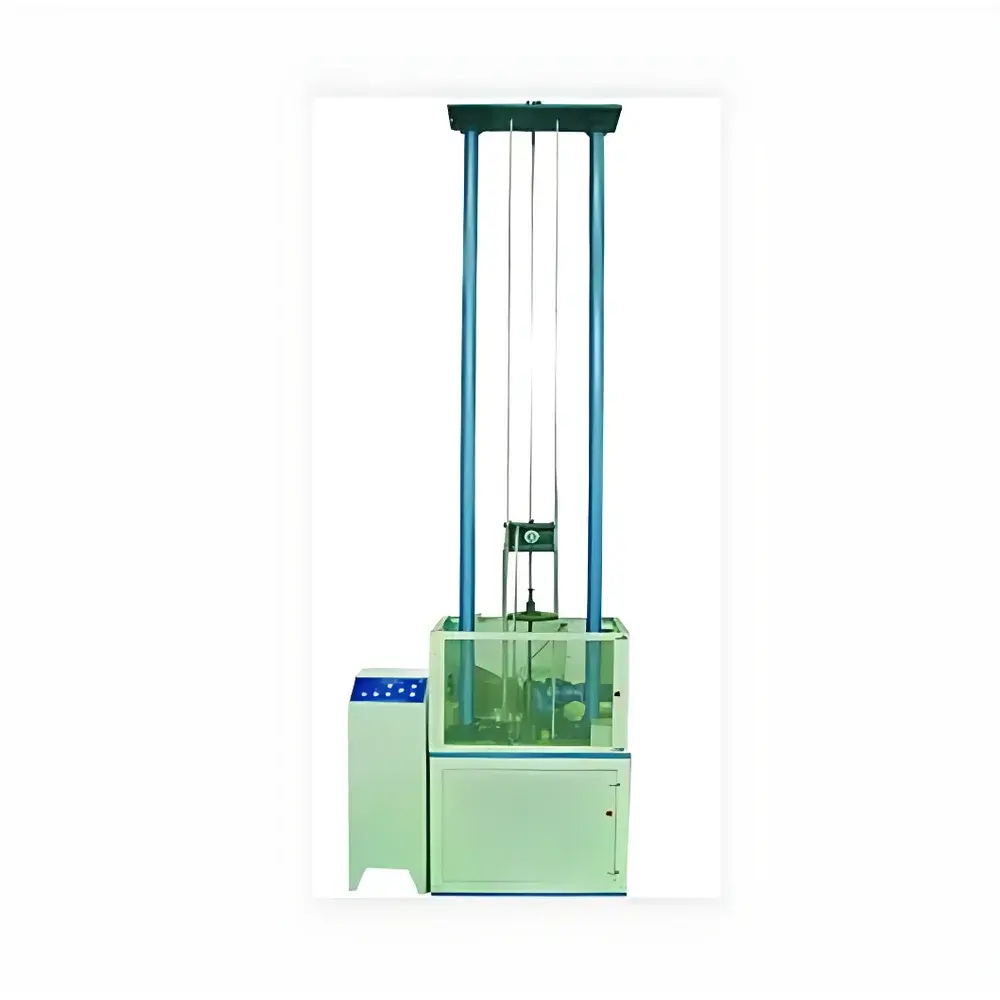
Beiguang Precision CLC-300 Series Microcomputer-Controlled Drop Weight Impact Tester
| Brand | Beiguang Precision Instrument |
|---|---|
| Origin | Beijing, China |
| Manufacturer Type | Direct Manufacturer |
| Model | CLC-300 Series |
| Maximum Impact Energy | 300 J (expandable up to 2000 J) |
| Maximum Drop Height | 2000 mm |
| Drop Mass Range | 0.25–15 kg (±0.1% accuracy) |
| Hammer Nose Radius Options | R=5 mm, R=10 mm, R=20 mm, R=30 mm |
| Specimen Support | Simply Supported Beam Configuration |
| Height Scale Accuracy | ±1% |
| Electromagnetic Catch Force | ≥20 kgf |
| Motorized Lifting Capacity | 20 kgf |
| Alignment Tolerance (Impact Center vs. Fixture Center) | ≤2 mm |
Overview
The Beiguang Precision CLC-300 Series Microcomputer-Controlled Drop Weight Impact Tester is a precision-engineered mechanical testing system designed for quantitative evaluation of impact resistance in rigid and semi-rigid polymeric materials—including plastic pipes, pipe fittings, sheets, and structural composites. It operates on the fundamental principle of gravitational potential energy conversion: a calibrated mass is elevated to a defined height and released to strike a standardized specimen supported in a simply supported beam configuration. The absorbed energy—calculated as the difference between pre-impact potential energy and post-impact residual energy—is measured directly via high-resolution position sensing and synchronized force-time data acquisition. This method conforms rigorously to ASTM D3029, ISO 3127, ISO 4422, GB/T 14152, GB/T 5836.1, and other internationally recognized standards governing impact performance assessment under controlled kinetic conditions.
Key Features
- Microprocessor-based control architecture with real-time height monitoring and automatic zero-point calibration at contact
- Motor-driven electromagnetic lifting mechanism enabling precise, repeatable drop height positioning from 0 to 2000 mm
- Integrated electromagnetic hammer capture system that engages within 15 ms of rebound detection, eliminating secondary impact artifacts
- Four interchangeable hammer noses (R=5, 10, 20, 30 mm) compliant with U-notch and V-notch specimen geometries per ISO 179 and ASTM D1275
- Robust cast-iron frame with precision-machined guide rods ensuring vertical alignment tolerance ≤1/1000 and lateral clearance of 0.5–1.0 mm
- Fail-safe dual-layer protection: interlocked safety door with microswitch validation and reinforced polycarbonate impact shield
- Modular load cell integration (2000 N full scale) with digital signal conditioning for direct force-time waveform capture
Sample Compatibility & Compliance
The CLC-300 accommodates cylindrical specimens (Ø20–400 mm), flat plates, and extruded profiles up to 300 mm in length. Standard fixtures include V-groove supports (200 × 300 × 25 mm) and annular clamping rings (Ø40 ±1.0 mm, Ø80 ±2.0 mm, Ø130 ±2.5 mm) for consistent edge support. All mechanical and software functions are traceable to ISO/IEC 17025 calibration protocols. The system satisfies mandatory requirements for GLP-compliant laboratories conducting material qualification under GB, ASTM, ISO, and EN regulatory frameworks. Data integrity is maintained through audit-trail-enabled software logging aligned with FDA 21 CFR Part 11 principles—ensuring electronic records are attributable, legible, contemporaneous, original, and accurate (ALCOA+).
Software & Data Management
The embedded Windows-based control suite provides full test sequence automation: height setting, pre-drop verification, impact triggering, rebound capture, and post-test calculation. It computes mean failure mass (MFM), mean failure height (MFH), and mean failure energy (MFE) using statistical analysis of multiple impacts per ASTM D3029 Annex A2. Raw force-time waveforms, displacement curves, and energy absorption histograms are exportable in CSV, XML, and PDF formats. Reporting modules generate compliant test certificates with embedded metadata—including operator ID, calibration certificate numbers, environmental conditions (temperature/humidity), and uncertainty budgets per GUM (JCGM 100:2008). All data files are digitally signed and time-stamped to meet ISO 17025 clause 7.7 record retention mandates.
Applications
This instrument serves critical quality assurance and R&D functions across polymer manufacturing, construction materials certification, medical device packaging validation, and aerospace component screening. Typical use cases include: determination of ductile-to-brittle transition behavior in PVC-U piping systems per GB/T 10002.3; evaluation of impact resilience in HDPE geomembranes per ISO 12236; validation of thermoplastic composite laminates used in automotive interior trim; and comparative fatigue resistance assessment of biodegradable packaging films under cyclic low-velocity impact. Its expandable energy range (up to 2000 J) also supports heavy-wall conduit testing per UL 651 and ASTM F2160 specifications.
FAQ
What standards does the CLC-300 comply with?
It meets GB/T 14152, GB/T 5836.1, ASTM D3029, ISO 3127, ISO 4422, and EN ISO 179-1 for Charpy-type impact testing on plastics.
Can the system perform both Method A (constant height) and Method B (constant mass) testing?
Yes—software-configurable test modes support both ASTM D3029 A-method (fixed drop height, variable mass) and B-method (fixed mass, variable height) protocols.
Is calibration traceability provided with the system?
Each unit ships with a UKAS-accredited calibration certificate covering height scale, mass verification, and load cell linearity, valid for 12 months.
How is data integrity ensured during long-term testing campaigns?
All test sessions generate immutable .log files with cryptographic hash signatures; database backups occur automatically every 24 hours to redundant NAS storage.
What maintenance intervals are recommended for sustained accuracy?
Annual verification of guide rod verticality, hammer nose radius metrology (via optical profilometry), and electromagnetic catch response latency is advised per ISO 17025 clause 6.4.



