
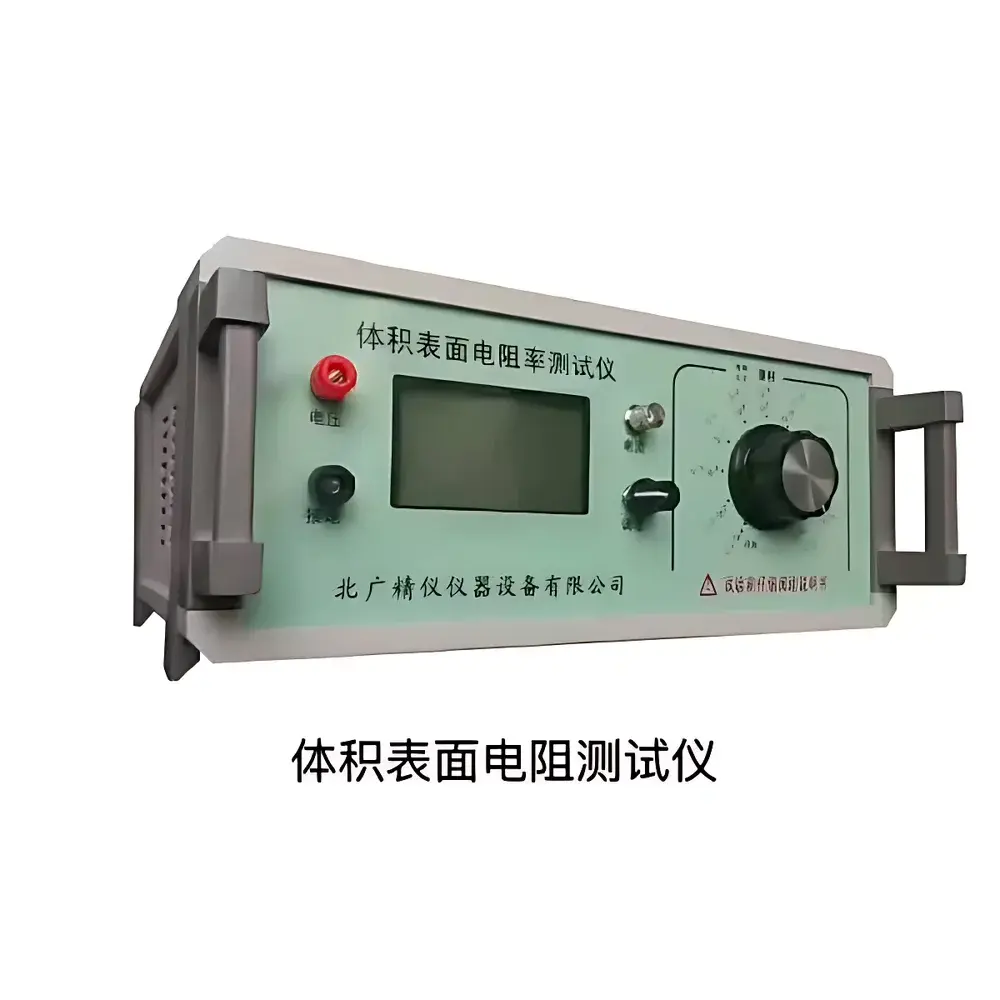
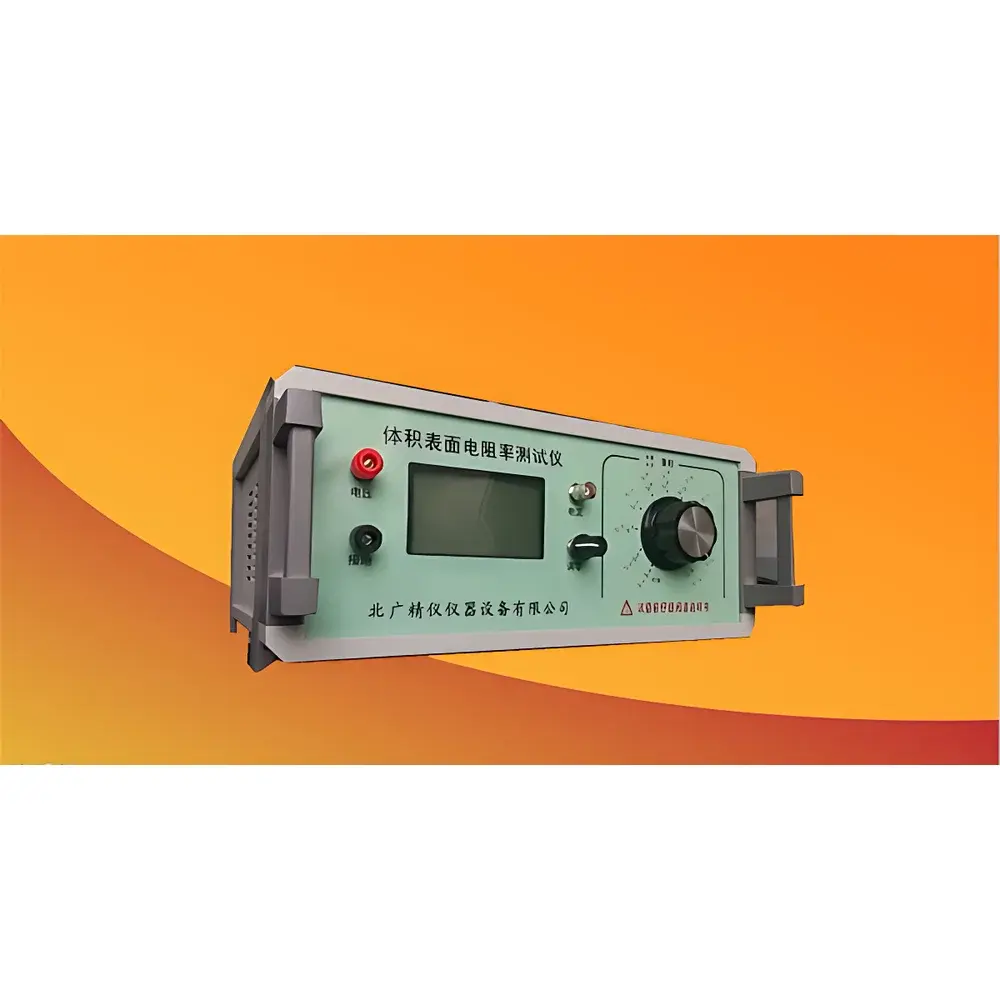
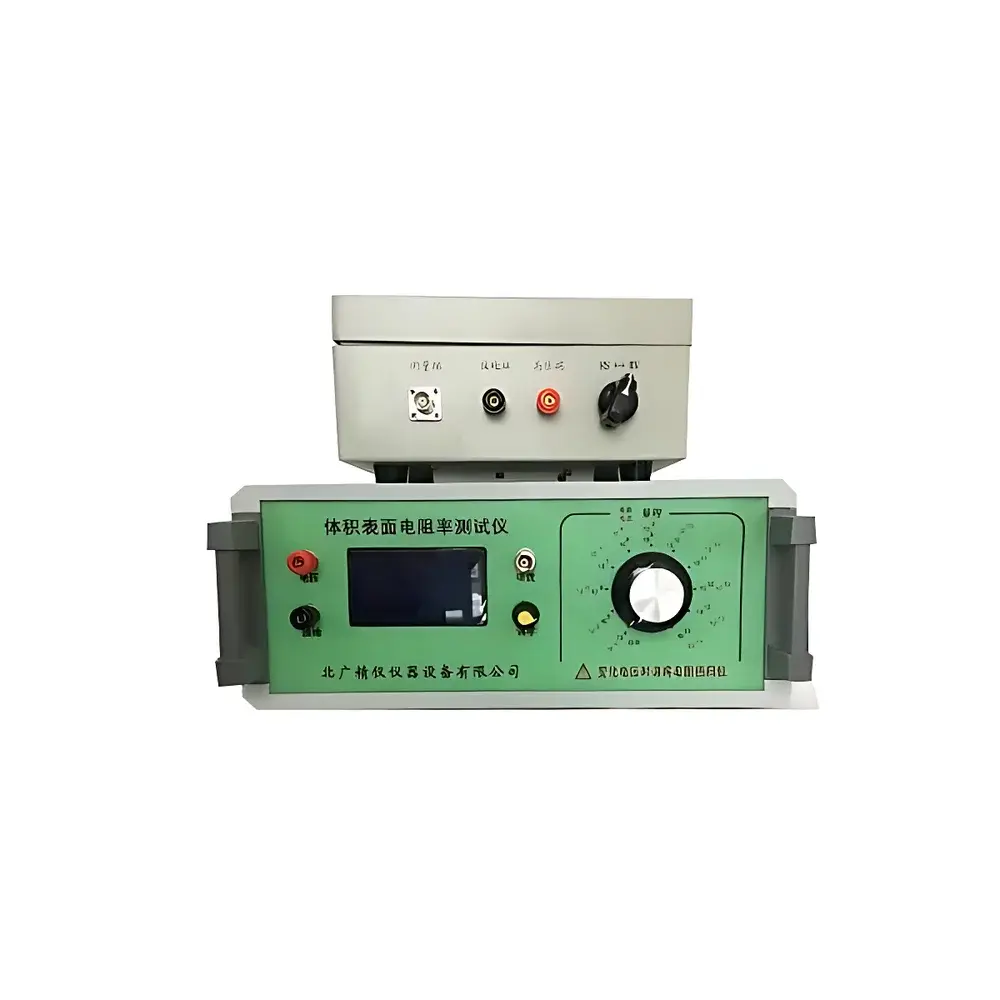
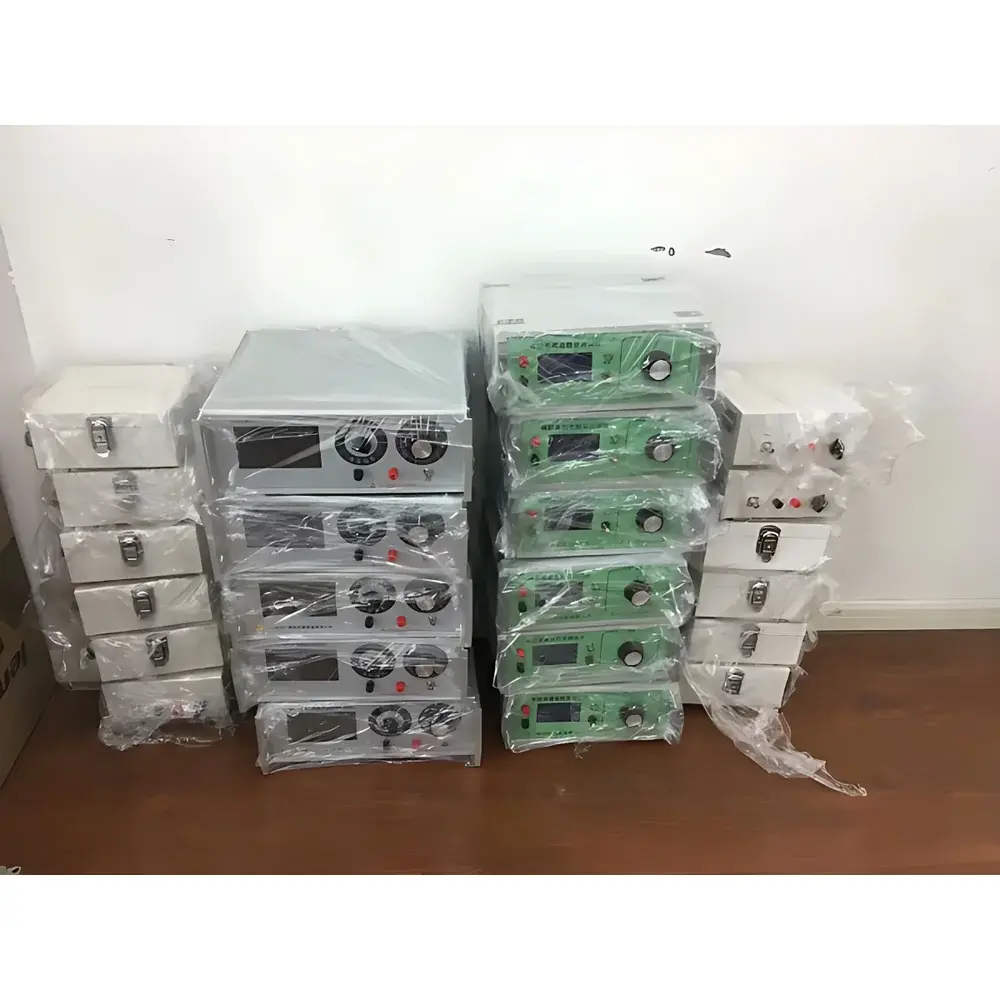
Beiguang BT Series DC/AC Resistivity Tester for Volume and Surface Resistivity Measurement
| Brand | Beiguang Precision Instrument |
|---|---|
| Origin | Beijing, China |
| Manufacturer Type | Direct Manufacturer |
| Country of Origin | China |
| Model | BT |
| Price | USD 1,050 (FOB Beijing) |
| Basic Accuracy | ≤1% |
| Resistance Range | 1×10⁴ Ω to 1×10¹⁸ Ω |
| Current Range | 2×10⁻⁴ A to 1×10⁻¹⁶ A |
| Test Voltages | 10 V, 50 V, 100 V, 250 V, 500 V, 1000 V (user-selectable, stepwise) |
| Display | Dual LCD readout (resistance & current simultaneously) |
| Power Supply | AC 220 V, 50 Hz, ~5 W |
| Compliance | Designed per GB/T 10580–2003, GB/T 1692–2008, IEC 60260, ASTM D257 |
Overview
The Beiguang BT Series DC/AC Resistivity Tester is a precision electrometric instrument engineered for the quantitative determination of volume resistivity (ρv) and surface resistivity (ρs) of solid dielectric materials, including polymers, elastomers, ceramics, composites, and insulating coatings. It operates on the principle of constant-voltage DC or low-frequency AC excitation across standardized electrode configurations—complying with guarded three-terminal measurement architecture per IEC 62631-3-1 and ASTM D257. The system employs a high-impedance electrometer circuit with guarded input stages and active feedback stabilization to ensure stable bias delivery and sub-femtoampere current resolution. Its design addresses critical metrological challenges in high-resistance characterization: dielectric absorption, electrode polarization, humidity-induced drift, and thermal activation of charge carriers—all of which govern exponential dependence of resistivity on temperature and conditioning time. The instrument supports full compliance with standardized environmental preconditioning protocols (e.g., GB/T 10580–2003 for conditioning; IEC 60260 for relative humidity control), enabling traceable, reproducible measurements under GLP-aligned laboratory workflows.
Key Features
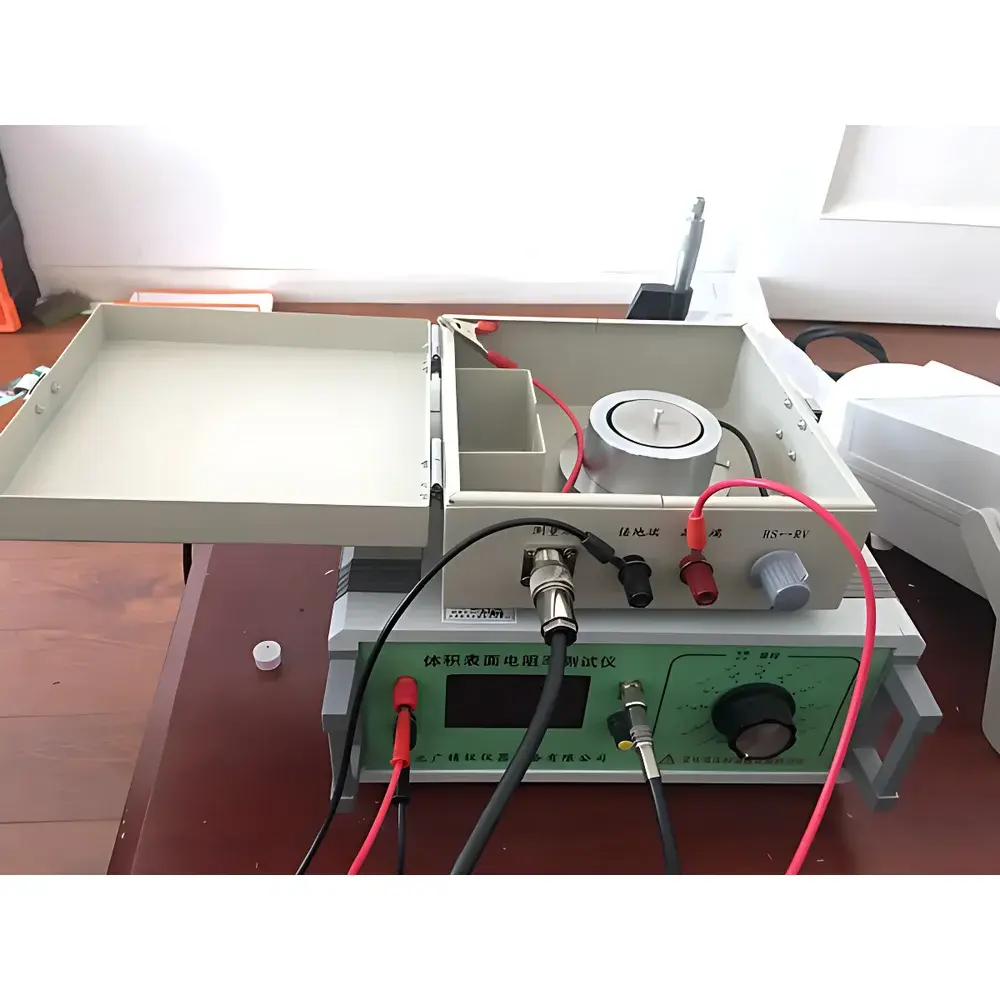
- Guarded three-electrode configuration (guarded electrode, measuring electrode, and guard ring) to eliminate surface leakage paths and isolate bulk conduction for accurate volume resistivity determination
- Stepwise selectable test voltages (10 V to 1000 V) with real-time resistance readout—no manual multiplication required
- Dual-parameter LCD display showing simultaneous resistance (Ω) and current (A) values, facilitating immediate verification of Ohm’s law consistency
- Auto-ranging current measurement from 200 µA down to 0.1 fA (1×10⁻¹⁶ A), optimized for ultra-high-impedance materials
- Integrated shielding enclosure with conductive gasketing and low-noise coaxial cabling to suppress electromagnetic interference and triboelectric noise
- Thermally stabilized electrometer amplifier with <10 mV offset drift over 8 hours, minimizing zero-drift during extended 1-minute polarization periods
- Front-panel mode selector for dedicated volume resistivity (Rv) or surface resistivity (Rs) testing—mechanically interlocked to prevent misconfiguration
Sample Compatibility & Compliance
The BT tester accommodates rigid and semi-flexible sheet specimens (up to 150 mm × 150 mm) using standard stainless-steel electrodes per GB/T 1692–2008 and ASTM D257. Optional liquid electrodes (e.g., silicone oil or non-aqueous electrolyte solutions) are supported for irregular or porous samples—mercury is explicitly excluded per RoHS and ISO 14001 guidelines. All measurements adhere to mandatory preconditioning timelines: minimum 48 h at 23 °C ± 2 °C / 50 % RH ± 5 % RH for equilibrium moisture content; extended conditioning (up to 30 days) is recommended for hygroscopic polymers such as polyamide or cellulose derivatives. The instrument meets mechanical and electrical safety requirements per GB 4793.1–2019 (IEC 61010-1), includes double-insulated HV circuitry, and features automatic voltage ramp-down upon overload detection to protect internal amplifiers.
Software & Data Management
While the BT operates as a standalone benchtop instrument, its analog output port (0–10 V DC proportional to log10(R)) enables integration with third-party data acquisition systems (e.g., LabVIEW, MATLAB, or custom SCADA platforms) for time-resolved resistivity monitoring. All front-panel operations are fully manual—no embedded firmware or USB interface is provided—ensuring deterministic behavior and eliminating cybersecurity risks associated with networked instruments. Calibration records, operator entries, and test parameters (voltage, dwell time, range selection) are documented manually per GLP Annex 11 and FDA 21 CFR Part 11 principles; audit trails are maintained via signed hard-copy test reports generated per internal SOPs. Firmware-free architecture ensures long-term calibration stability without software obsolescence concerns.
Applications
- Quality control of insulating materials in wire & cable manufacturing (e.g., cross-linked polyethylene, EPR, silicone rubber)
- R&D evaluation of antistatic additives in packaging films and electronic housings
- Validation of ceramic substrate purity in semiconductor packaging substrates
- Compliance testing for aerospace-grade composites per MIL-STD-883 Method 3003.1
- Environmental aging studies tracking resistivity degradation under thermal/humidity cycling (e.g., IPC-TM-650 2.6.3)
- Research on ion-conducting polymer electrolytes for solid-state batteries
FAQ
Why does resistance reading vary when switching ranges?
This reflects the instrument’s auto-ranging electrometer architecture: each range corresponds to a fixed gain setting and optimized feedback resistor. Switching ranges alters the effective input impedance and noise floor—thus requiring stabilization time. Always allow ≥2 s settling after range change before recording.
What causes unstable readings during prolonged measurement?
Dielectric absorption and electrode polarization dominate in the first 60 s. ASTM D257 mandates 60 s polarization time for final reading; shorter intervals yield non-equilibrium values.
Can I measure liquids or powders directly?
Liquids require a guarded liquid-cell fixture (not supplied); powders must be compressed into pellets with defined geometry and electrode contact—refer to ASTM D257 Annex A3 for methodology.
Is the 10⁴ Ω lower limit fixed?
Yes—the instrument is optimized for >10⁴ Ω. For lower resistances, use a 4-wire Kelvin ohmmeter per ASTM D4496.
Does the BT support automated compliance reporting?
No—it is a manual, audit-ready instrument. All compliance documentation (test voltage, conditioning history, electrode geometry) must be recorded externally per ISO/IEC 17025 clause 7.8.



