
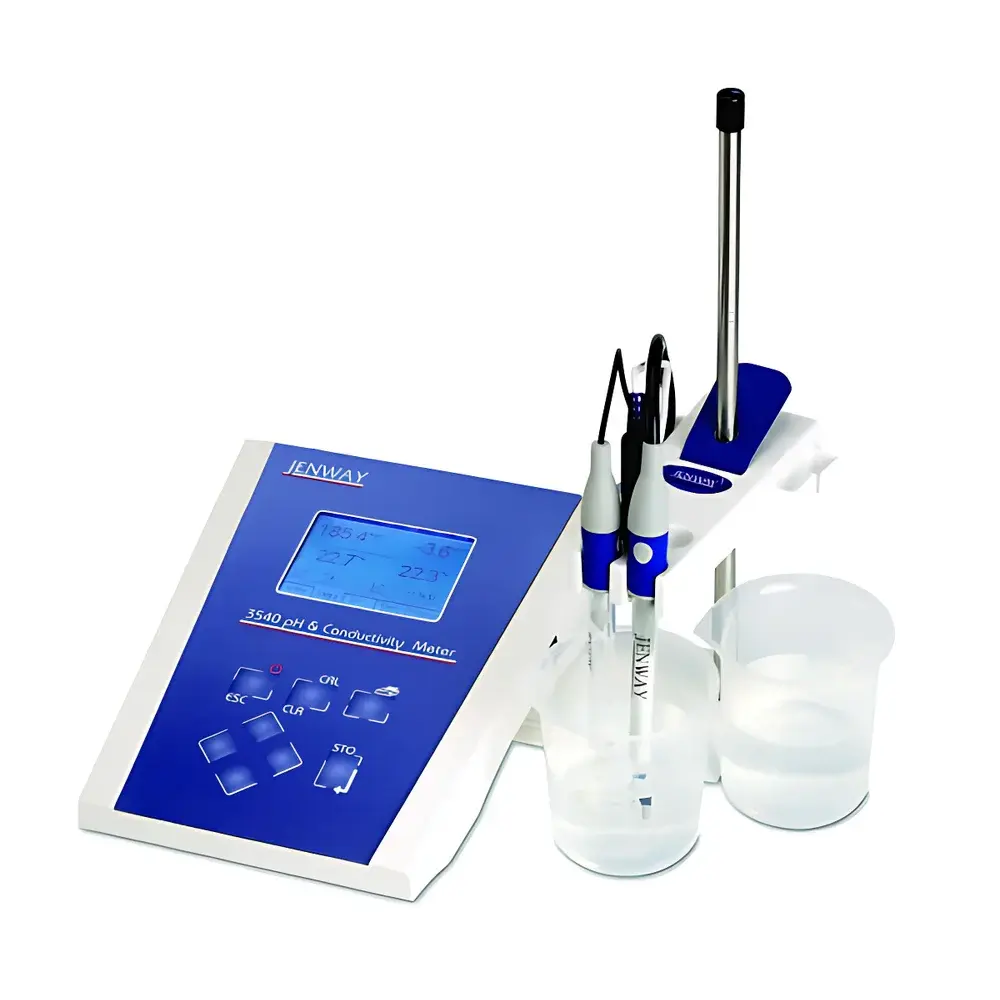
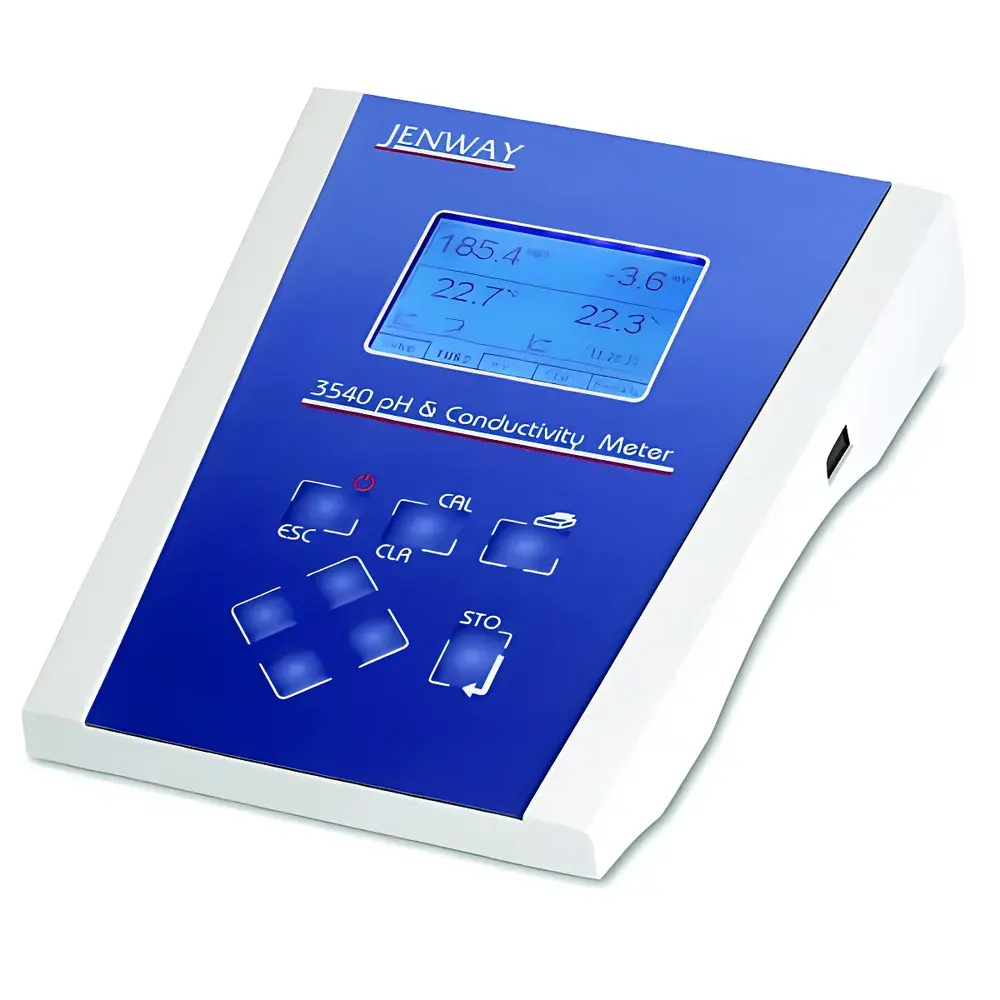
Jenway 3540 Benchtop pH and Conductivity Meter
| Brand | Jenway |
|---|---|
| Origin | United Kingdom |
| Model | 3540 |
| Instrument Type | Benchtop |
| Parameter Types | Dual (pH & Conductivity) |
| pH Range | -2.000 to 20.000 |
| pH Resolution | 0.001 / 0.01 / 0.1 |
| pH Accuracy | ±0.003 |
| mV Range | ±1999.9 mV |
| mV Resolution | 0.1 mV |
| mV Accuracy | ±0.2 mV |
| Conductivity Range | Auto-ranging from 0.01 µS to 1.999 S |
| Conductivity Resolution | 0.01 µS to 1 mS |
| Conductivity Accuracy | ±0.5% ±2 digits |
| Temperature Range | -10 to 105 °C |
| Temperature Resolution | 0.1 °C |
| Temperature Accuracy | ±0.5 °C |
| ATC Range | 0 to 100 °C |
| Temperature Coefficient | 0.00 to 4.00 %/°C |
| Reference Temperatures | 18, 20, 25 °C |
| Calibration Points | 1–3 point auto-calibration (pH), 1–3 point auto-calibration (conductivity) |
| Data Storage | 500 readings (250 per mode) |
| Interfaces | BNC (pH), 7-pin DIN (conductivity), RS232, IrDA, analog output |
| Power Supply | 9 V AC ±10%, 50/60 Hz |
| Dimensions (L×W×D) | 210 × 250 × 55 mm |
| Weight | 850 g |
Overview
The Jenway 3540 Benchtop pH and Conductivity Meter is a dual-parameter electrochemical analyzer engineered for precision, repeatability, and operational flexibility in regulated laboratory environments. Designed and manufactured in the United Kingdom, the instrument employs potentiometric measurement for pH determination and four-electrode (or two-electrode, depending on probe configuration) conductometric principles for conductivity analysis—ensuring minimal polarization error and high stability across wide dynamic ranges. Its dual-channel architecture isolates pH and conductivity signal paths at the hardware level, eliminating cross-talk and enabling simultaneous, independent measurements without interference—a critical requirement for quality control workflows involving buffer verification, cell culture media monitoring, or pharmaceutical formulation validation. The meter supports full GLP-compliant operation through timestamped calibration logging, operator ID assignment, sample ID tagging, and configurable calibration reminder intervals—features aligned with ISO/IEC 17025, USP , and FDA 21 CFR Part 11 data integrity expectations when paired with validated software and audit-trail-enabled data acquisition systems.
Key Features
- Dual independent measurement channels with hardware-level electrical isolation to prevent signal crosstalk between pH and conductivity sensors
- Auto-ranging conductivity measurement from 0.01 µS/cm up to 1.999 S/cm, with selectable cell constants (K = 1.0 standard) and temperature compensation algorithms (linear or non-linear)
- Potentiometric pH measurement over an extended range of –2.000 to 20.000 pH units, supporting both aqueous and non-aqueous applications with optional high-temperature or low-ionic-strength electrodes
- Three-point automatic pH calibration and multi-point conductivity calibration with real-time slope and offset diagnostics
- Integrated temperature measurement via ATC (Automatic Temperature Compensation) probe (027 500) or manual entry; reference temperatures configurable to 18 °C, 20 °C, or 25 °C per ISO 7888 and ASTM D1125
- Simultaneous display of primary parameter (pH or conductivity) and secondary derived values—including resistivity, TDS (with selectable conversion factors), salinity (NaCl or seawater basis), and mV (for redox or direct potential assessment)
- Onboard data logger storing up to 500 total readings (250 per measurement mode), with time/date stamping and user-defined sample identifiers
Sample Compatibility & Compliance
The Jenway 3540 accommodates a broad spectrum of sample types—from ultrapure water (resistivity >18.2 MΩ·cm) and aggressive caustic solutions (e.g., 1 M NaOH, pH ~14) to high-salinity brines and viscous biological buffers. Its glass combination pH electrode (924 005) and K = 1.0 glass conductivity cell (027 013) meet IUPAC-recommended specifications for electrode geometry and response kinetics. All calibration and measurement protocols comply with ISO 3696 (water purity), ISO 7888 (conductivity of water), and ASTM E70 (pH of aqueous solutions). The instrument’s firmware supports GLP traceability requirements including calibration history retention, operator authentication prompts, and editable audit trails—making it suitable for laboratories operating under GMP, CLIA, or ISO 15189 accreditation frameworks.
Software & Data Management
Data export is facilitated via RS232 serial interface (standard), IrDA infrared link (optional), or analog output (0–1 V or 4–20 mA, configurable). When connected to compliant PC-based software (e.g., Jenway LogPro or third-party LabArchives-compatible platforms), the 3540 generates CSV-formatted reports containing raw values, calibration metadata, environmental conditions, and operator credentials—fully traceable for regulatory submission. Internal memory retains calibration dates, slopes, offsets, and drift metrics for both channels, enabling trend analysis of sensor performance over time. Password-protected setup menus restrict access to critical configuration parameters, satisfying data governance requirements under 21 CFR Part 11 when used with appropriate electronic signature controls.
Applications
- Pharmaceutical QC: Monitoring pH and conductivity of purified water (PW), water for injection (WFI), and buffer solutions per USP and EP 2.2.38
- Environmental testing: Field-deployable lab verification of surface water, wastewater effluent, and soil leachates per EPA Method 120.1 and ISO 10523
- Food & beverage R&D: Batch consistency checks for dairy, brewing, and juice processing where pH and ionic strength directly impact microbial stability and enzyme activity
- Academic research: Teaching labs requiring robust, dual-parameter instrumentation for electrochemistry fundamentals and sensor characterization experiments
- Chemical manufacturing: In-process control of neutralization reactions, acid/base titrations, and electrolyte concentration in battery electrolyte production
FAQ
Does the Jenway 3540 support automatic temperature compensation for both pH and conductivity measurements?
Yes—using either the supplied ATC probe (027 500) or manual temperature input, the instrument applies standardized temperature compensation algorithms per ISO 7888 (conductivity) and NIST SRM guidelines (pH), with adjustable temperature coefficient (0.00–4.00 %/°C) and reference temperature selection.
Can the 3540 store calibration data separately for multiple electrodes?
No—the internal memory retains only the most recent calibration set per channel; however, full calibration logs (including date, slope, offset, and buffer IDs) are exportable via RS232 for external archival and review.
Is the instrument compatible with non-standard conductivity cells (e.g., K = 0.1 or K = 10)?
Yes—cell constant can be manually entered during setup, enabling accurate measurement with any certified conductivity cell meeting DIN EN 27888 or ASTM D1125 dimensional tolerances.
What power supply options are available for international deployment?
The unit ships with region-specific AC adapters (UK, US, EU variants); all operate at 9 V AC ±10% @ 50/60 Hz—no internal voltage conversion required.
How does the 3540 ensure measurement traceability in audited environments?
Through GLP-mode features including mandatory operator ID entry, sample ID tagging, calibration due-date alerts, and timestamped storage of all measured and derived values—providing foundational elements for data integrity assessments under ISO/IEC 17025 Clause 7.7 and ALCOA+ principles.





