
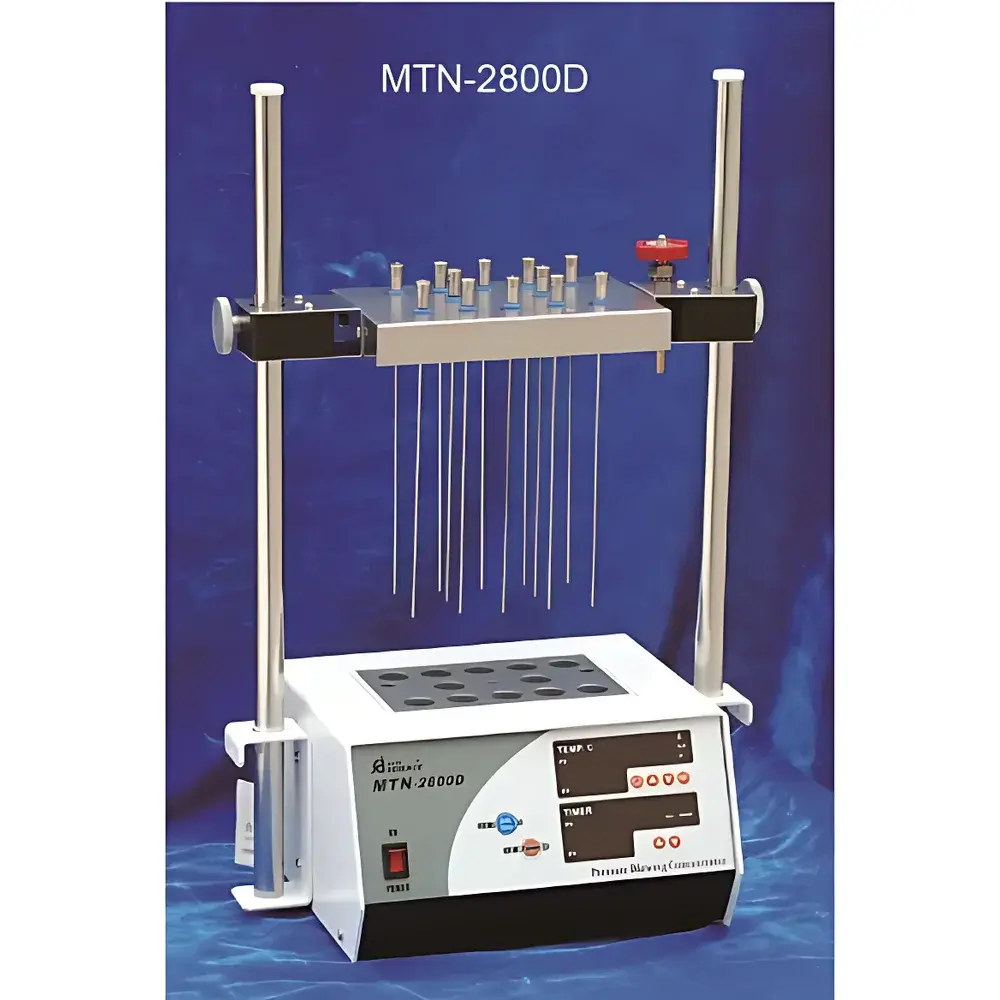
Autosense MTN-2800D Dry-Block Nitrogen Evaporator
| Brand | Autosense |
|---|---|
| Origin | Tianjin, China |
| Model | MTN-2800D |
| Heating Method | Dry-block heating |
| Temperature Range | Ambient +5°C to 180°C |
| Temperature Stability | ±0.1°C |
| Sample Tube Diameter Compatibility | 10–30 mm |
| Nitrogen Flow Rate | 0–15 mL/min |
| Sample Positions | 12 / 24 / 40 |
| Heating Power | 350 W |
Overview
The Autosense MTN-2800D Dry-Block Nitrogen Evaporator is a precision-engineered sample concentration system designed for high-throughput and reproducible solvent removal in analytical laboratories. It operates on the principle of inert gas-assisted evaporation—introducing a controlled stream of nitrogen gas across the surface of liquid samples held in test tubes or vials while simultaneously maintaining precise thermal conditions via a solid aluminum heating block. This method eliminates oxidative degradation of thermolabile analytes, offering a robust alternative to rotary evaporation—particularly for applications requiring low residual solvent levels, such as LC-MS, GC-MS, and clinical toxicology workflows. The MTN-2800D is widely deployed in QC/QA labs, environmental testing facilities, food safety laboratories, and pharmaceutical R&D environments where regulatory compliance, traceability, and method consistency are critical.
Key Features
- High-precision dry-block heating system with 70 mm thick anodized aluminum thermal block—ensuring exceptional thermal uniformity and minimal axial temperature gradient across all sample positions.
- Independent, height-adjustable nitrogen delivery needles per sample position—eliminating cross-contamination and enabling simultaneous processing of heterogeneous sample volumes and tube geometries.
- Dual operating modes: time-controlled (programmable timer up to 99 h 59 min) and continuous heating—supporting both standardized SOP-driven protocols and exploratory method development.
- Integrated spill containment tray beneath the heating block—designed to capture accidental liquid overflow and protect internal electronics from corrosion or short-circuiting.
- Four-digit dual-display interface showing set temperature, real-time block temperature, preset timer value, and countdown status—enabling immediate visual verification without menu navigation.
- Over-temperature cut-off protection (hardware-based thermal fuse) activated at block temperatures exceeding user-defined limits—ensuring instrument integrity and lab safety during unattended operation.
- Modular configuration options: interchangeable 12-, 24-, and 40-position heating blocks—allowing flexible adaptation to throughput requirements without replacing the entire unit.
Sample Compatibility & Compliance
The MTN-2800D accommodates standard borosilicate glass test tubes (10–30 mm outer diameter), HPLC vials (12 × 32 mm, 15 × 45 mm), and custom-format microcentrifuge tubes. Its inert nitrogen environment complies with ASTM D7067–22 (Standard Practice for Preparation of Aqueous Samples for Analysis by Gas Chromatography) and supports USP chromatographic method validation requirements for sample preparation reproducibility. While not certified to IEC 61010-1 or CE for standalone medical device use, the instrument meets general laboratory equipment safety standards applicable to Class II electrical appliances under GB 4793.1–2007 (Chinese national equivalent of IEC 61010-1). Data integrity features—including non-volatile parameter storage and timestamped operational logs—are compatible with GLP/GMP documentation practices when integrated into validated lab workflows.
Software & Data Management
The MTN-2800D is a stand-alone hardware platform with no embedded firmware-based data logging or PC connectivity. All operational parameters—including temperature setpoint, timer duration, and runtime status—are retained in non-volatile memory across power cycles. For laboratories requiring audit trails, integration with LIMS or electronic lab notebooks (ELNs) is achieved via external process documentation: users record instrument ID, batch number, operator ID, start/end timestamps, and observed final volume per sample in structured digital forms. Optional external USB temperature loggers (e.g., Omega OM-DAQPRO-5300 series) may be used to supplement thermal validation reports required under ISO/IEC 17025 clause 5.9.1.
Applications
- Routine concentration of extracts from solid-phase extraction (SPE), QuEChERS, and liquid–liquid extraction (LLE) prior to GC or LC injection.
- Pre-concentration of environmental water samples (e.g., PAHs, PCBs, pesticides) per EPA Method 525.3 and 8270D.
- Residual solvent removal from synthetic intermediates in API purification workflows.
- Parallel processing of forensic urine specimens for drug metabolite screening using immunoassay or LC-MS/MS confirmation.
- Preparation of calibration standards and QC reference materials requiring exact final volumes and minimal analyte loss.
FAQ
What is the maximum recommended nitrogen pressure for safe operation?
The MTN-2800D is designed for low-pressure nitrogen supply (≤30 psi / 2 bar); higher pressures risk needle dislodgement or turbulent gas flow that compromises evaporation efficiency.
Can the heating block be calibrated externally?
Yes—calibration is performed using NIST-traceable PT100 or thermistor probes inserted into designated calibration wells; procedures align with ISO/IEC 17025 Section 6.5.2 for measurement equipment verification.
Is the unit compatible with argon or other inert gases?
Yes—any dry, oil-free, particle-filtered inert gas meeting ISO 8573-1 Class 2 purity specifications may be substituted for nitrogen without modification.
How often should the O-rings and needle gaskets be replaced?
Under continuous daily use, replace silicone O-rings every 6 months and stainless-steel needle gaskets annually—or immediately upon observing gas leakage or inconsistent flow distribution.
Does the MTN-2800D support remote monitoring or Ethernet connectivity?
No—this model lacks network interfaces or analog/digital I/O ports; remote supervision requires third-party environmental monitoring systems interfaced via external temperature and status sensors.



