
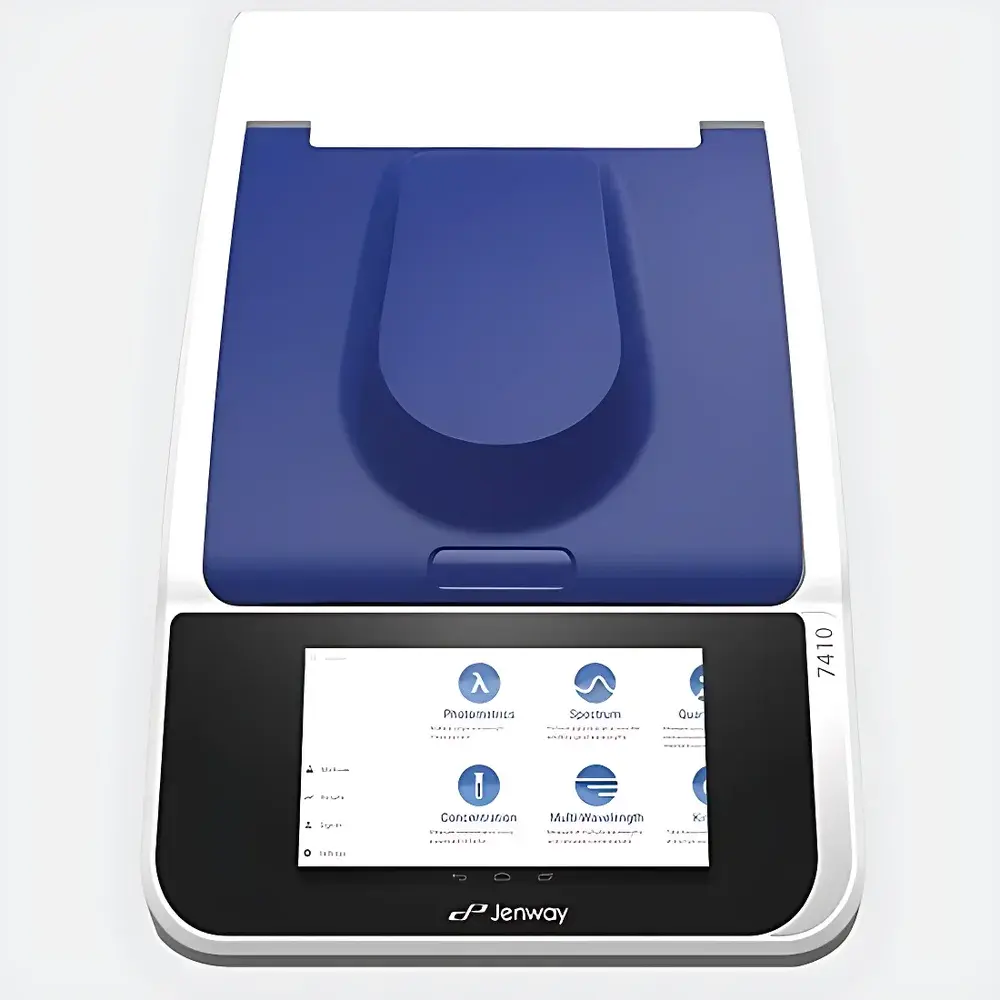
Jenway 7410 Scan Visible Spectrophotometer (Officially Authorized Distribution)
| Brand | Jenway |
|---|---|
| Origin | United Kingdom |
| Model | 7410 |
| Wavelength Range | 320–1000 nm |
| Display | 7-inch full-color capacitive touchscreen |
| Sample Chamber | Light-tight dome design with large access lid |
| Standard Cuvette Holder | 10 × 10 mm (3 mL capacity) |
| Memory | 10 GB internal storage |
| Connectivity | Ethernet, dual USB-A ports |
| Software Platform | CPLive™ cloud-enabled suite |
| Compliance | Designed for GLP/GMP-aligned workflows |
Overview
The Jenway 7410 Scan Visible Spectrophotometer is a precision-engineered benchtop instrument designed for routine quantitative and qualitative analysis across academic teaching laboratories, industrial quality control environments, and applied research settings. Operating on the principle of single-beam UV-Vis absorption spectroscopy, it delivers high-fidelity spectral data across the visible and near-UV range (320–1000 nm) with wavelength accuracy ±1.0 nm and photometric repeatability <0.002 A at 546 nm. Its optical architecture employs a stabilized tungsten-halogen lamp and a precision diffraction grating monochromator, ensuring consistent spectral resolution and long-term baseline stability. The instrument is not intended for regulatory submission without complementary validation documentation but is fully compatible with method qualification protocols aligned with ISO/IEC 17025 and ASTM E275–22 standards for spectrophotometric performance verification.
Key Features
- 7-inch high-resolution capacitive touchscreen interface enabling glove-compatible operation, pinch-to-zoom spectral navigation, and direct point selection on absorbance or transmittance curves
- Integrated 10 GB non-volatile memory for secure local storage of methods, calibration curves, kinetic time-series datasets, and full-spectrum scans
- Light-tight sample chamber with dome-shaped geometry accommodating tall multi-cell holders, 10 mm pathlength cuvettes, and optional accessories including variable-pathlength cells and temperature-controlled holders
- Multi-mode measurement capability: fixed-wavelength photometry, concentration determination (via standard curve or factor-based calculation), full-spectrum scanning (1 nm increments), purity assessment (A260/A280, A260/A230), kinetics (up to 999 time points), and quantitative analysis using up to 20-point calibration curves
- Dual USB-A ports for direct connection to printers, flash drives, or external keyboards; Ethernet port for network integration into lab-wide instrument management systems
Sample Compatibility & Compliance
The 7410 accepts standard 10 × 10 mm rectangular cuvettes with nominal 3 mL sample volume. Its universal cuvette holder supports quartz, glass, and plastic cuvettes with pathlengths from 1 mm to 50 mm when used with optional adapters. While the base configuration does not include microvolume capability (available only on the 7415 model with dedicated nano-accessory), the 7410’s low-stray-light optical design ensures reliable quantification of dilute aqueous solutions, colored dyes, enzyme reaction mixtures, and pharmaceutical formulations. It complies with core elements of ISO 6060 (water quality — determination of chemical oxygen demand) and supports method development in accordance with USP Spectrophotometry and Light-Scattering. Data export functions generate timestamped CSV and PDF reports suitable for GLP documentation; when paired with validated CPLive™ server deployment, full 21 CFR Part 11 compliance—including electronic signatures and audit trails—is achievable.
Software & Data Management
CPLive™ serves as the unified software ecosystem for the 7410, enabling remote monitoring, centralized method distribution, and synchronized data aggregation across multiple instruments. Through the web-based CPLive Portal or native iOS/Android applications, users can upload spectra, annotate results, assign metadata (operator ID, sample ID, instrument serial), and share calibrated methods with team members. All locally stored data is automatically backed up to encrypted cloud storage with configurable retention policies. Instrument firmware updates, spectral library imports (e.g., NIST SRM reference spectra), and custom report templates are managed via the CPLive Admin Console—designed for IT-administered deployment in regulated environments requiring change control and version history tracking.
Applications
The 7410 is routinely deployed in undergraduate chemistry teaching labs for Beer-Lambert law verification and equilibrium constant determination; in food & beverage QA/QC for color index (e.g., AOAC 993.01), nitrate/nitrite quantification, and antioxidant capacity assays; in water treatment facilities for orthophosphate and ammonia-nitrogen analysis per APHA Standard Methods 4500-P E and 4500-NH3 G; and in polymer manufacturing for dye concentration monitoring and degradation kinetics under accelerated aging conditions. Its robust mechanical construction and thermally stable optics support uninterrupted operation over extended shifts in ambient laboratory conditions (15–30 °C, ≤80% RH non-condensing).
FAQ
Does the Jenway 7410 support microvolume measurements?
No—the 7410 is configured exclusively for standard 10 mm pathlength cuvettes. Microvolume analysis (0.5–2 µL) requires the Jenway 7415 with integrated nano-spectrophotometer accessory (P/N 83056-23).
Can I export raw spectral data for third-party analysis?
Yes—CSV exports include wavelength (nm), absorbance (A), and transmittance (%) columns with instrument metadata (date/time, lamp hours, calibration status).
Is CPLive™ cloud hosting compliant with GDPR or HIPAA?
CPLive™ offers on-premise server deployment options for full data sovereignty. Cloud-hosted instances comply with ISO 27001-certified infrastructure; HIPAA Business Associate Agreements are available upon request.
What validation documentation is provided with the instrument?
Each unit ships with a Factory Performance Certificate (including wavelength and photometric accuracy verification against NIST-traceable standards), IQ/OQ checklist templates, and a comprehensive user manual aligned with ISO/IEC 17025 Annex A.3 guidance.
How frequently should the instrument be recalibrated?
Annual verification against certified reference materials (e.g., Holmium oxide filter for wavelength, potassium dichromate solution for photometric linearity) is recommended. Daily zeroing with air or solvent blank remains mandatory prior to each analytical session.



