
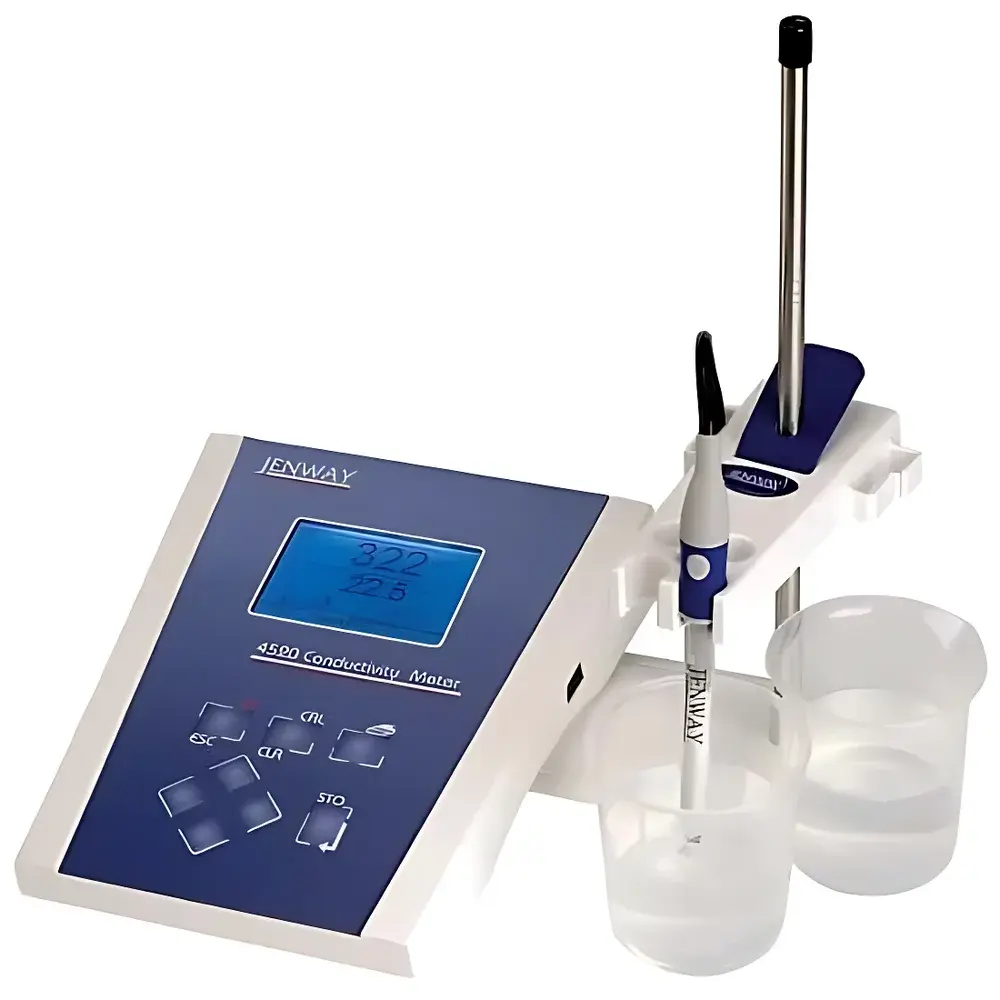
Jenway 4520 Benchtop Conductivity Meter
| Brand | Jenway |
|---|---|
| Origin | United Kingdom |
| Model | 4520 |
| Form Factor | Benchtop |
| Conductivity Range | 0 to 19.99 S |
| TDS Range | 0–1999 g/L |
| Resistivity Range | 0–20 MΩ·cm |
| Salinity Range | 0–99.9 g/L |
| Temperature Range | –10 to 105 °C |
| Accuracy | ±0.5% ±2 digits |
| Minimum Resolution | 0.01 µS (in low-range modes) |
| Calibration | 1-, 2-, or 3-point auto-recognized (10 µS, 84 µS, 1413 µS, 12.88 mS) |
| Cell Constant Support | 0.010–19.999 cm⁻¹ |
| GLP Compliance | Yes (calibration log, timestamped records, security codes) |
| Data Storage | 500 measurements with date/time stamp |
| Interfaces | RS232, IrDA, analog output |
| Power | 9 V AC adapter (230 V, 50/60 Hz) |
| Dimensions | 210 × 250 × 55 mm |
| Weight | 850 g |
Overview
The Jenway 4520 Benchtop Conductivity Meter is a high-precision, multi-parameter electrochemical analyzer engineered for rigorous laboratory environments where reproducibility, traceability, and regulatory compliance are critical. It operates on the principle of two- or four-electrode conductometric measurement—applying an alternating current across a pair of electrodes immersed in solution and measuring the resulting conductance, corrected for cell geometry via user-defined or auto-recognized cell constants (K = 0.010–19.999 cm⁻¹). The instrument simultaneously reports conductivity (S), resistivity (MΩ·cm), total dissolved solids (TDS, g/L), salinity (g/L), and temperature (°C), with full temperature compensation (ATC or manual mode) and configurable reference temperatures (18 °C, 20 °C, or 25 °C). Its dedicated Ultra-Pure Water Mode employs low-frequency excitation and optimized signal processing to minimize polarization errors and capacitive interference—essential for sub-1 µS/cm measurements common in pharmaceutical water systems (PW, WFI), semiconductor rinse monitoring, and ultrapure boiler feedwater analysis.
Key Features
- Multi-parameter capability: simultaneous real-time measurement of conductivity, resistivity, TDS, salinity, and temperature
- Dedicated Ultra-Pure Water Mode with enhanced low-conductivity stability and noise rejection
- Auto-ranging across six decades (0.01 µS to 19.99 S) with resolution down to 0.01 µS in low-range configurations
- Integrated GLP-compliant data logging: stores up to 500 timestamped readings with operator ID, calibration history, and environmental metadata
- Triple interface architecture: RS232 serial port (for printers or legacy lab systems), infrared (IrDA) for wireless thermal printer pairing, and analog output (0–1 V or 4–20 mA) for process integration
- Configurable temperature coefficient (0.00–4.00 %/°C) and selectable reference temperature (18 °C, 20 °C, or 25 °C) per ASTM D1125 and ISO 7888
- Security-enabled operation: password-protected calibration, configuration lockout, and audit-trail-capable calibration alerts
- Robust benchtop housing (IP20-rated) with ergonomic front-panel navigation and high-contrast LCD display with backlight
Sample Compatibility & Compliance
The Jenway 4520 supports a wide range of aqueous sample matrices—from aggressive industrial effluents (pH 0–14, oxidizing or reducing) to ultra-pure water systems—via interchangeable electrode options including glass-bodied (e.g., 027 013, K=1), epoxy-bodied (027 212, K=1; 027 801, K=0.1), flow-through (027 177), and ultra-low-conductivity probes (027 900, K<0.1). All probe selections comply with IEC 61000-6-2 (immunity) and IEC 61000-6-3 (emissions) standards. The instrument meets essential requirements of the EU Medical Device Regulation (MDR) Annex I for general-purpose laboratory equipment and supports validation under FDA 21 CFR Part 11 when used with DataWay software (electronic signatures, audit trails, and secure export). Calibration verification aligns with ISO/IEC 17025 clause 6.4.6 and USP for purified water and water for injection testing.
Software & Data Management
DataWay PC software (included) enables bidirectional communication, automated report generation (PDF/CSV), and full GLP traceability—including electronic signatures, session logs, and version-controlled method templates. Raw data exports retain all metadata: measurement time, probe ID, cell constant, calibration points, temperature reading, and operator code. The instrument’s internal memory retains calibration events with timestamps and deviation values, satisfying ISO 17025 clause 7.7 and GMP Annex 11 requirements for analytical instrument qualification (AIQ). Optional RS232-to-USB adapters allow seamless integration into LIMS or ELN platforms without proprietary drivers.
Applications
- Pharmaceutical QC: USP compliant water resistivity verification (≥1.0 MΩ·cm at 25 °C) and conductivity profiling of Purified Water (PW) and Water for Injection (WFI)
- Power generation: Boiler feedwater purity monitoring and condensate leak detection
- Environmental labs: TDS and salinity quantification in surface water, wastewater, and estuarine samples per EPA Method 120.1
- Food & beverage: Brine concentration control, syrup conductivity validation, and cleaning-in-place (CIP) rinse monitoring
- Academic research: Electrolyte characterization, ion exchange studies, and membrane performance evaluation
- Chemical manufacturing: Reaction mixture conductivity tracking for endpoint determination in neutralization or precipitation processes
FAQ
Does the Jenway 4520 support automatic temperature compensation (ATC)?
Yes—it accepts input from integrated ATC probes (e.g., 027 013, 027 113) or allows manual temperature entry, applying linear or non-linear (configurable %/°C) compensation per ISO 7888.
Can the instrument store calibration data separately for multiple electrodes?
Yes—each calibration event is tagged with probe identifier, cell constant, standard used, and date/time; up to three independent electrode profiles may be retained and recalled.
Is the 500-measurement memory sufficient for long-term unattended operation?
For routine batch testing (e.g., daily PW checks), the internal log provides >12 months of retention; for continuous monitoring, use DataWay with scheduled auto-export to network storage.
What validation documentation is provided for GxP environments?
Factory calibration certificate (traceable to NPL), IQ/OQ protocol templates, and DataWay 21 CFR Part 11 compliance package—including electronic signature workflow and audit trail configuration guide—are available upon request.
How does the Ultra-Pure Water Mode improve measurement integrity below 1 µS/cm?
It reduces excitation frequency, applies guard electrode shielding (where supported), disables auto-ranging hysteresis, and applies specialized drift-compensation algorithms—minimizing stray capacitance and electrode polarization artifacts inherent in high-resistivity media.





