
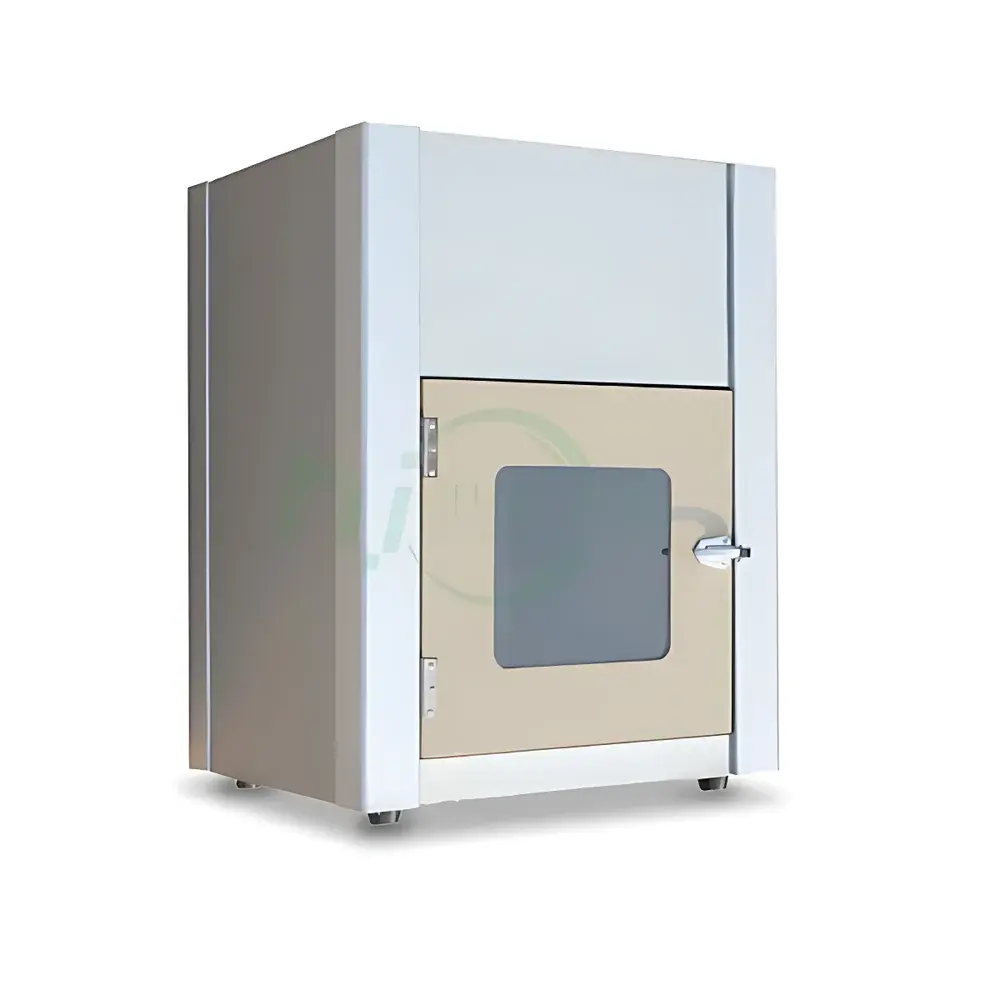
304 Stainless Steel Interlocked Cleanroom Pass-Through Chamber
| Brand | HJ Purification |
|---|---|
| Model | APB-777 |
| Construction Material | 304 Stainless Steel |
| Cleanliness Class | ISO Class 5 (equivalent to Fed. Std. 209E Class 100 @ ≥0.5 µm) |
| Average Air Velocity | 0.25–0.45 m/s |
| Sound Pressure Level | ≤62 dB(A) |
| Power Supply | AC 220 V, 50 Hz |
| HEPA Filter Dimensions | 480 × 460 × 38 mm |
| Internal Working Dimensions | 500 × 480 × 500 mm |
| External Dimensions | 650 × 530 × 850 mm |
| Interlock Logic | Dual-door mechanical/electrical interlock with fan activation on either door opening |
| UV Germicidal Lamp | Integrated, synchronized with fan operation |
| Illumination | LED lighting, fan-synchronized |
| Compliance | Designed per ISO 14644-1, GMP Annex 1 (2022), and Chinese YY 0569-2011 standards |
Overview
The HJ Purification APB-777 Interlocked Cleanroom Pass-Through Chamber is an engineered solution for controlled material transfer between adjacent clean environments—such as ISO Class 5 (Fed. Std. 209E Class 100) cleanrooms—or between classified and unclassified zones. Constructed entirely from electropolished 304 stainless steel, the unit eliminates crevices and supports rigorous cleaning protocols required in pharmaceutical manufacturing, biotechnology labs, medical device assembly, and semiconductor R&D facilities. Its core function is to minimize door cycling in critical environments, thereby reducing particle ingress, airflow disruption, and pressure differential instability. The chamber operates on a validated dual-door interlock principle: only one door may be opened at a time, and fan activation is triggered automatically upon initiation of either door motion—ensuring continuous laminar airflow across the transfer cavity during use. This architecture conforms to fundamental cleanroom engineering principles defined in ISO 14644-1 and supports compliance with EU GMP Annex 1 (2022) Section 4.42 on material transfer systems.
Key Features
- Electropolished 304 stainless steel construction throughout—interior surfaces, frame, and door panels—with seamless, radius-rounded internal corners (R ≥15 mm) to prevent particle accumulation and facilitate WIP validation.
- Fail-safe mechanical and electrical interlock system prevents simultaneous door opening; verified via third-party functional testing per ISO 14644-3 Annex D.
- Integrated centrifugal blower with adjustable speed control maintains consistent air velocity (0.25–0.45 m/s) across the HEPA-filtered airstream, ensuring rapid particle removal (<15 s residence time for 99.99% @ 0.3 µm).
- Synchronized operation: UV-C germicidal lamp (254 nm, 15 W) and LED task lighting activate only when the fan is running—eliminating unnecessary UV exposure and energy waste.
- HEPA filter (H14 grade per EN 1822-1) installed upstream of the blow-through chamber, rated for ≥99.995% efficiency at MPPS (Most Penetrating Particle Size), with accessible front-loading design for routine replacement under ISO 14644-3 Class 5 conditions.
- No external control panel or touchscreen—reducing surface area for contamination and simplifying qualification (IQ/OQ) in regulated environments.
Sample Compatibility & Compliance
The APB-777 accommodates standard laboratory containers including Petri dishes, vials (up to 50 mL), pipette tip racks, glassware (≤Φ120 mm), and small instrumentation components. It is not intended for sterile product transfer requiring aseptic processing (e.g., fill-finish operations), but rather for non-sterile ancillary items such as tools, documentation, calibration standards, and packaging samples. Regulatory alignment includes design conformance to ISO 14644-1:2015 (airborne particle concentration limits), ISO 14644-3:2019 (testing methodologies), and EU GMP Annex 1 (2022) clauses on material transfer risk mitigation. For FDA-regulated facilities, the unit supports 21 CFR Part 11-compliant data integrity when integrated with facility-wide monitoring systems via optional dry-contact relay outputs (available upon request).
Software & Data Management
The APB-777 operates as a standalone hardware-controlled device without embedded firmware or network connectivity—intentionally minimizing cybersecurity risk and validation burden. All operational parameters (fan runtime, UV exposure duration, door cycle count) are recorded manually in logbooks per GMP Annex 1 Section 4.44. Optional analog/digital I/O interfaces (4–20 mA or Modbus RTU) can be added for integration into building management systems (BMS) or environmental monitoring platforms (e.g., Vaisala viewLinc, Sartorius LabX). Audit trail functionality is maintained externally through facility-level electronic records systems compliant with ALCOA+ principles.
Applications
- Pharmaceutical QC laboratories transferring reference standards between analytical suites and sample preparation areas.
- Cell therapy cleanrooms passing cryovials and media bottles between ISO Class 5 and ISO Class 7 buffer zones.
- Microelectronics fabrication facilities exchanging wafer carriers and metrology tools across class-divided tool bays.
- Hospital pharmacy compounding units moving IV bags and syringes between anterooms and ISO Class 5 hoods.
- Academic research cleanrooms supporting nanomaterial handling where static dissipation and particulate control are co-dependent requirements.
FAQ
Does the APB-777 meet FDA 21 CFR Part 11 requirements?
The unit itself does not generate electronic records; however, its optional relay interface enables integration with Part 11–compliant BMS or EM systems for electronic audit trails.
Can the UV lamp be disabled independently of the fan?
No—UV operation is hardwired to fan status to ensure personnel safety and regulatory consistency with ISO 15190:2020 Annex C.
What is the recommended HEPA filter replacement interval?
Under continuous operation in ISO Class 5 environments, replace every 12–18 months—or after 7,500 operating hours—verified by in-situ DOP/PAO challenge testing per ISO 14644-3.
Is validation support documentation available?
Yes—HJ Purification provides IQ/OQ protocol templates, filter certification reports (EN 1822 test data), and interlock verification checklists aligned with ASTM E2500-13.
Can the unit be installed in a wall with fire-rated construction?
Mounting requires a minimum 2-hour fire-rated penetration assembly; HJ supplies certified firestop details and UL-listed sleeve kits upon project specification.



