
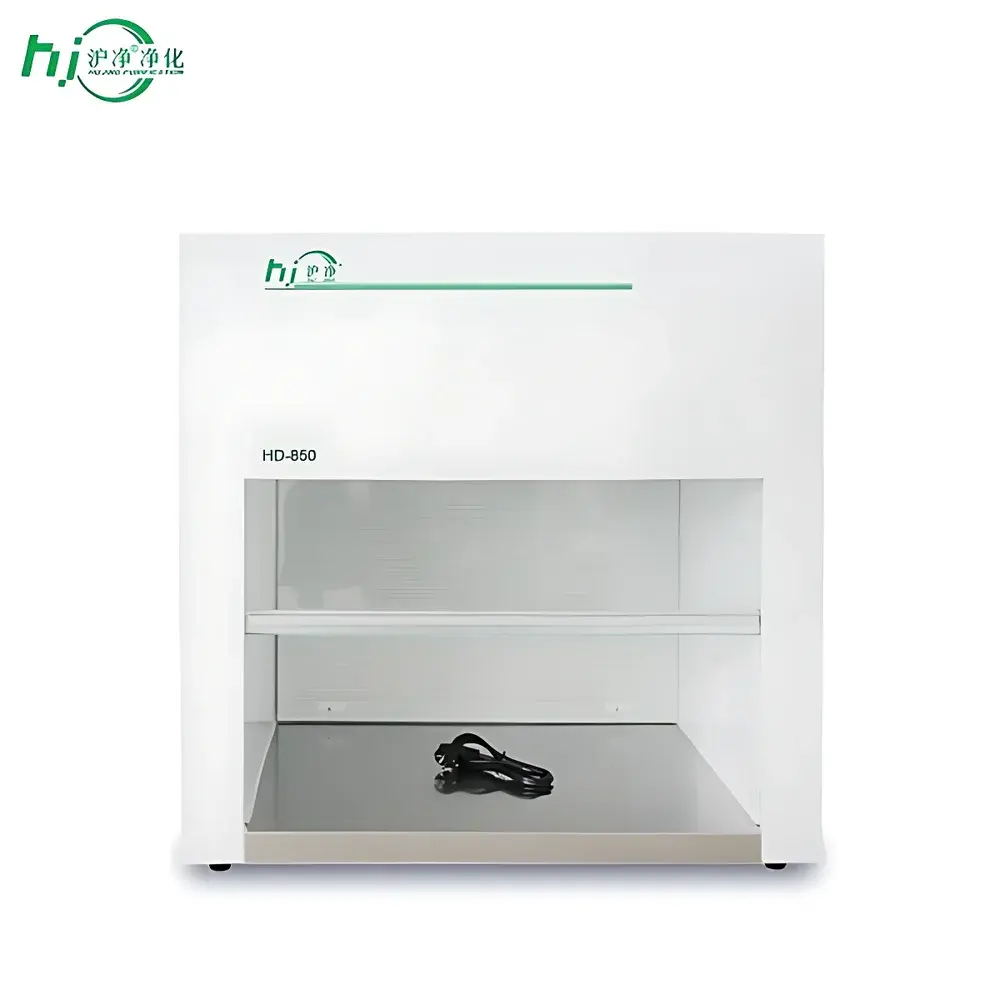
HJ HD850 Stainless Steel Single-Person Horizontal Laminar Flow Clean Bench
| Brand | HJ Purification |
|---|---|
| Origin | Shanghai, China |
| Manufacturer Type | Direct Manufacturer |
| Region of Origin | Domestic (China) |
| Model | HD850 |
| Instrument Category | Horizontal Laminar Flow Clean Bench |
| Cleanliness Class | ISO Class 5 (100 @ ≥0.5 µm, per US Federal Standard 209E) |
| Noise Level | ≤62 dB(A) |
| User Capacity | Single operator, front-facing access |
| Airflow Pattern | Horizontal unidirectional laminar flow |
| Pre-filter | Yes |
| HEPA Filter Specification | 670 × 455 × 38 mm (single unit) |
| Average Air Velocity | 0.25–0.45 m/s |
| Microbial Contamination | ≤0.5 CFU/plate·hour (90 mm Petri dish) |
| Vibration (Peak-to-Peak) | ≤5 µm (X/Y/Z axes) |
| Illumination | ≥300 lx |
| Power Supply | AC 220 V, 50 Hz |
| Work Area Dimensions (W×D×H) | 690 × 350 × 490 mm |
| Overall Dimensions (W×D×H) | 850 × 530 × 850 mm |
| Fluorescent Lamp | 12 W × 1 |
| UV Lamp | 20 W × 1 |
Overview
The HJ HD850 Stainless Steel Single-Person Horizontal Laminar Flow Clean Bench is an ISO Class 5-certified containment workstation engineered for applications requiring particle-free ambient conditions during non-hazardous sample handling. It operates on the principle of horizontal unidirectional laminar airflow—air drawn through a pre-filter and then forced through a certified HEPA filter (≥99.99% efficiency at 0.3 µm), delivering uniform, low-turbulence airflow across the work surface from back to front. This configuration ensures continuous sweeping of airborne particulates away from the operator and out of the work zone, maintaining a sterile microenvironment suitable for microbiological culture, semiconductor component assembly, precision optics handling, and pharmaceutical aseptic processing where personnel protection is not required but product integrity is critical.
Key Features
- Full stainless steel construction: Work surface fabricated from brushed SUS304 stainless steel—resistant to corrosion, non-porous, and compatible with common laboratory disinfectants and alcohol-based sanitizers.
- Adjustable sash system: Ergonomically designed vertical sliding window with frictionless positioning mechanism, enabling precise height adjustment to optimize airflow uniformity and user comfort.
- Dual interlocked lighting and UV systems: Fluorescent lamp (12 W) and germicidal UV lamp (20 W) operate independently; UV activation is automatically disabled when the sash is raised above a defined safety threshold, complying with IEC 61000-4-2 and UL 61010-1 safety requirements.
- Two-speed remote control operation: Wireless infrared remote (effective range ≤20 m) allows real-time adjustment of fan speed—low mode for energy conservation and quiet operation, high mode for rapid recovery after door opening or procedural interruption.
- Integrated pre-filter: Washable aluminum mesh pre-filter captures coarse particulates (>5 µm), reducing loading on the primary HEPA filter and extending its service life by up to 30% under typical lab usage conditions.
- Vertical quasi-enclosed work chamber: Optimized internal geometry promotes formation of a stable downward-redirected air curtain at the front aperture, minimizing ingress of room air contaminants into the work area.
Sample Compatibility & Compliance
The HD850 is validated for use with non-volatile, non-toxic, non-aerosol-generating materials including bacterial and fungal cultures, cell lines, sterile media preparations, electronic wafers, optical lenses, and lyophilized reagents. It conforms to ISO 14644-1:2015 for cleanroom performance classification and meets the particle concentration limits specified in US Federal Standard 209E (Class 100). While not designed for chemical fume or biohazard containment, its airflow profile and filtration architecture support compliance with Good Laboratory Practice (GLP) and current Good Manufacturing Practice (cGMP) Annex 1 requirements for aseptic processing environments. Routine certification per ISO 14644-3 is recommended every six months or after filter replacement.
Software & Data Management
As a Class I mechanical containment device, the HD850 operates without embedded software or digital data logging. All operational parameters—including airflow velocity, illumination intensity, and UV irradiance—are verified manually using calibrated handheld instruments (e.g., anemometer, lux meter, UV-C radiometer) during qualification and periodic performance verification. Maintenance logs, filter change dates, and certification reports must be retained per institutional SOPs and FDA 21 CFR Part 11-compliant documentation practices where applicable. Optional external monitoring modules (e.g., IoT-enabled airflow sensors) may be integrated via third-party hardware interfaces for centralized facility management systems.
Applications
- Aseptic transfer of microbial cultures and mammalian cell lines in academic and industrial biotechnology labs.
- Preparation of sterile pharmaceutical intermediates and excipients under controlled ISO Class 5 conditions.
- Assembly and inspection of microelectromechanical systems (MEMS) and photonic components sensitive to sub-micron particulate deposition.
- Handling of high-purity reference standards in analytical chemistry laboratories prior to HPLC or ICP-MS analysis.
- Quality control testing of medical devices requiring particulate-free packaging environments.
- Seed propagation and tissue culture in plant science facilities where fungal spore contamination must be minimized.
FAQ
What is the recommended frequency for HEPA filter replacement?
Under standard operating conditions (8 hrs/day, 5 days/week), HEPA filter replacement is typically required every 18–24 months. However, actual service life depends on ambient air quality, pre-filter maintenance frequency, and observed pressure drop across the filter—monitoring via manometer or built-in differential pressure indicator is advised.
Can the HD850 be used for handling hazardous biological agents?
No. The HD850 provides product protection only and does not protect the operator or environment from aerosolized pathogens or toxins. Biosafety Level 2 (BSL-2) or higher work requires a certified Class II biological safety cabinet (BSC) per NSF/ANSI 49 standards.
Is UV lamp calibration required?
Yes. Germicidal UV output degrades over time. Annual radiometric validation using a NIST-traceable UV-C sensor is recommended to ensure ≥40 µW/cm² irradiance at 1 meter distance for effective surface decontamination.
Does the unit comply with international electrical safety standards?
Yes. The HD850 meets IEC 61010-1:2010 for laboratory equipment safety and carries CE marking for EMC and Low Voltage Directive compliance. Input power conditioning includes thermal overload protection and EMI filtering.
Can the workbench be installed in a non-temperature-controlled room?
Ambient operating temperature should be maintained between 15–30°C with relative humidity <70% RH to prevent condensation on internal surfaces and ensure stable HEPA filter performance. Extended operation outside this range may affect airflow consistency and filter integrity.



