
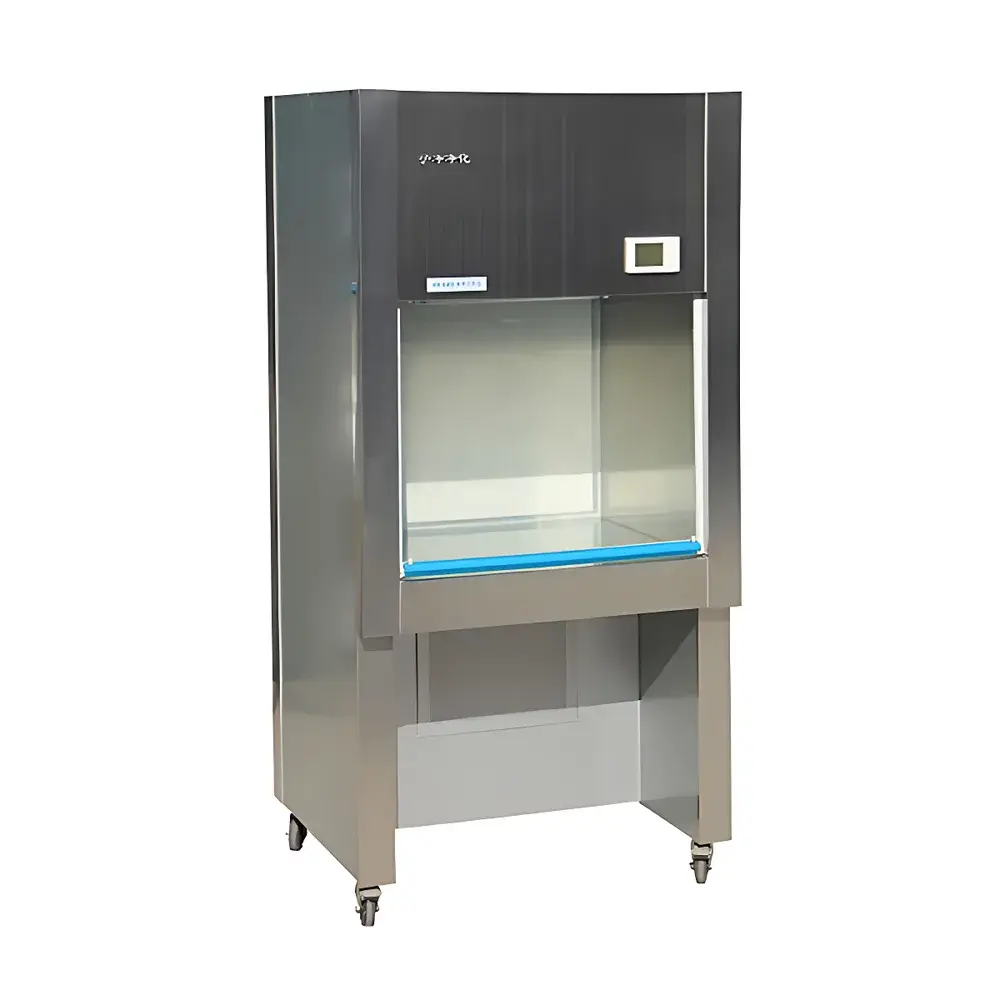
HS-840U Horizontal Laminar Flow Clean Bench by HJ Purification
| Brand | HJ Purification |
|---|---|
| Origin | Shanghai, China |
| Manufacturer Type | Direct Manufacturer |
| Product Category | Domestic |
| Model | HS-840U |
| Instrument Type | Horizontal Flow Clean Bench |
| Cleanliness Class | ISO Class 5 (100 @ ≥0.5 μm, Fed. Std. 209E) |
| Noise Level | ≤62 dB(A) |
| User Capacity | Single Operator, Front-Access Configuration |
| Airflow Pattern | Horizontal Laminar Flow |
| Pre-filter Material | Aluminum Alloy |
| HEPA Filter Specification | 695 × 600 × 38 mm, Single Unit |
| Illumination | ≥300 lx |
| Average Air Velocity | 0.25–0.45 m/s (Dual-Speed Control) |
| Vibration Amplitude | ≤0.5 μm (peak-to-peak, XYZ axes) |
| Power Supply | AC 220 V / 50 Hz |
| Max. Power Consumption | 400 W |
| Net Weight | 100 kg |
| Work Area Dimensions (W×D×H) | 700 × 560 × 580 mm |
| Overall Dimensions (W×D×H) | 855 × 765 × 1765 mm |
| UV Lamp | 20 W × 1 |
| Fluorescent Lamp | 20 W × 1 |
| Microbial Recovery | ≤0.5 CFU/plate·hr (90 mm Petri dish) |
Overview
The HS-840U Horizontal Laminar Flow Clean Bench is an ISO Class 5-certified containment workstation engineered for non-hazardous applications requiring particulate-free environments—such as aseptic sample handling, microbiological plating, cell culture preparation, and precision instrument assembly. Unlike vertical flow hoods, this unit directs filtered air horizontally across the work surface—from rear to front—at a controlled, uniform velocity (0.25–0.45 m/s), minimizing turbulence and cross-contamination risk. Its airflow path conforms to Fed. Std. 209E and aligns with ISO 14644-1 requirements for unidirectional laminar flow systems. The bench employs a single, ultra-thin, zero-leakage pleated HEPA filter (695 × 600 × 38 mm, ≥99.995% efficiency at 0.3 μm) mounted in a compact static pressure chamber, enabling reduced cabinet depth without compromising filtration integrity or uniformity. Structural integration of an aluminum alloy pre-filter, tempered glass side panels, and seamless aluminum-plastic laminate work surface ensures long-term dimensional stability, chemical resistance, and ease of decontamination.
Key Features
- Optimized aerodynamic design with horizontal laminar airflow profile validated per ISO 14644-3 Annex B protocols for uniform velocity distribution across the full work area.
- Digitally controllable dual-speed fan system with LCD interface, allowing real-time adjustment of face velocity to accommodate procedural variability while maintaining ISO Class 5 compliance.
- Integrated dual-lighting system: 20 W fluorescent lamp (≥300 lx at work surface) for routine operation and 20 W germicidal UV-C lamp (254 nm) for pre-use surface decontamination—interlocked to prevent UV exposure during active operation.
- Robust mechanical construction featuring corrosion-resistant aluminum alloy frame, reinforced base chassis, and vibration-damped mounting—measured ≤0.5 μm peak-to-peak displacement across orthogonal axes under operational load.
- Low-noise acoustics (<62 dB[A] at 1 m distance) achieved via aerodynamically tuned impeller geometry and acoustic insulation within the blower housing—critical for shared laboratory environments.
Sample Compatibility & Compliance
The HS-840U supports open-vessel manipulations of sterile media, microbial cultures, tissue explants, and sensitive reagents where operator protection is not required but environmental control is essential. It complies with ISO 14644-1:2015 (Class 5), Fed. Std. 209E (Class 100), and CNAS-CL01:2018 requirements for cleanroom equipment validation. While not designed for biohazardous or toxic material handling (i.e., lacks recirculation safeguards or negative-pressure containment), it meets GLP-relevant documentation standards for equipment qualification (IQ/OQ/PQ) when deployed in regulated QC labs. Surface microbial recovery testing is performed using settle plate methodology (ISO 14698-1), yielding ≤0.5 CFU/90 mm Petri dish per hour under steady-state conditions.
Software & Data Management
This clean bench operates as a standalone mechanical system with no embedded firmware or network connectivity. All operational parameters—including fan speed selection, lighting mode, and UV cycle activation—are managed via a tactile LCD control panel with non-volatile memory for user-defined presets. No data logging, remote monitoring, or audit trail functionality is provided; however, the unit’s design facilitates integration into facility-wide environmental monitoring systems (EMS) through external anemometer and particle counter interfaces. For FDA-regulated environments operating under 21 CFR Part 11, procedural SOPs must define manual calibration records, UV intensity verification (using calibrated radiometer), and periodic HEPA integrity testing (e.g., DOP/PAO scanning per ISO 14644-3).
Applications
- Aseptic transfer of bacterial/fungal cultures in clinical microbiology and pharmaceutical QC laboratories.
- Preparation of sterile agar plates, broth dilutions, and antibiotic susceptibility test setups.
- Handling of primary cells and stem cell lines prior to incubation—where laminar airflow prevents airborne particulate deposition on open vessels.
- Assembly and calibration of high-precision optical and microfluidic devices sensitive to sub-micron contamination.
- Electronics prototyping involving soldering of fine-pitch components under low-static, particle-controlled conditions.
FAQ
Does the HS-840U provide personnel or environmental protection against hazardous agents?
No. As a horizontal laminar flow device, it directs filtered air toward the operator and does not contain aerosols generated at the work surface. It is strictly intended for non-hazardous, non-toxic applications.
What HEPA filter standard does the unit meet?
It uses a single HEPA filter certified to EN 1822-1:2019 H14 classification (≥99.995% retention at MPPS ~0.3 μm), equivalent to US DoD MIL-STD-282 and IEST-RP-CC001.6.
Is UV lamp intensity monitored or validated?
UV output must be verified annually using a NIST-traceable UV-C radiometer (254 nm); intensity at the work surface shall exceed 40 µW/cm² to ensure effective microbial inactivation per ISO 15190.
Can the unit be integrated into a building automation system (BAS)?
Not natively. Optional analog voltage outputs (0–10 VDC) for fan speed and status signals may be added via third-party retrofit kits, subject to electromagnetic compatibility (EMC) validation per IEC 61326-1.
What maintenance intervals are recommended for optimal performance?
Pre-filter cleaning every 2 weeks; HEPA integrity testing semiannually; UV lamp replacement every 12 months or after 2000 hours of cumulative use—per ISO 14644-3 Annex F guidance.
Related Products



