
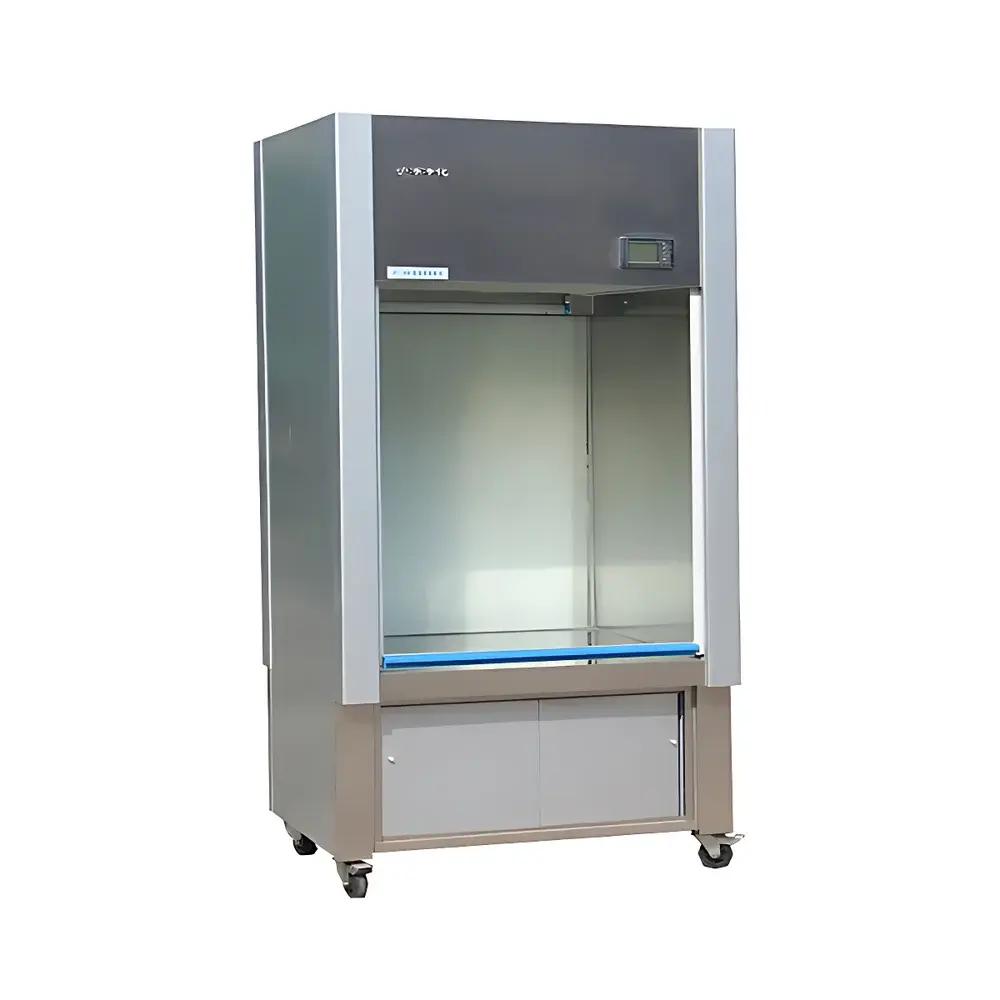
HJ JC-900 Mobile Clean Sampling Cart
| Brand | HJ Purification |
|---|---|
| Origin | Shanghai, China |
| Manufacturer Type | Direct Manufacturer |
| Product Category | Domestic |
| Model | JC-900 |
| Instrument Type | Vertical Laminar Flow Clean Bench |
| Cleanliness Class | ISO Class 5 (100 @ ≥0.5 µm, Fed. Std. 209E) |
| Noise Level | ≤62 dB(A) |
| User Capacity | 1 operator |
| Airflow Pattern | Vertical Downflow |
| Average Air Velocity | 0.25–0.6 m/s |
| Vibration Half-Peak | ≤5 µm (X/Y/Z axes) |
| Illuminance | ≥300 lx |
| Power Supply | AC 220 V, 50 Hz |
| Power Consumption | 400 W |
| Net Weight | 160 kg |
| Working Area Dimensions | 730 × 650 × 950 mm |
| Overall Dimensions | 900 × 730 × 1950 mm |
| Microbial Count | <0.5 CFU/plate·hour (90 mm Petri dish) |
| Filter Configuration | Pre-filter + HEPA (H14, ≥99.995% @ 0.3 µm) |
| Backup Power Support | Yes (integrated UPS interface) |
Overview
The HJ JC-900 Mobile Clean Sampling Cart is an engineered solution for controlled, localized particulate and microbial contamination control during raw material sampling in regulated pharmaceutical, biotechnology, and quality control environments. Designed as a self-contained vertical laminar flow clean bench, it operates on the principle of unidirectional, downward airflow—generated by a centrifugal blower system—that passes sequentially through a pre-filter (G4 class) and a certified HEPA filter (H14 per EN 1822-1, ≥99.995% efficiency at 0.3 µm). This ensures uniform, low-turbulence air delivery across the work surface at a user-adjustable velocity range of 0.25–0.6 m/s, maintaining ISO Class 5 (Fed. Std. 209E Class 100) conditions at ≥0.5 µm particle size. Its mobility—enabled by integrated heavy-duty casters with locking brakes—and compact footprint make it suitable for deployment across multiple sampling points without permanent installation, supporting flexible GMP-aligned workflows.
Key Features
- Vertical laminar airflow architecture optimized for personnel protection and sample integrity during open-container sampling operations.
- Robust structural frame fabricated from dust-free, fire-retardant high-precision paneling; working chamber lined with electropolished stainless steel (AISI 304) for corrosion resistance, cleanability, and compliance with ISO 14644-1 surface roughness requirements.
- Integrated uninterruptible power supply (UPS) interface enabling continuous operation during brief grid fluctuations—critical for uninterrupted sterility assurance during time-sensitive sampling events.
- Acoustically damped blower assembly achieving ≤62 dB(A) operational noise—validated per ISO 7779—ensuring compatibility with quiet laboratory zones and minimizing operator fatigue during extended use.
- Uniform illumination ≥300 lx across the full work surface, measured per IEC 60598-1, facilitating visual inspection of powders, granules, and liquid samples under consistent lighting conditions.
- Sealed perimeter design with gasketed sash and zero dead-air zones to prevent cross-contamination between ambient and work areas.
Sample Compatibility & Compliance
The JC-900 supports sampling of non-hazardous solid and liquid pharmaceutical intermediates, excipients, active pharmaceutical ingredients (APIs), and herbal materials where containment beyond ISO Class 5 is not required. It complies with core environmental monitoring standards referenced in EU GMP Annex 1 (2022), PIC/S PI 007-6, and USP . Microbial performance is validated using settle plate methodology (90 mm Petri dishes) per ISO 14698-1, yielding ≤0.5 CFU/plate·hour under steady-state operation. While not rated for toxic or volatile compounds (lacking negative pressure or ducted exhaust), its construction meets UL 61010-1 electrical safety requirements and conforms to CE marking directives for laboratory equipment. Documentation packages include factory-issued filter certification reports, airflow mapping summaries, and calibration records traceable to NIM (National Institute of Metrology, China).
Software & Data Management
The JC-900 is a hardware-integrated, non-networked device with no embedded microprocessor or digital interface. All operational parameters—including airflow velocity, illumination output, and filter differential pressure—are verified manually using calibrated external instruments (e.g., hot-wire anemometer, lux meter, manometer) during routine qualification (IQ/OQ) and periodic requalification per ASTM E2500 and WHO TRS 961 Annex 6. Audit trails for maintenance, filter replacement, and environmental monitoring are maintained externally in paper-based or LIMS-integrated electronic logs compliant with FDA 21 CFR Part 11 when paired with validated documentation systems. No firmware updates or software validation are applicable.
Applications
- Raw material sampling in API manufacturing suites prior to release testing.
- Intermediate batch sampling during multi-step synthesis under Grade C background environments.
- Stability sample withdrawal in temperature-/humidity-controlled storage rooms.
- Pre-sterilization component inspection in non-aseptic packaging lines.
- Environmental monitoring kit preparation in QC laboratories adhering to ISO/IEC 17025 accreditation criteria.
- Field-deployable sampling support during vendor audits or multi-site technology transfers.
FAQ
Is the JC-900 suitable for sterile product sampling?
No. It provides personnel and product protection only—not operator protection—and lacks the dynamic pressure differentials, gowning protocols, and environmental controls required for aseptic processing per EU GMP Annex 1 Section 4.12.
Can it be used with hazardous or volatile substances?
No. The unit has no exhaust ducting, fume extraction, or containment rating; it is strictly intended for non-toxic, non-volatile materials.
What filter replacement interval is recommended?
HEPA filter service life depends on ambient particulate load and usage frequency; typical replacement occurs every 12–24 months, confirmed by differential pressure monitoring and upstream pre-filter inspection per ISO 14644-3 Annex B.
Does it meet ISO 14644-1:2015 classification requirements?
Yes—when qualified per ISO 14644-3 using light-scattering airborne particle counters (≥0.5 µm channel), it achieves sustained ISO Class 5 performance in the working zone under defined test conditions.
Is third-party certification available for GMP compliance?
Yes. HJ Purification provides optional IQ/OQ protocol templates and supports third-party qualification by accredited firms; final compliance determination remains the responsibility of the end-user’s QA department per ICH Q5E and PIC/S PI 011-3.
Related Products



