
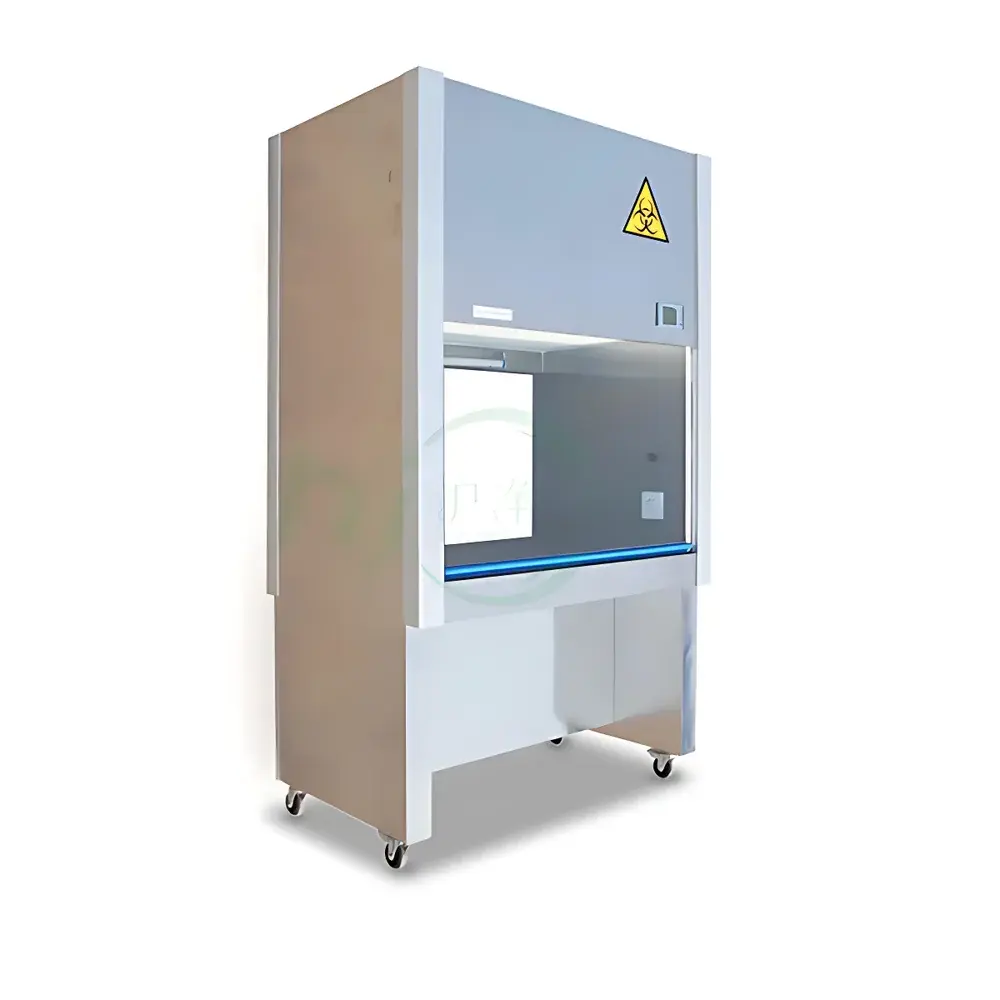
HJ BCM-1000 Horizontal Laminar Flow Clean Bench
| Brand | HJ Purification |
|---|---|
| Origin | Shanghai, China |
| Manufacturer Type | Direct Manufacturer |
| Product Category | Domestic |
| Model | BCM-1000 |
| Instrument Type | Horizontal Laminar Flow Clean Bench |
| Cleanliness Class | ISO Class 5 (equivalent to Fed. Std. 209E Class 100 @ ≥0.5 µm) |
| Microbial Count | ≤0.5 CFU/plate·hour (Φ90 mm settle plate) |
| Average Air Velocity | 0.25–0.45 m/s (dual-speed adjustable) |
| Noise Level | ≤62 dB(A) |
| Vibration Peak-to-Peak Amplitude | ≤1.0 µm (X/Y/Z axes) |
| Illuminance | ≥450 lx |
| Power Supply | AC 220 V, 50 Hz |
| Power Consumption | 800 W |
| Net Weight | 200 kg |
| Work Area Dimensions (W×D×H) | 1000 × 700 × 620 mm |
| Overall Dimensions (W×D×H) | 1200 × 740 × 1950 mm |
| Operator Capacity | Single-user, front-access configuration |
| HEPA Filter Specification | 995 × 640 × 50 mm (single unit, ≥99.995% @ 0.3 µm) |
| Lighting | 20 W fluorescent lamp × 1 |
| UV Lamp | 20 W germicidal lamp × 1 |
| Airflow Mode | Horizontal unidirectional laminar flow with negative-pressure containment design |
| Control Interface | LCD digital panel with fan speed and lighting/UV toggle controls |
Overview
The HJ BCM-1000 Horizontal Laminar Flow Clean Bench is an ISO Class 5-certified (Fed. Std. 209E Class 100) laboratory workstation engineered for non-hazardous microbiological procedures requiring particulate-free environments. Unlike vertical-flow biosafety cabinets, the BCM-1000 employs a horizontal laminar airflow architecture—air is drawn through a pre-filter, conditioned by a variable-speed centrifugal blower, and then passed through a single high-efficiency particulate air (HEPA) filter (99.995% efficiency at 0.3 µm). The filtered air exits uniformly across the work surface in a parallel, low-turbulence stream—minimizing particle resuspension and ensuring consistent protection of samples from ambient airborne contamination. Its negative-pressure containment design isolates the work area from room air via an aerodynamic air curtain, preventing cross-contamination between operator and sample while maintaining operator safety during non-toxic applications.
Key Features
- Full-recirculation airflow system with optional exhaust port activation when external fresh-air supplementation is required—enabling flexible integration into varying HVAC conditions.
- Motorized vertical sash windows on both front and rear access panels, offering precise height adjustment and ergonomic positioning for diverse procedural workflows.
- Aerodynamic air-curtain barrier formed by laminar outflow along the work surface perimeter—effectively suppressing lateral ingress of unfiltered room air and mitigating cross-contamination risk.
- Dual-speed electronically controlled blower system with real-time LCD interface, allowing operators to maintain optimal face velocity (0.25–0.45 m/s) across changing load conditions or environmental variables.
- Integrated dual-lighting system: 20 W daylight-balanced fluorescent lamp for routine visual inspection and a 20 W UVC germicidal lamp (254 nm) for pre- and post-use surface decontamination—both independently switchable via the control panel.
- Structural frame fabricated from corrosion-resistant stainless steel (SUS304) with seamless welded joints; work surface finished with electropolished 304-grade stainless steel for chemical resistance and ease of sterilization.
Sample Compatibility & Compliance
The BCM-1000 supports a broad range of non-pathogenic biological and pharmaceutical applications—including cell culture passaging, media preparation, sterile filtration, and aseptic packaging of diagnostic reagents. It is validated per ISO 14644-1:2015 for cleanroom performance and conforms to Fed. Std. 209E Class 100 requirements for airborne particulate concentration (≤3,520 particles/m³ ≥0.5 µm). Microbiological validation follows ISO 14698-1:2003 principles, with documented settle-plate testing yielding ≤0.5 CFU/plate·hour under standard operating conditions. While not certified as a biosafety cabinet per NSF/ANSI 49, the unit complies with general electrical safety standards (IEC 61010-1) and electromagnetic compatibility (IEC 61326-1). It is suitable for GLP-compliant laboratories where environmental monitoring, maintenance logs, and periodic HEPA integrity testing (via DOP/PAO scan) are maintained per internal SOPs.
Software & Data Management
The BCM-1000 operates as a standalone mechanical-electrical system without embedded firmware or network connectivity. All operational parameters—including fan speed selection, lighting mode, and UV exposure timing—are managed locally via its tactile LCD control panel. No data logging, remote diagnostics, or audit-trail functionality is provided. For regulated environments requiring traceability, users must implement manual logbooks or integrate external environmental monitoring systems (EMS) compliant with FDA 21 CFR Part 11 for electronic record retention. Routine calibration and HEPA filter integrity verification should be documented per ISO/IEC 17025-accredited procedures when used in accredited testing labs.
Applications
- Aseptic handling of mammalian and insect cell lines in academic and industrial research settings.
- Preparation of sterile culture media, buffers, and diluents for microbiology and molecular biology workflows.
- Assembly and packaging of sterile medical devices and in vitro diagnostic (IVD) kits under controlled particulate conditions.
- Quality control sampling and environmental monitoring in pharmaceutical manufacturing support labs.
- Non-hazardous botanical extract processing and formulation development in nutraceutical R&D.
FAQ
Is the BCM-1000 suitable for handling infectious agents or toxic chemicals?
No. This unit provides only product protection—not personnel or environmental protection. It must not be used for work involving Risk Group 2 or higher microorganisms, volatile solvents, or cytotoxic compounds.
What is the recommended HEPA filter replacement interval?
Filter life depends on ambient air quality and usage frequency. Under typical laboratory conditions (8 hrs/day, ISO Class 8 ambient), replacement is advised every 18–24 months—or sooner if pressure drop exceeds 250 Pa or particle challenge tests fail.
Can the unit be installed in a non-conditioned space?
Ambient temperature should remain between 15–30°C with relative humidity ≤70% non-condensing. Excessive dust or humidity may compromise filter integrity and optical clarity of the sash.
Does the UV lamp provide full-surface sterilization?
UVC irradiation is effective only on directly exposed surfaces. Shadowed areas, crevices, or porous materials require supplemental chemical disinfection per institutional biosafety protocols.
Is third-party certification available for ISO Class 5 compliance?
Yes—certification reports issued by CNAS-accredited testing laboratories (e.g., SGS, BV, or local provincial CDC labs) can be commissioned upon request, subject to on-site performance validation.



