
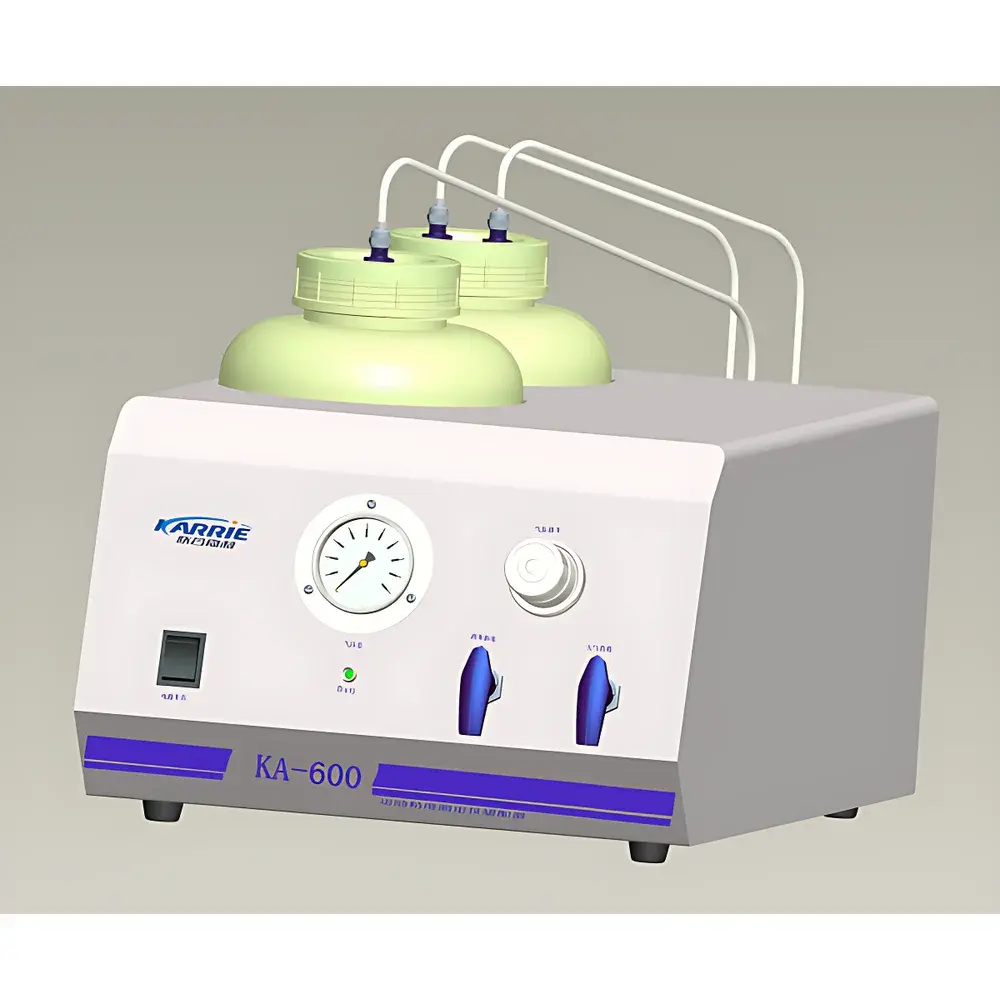
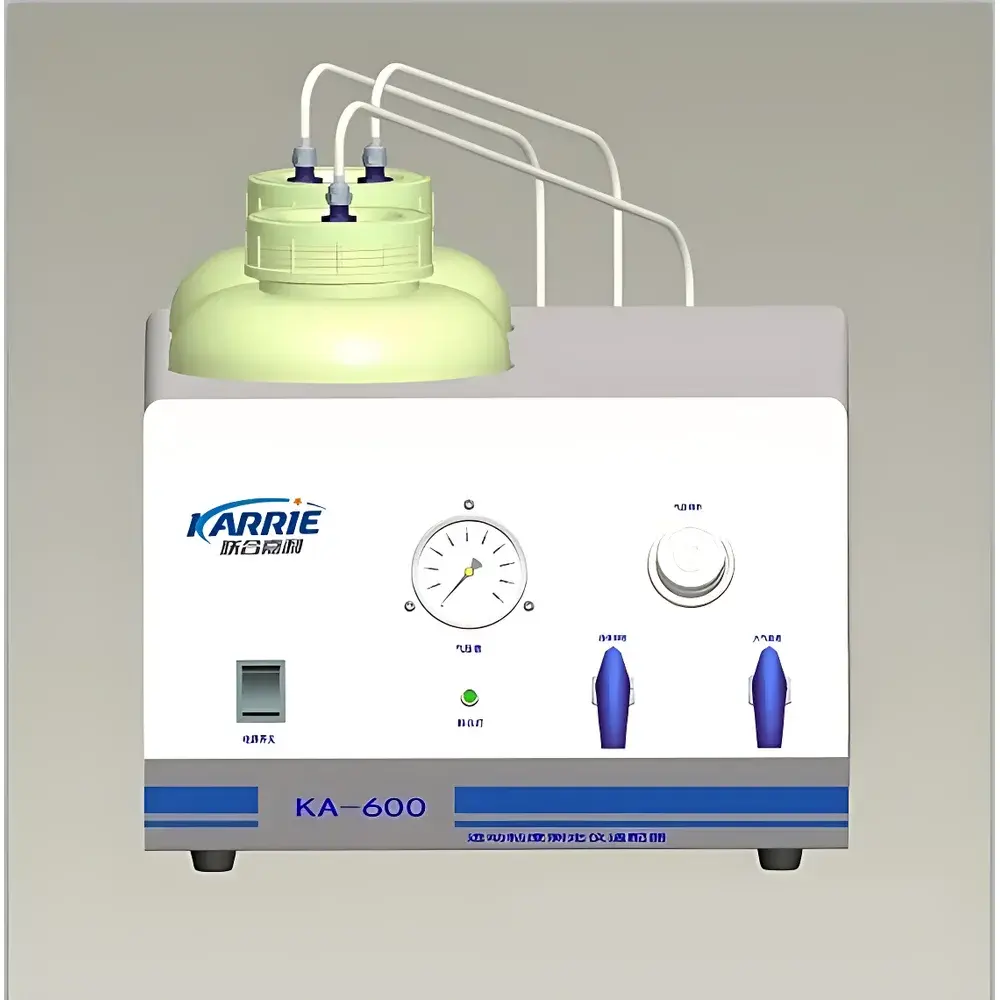
Karrie KA-600 Vacuum-Assisted Kinematic Viscosity Tester Adapter
| Brand | Karrie |
|---|---|
| Model | KA-600 |
| Origin | Shenzhen, China |
| Power Supply | AC 220 V ±10% |
| Power Consumption | 30 W |
| Vacuum Range | −0.05 to 0 MPa |
| Cleaning Fluid Capacity | 5000 mL |
| Waste Fluid Capacity | 5000 mL |
| Dimensions (W × D × H) | 360 × 520 × 230 mm |
| Weight | 10 kg |
Overview
The Karrie KA-600 Vacuum-Assisted Kinematic Viscosity Tester Adapter is an engineered auxiliary module designed to standardize and streamline manual kinematic viscosity testing workflows in accordance with ASTM D445, ISO 3104, and GB/T 265. It functions as a vacuum-driven fluid handling interface between laboratory personnel and conventional Ubbelohde or Cannon-Fenske capillary viscometers. Unlike standalone viscometers, the KA-600 does not perform direct viscosity measurement; rather, it automates three critical ancillary operations: sample aspiration into the capillary tube, post-test solvent rinsing of the viscometer tube, and controlled air-drying via regulated vacuum drawdown. Its operation relies on negative pressure generation within a sealed pneumatic circuit, enabling precise control over fluid displacement rates—critical for minimizing operator-induced variability in timing-sensitive capillary flow measurements.
Key Features
- Vacuum regulation via calibrated rotary knob, offering continuous adjustment from −0.05 MPa to atmospheric pressure (0 MPa), accommodating a broad range of kinematic viscosities—from low-viscosity solvents (e.g., hexane, ~0.3 mm²/s) to high-viscosity lubricants (e.g., SAE 50 oils, >200 mm²/s).
- Dual-bottle modular design: independent 5 L polypropylene reservoirs for cleaning solvent (e.g., toluene, xylene, or isopropanol) and waste collection, both equipped with quick-connect bayonet fittings and level indicators.
- Integrated pneumatic manifold with stainless steel valves and PTFE-sealed ball valves for sample aspiration, rinse delivery, and purge cycles—designed for chemical resistance and long-term leak integrity.
- Compact footprint (360 × 520 × 230 mm) and lightweight construction (10 kg) enable placement directly adjacent to constant-temperature baths or viscometer stands without requiring dedicated bench space or structural anchoring.
- Low-power operation (30 W nominal) ensures compatibility with standard laboratory circuits and supports extended unattended use during multi-sample batch processing.
Sample Compatibility & Compliance
The KA-600 adapter interfaces exclusively with gravity-driven capillary viscometers conforming to ISO 3104 Annex A geometry specifications—including Ubbelohde, Cannon-Fenske, and Ostwald types—regardless of manufacturer origin. It supports all standard viscometer calibration fluids traceable to NIST SRMs or equivalent national metrology institutes. The system is compatible with common cleaning solvents approved under ASTM D445 Section 7.2, including petroleum ether, acetone, and chlorinated hydrocarbons (with appropriate fume hood ventilation). No electrical or data connectivity is required between the adapter and the viscometer, preserving original instrument certification status. While the KA-600 itself carries no CE or UL marking, its passive pneumatic architecture ensures compliance with IEC 61010-1 safety principles for laboratory auxiliary equipment when operated within specified voltage and ambient temperature ranges (15–30 °C).
Software & Data Management
The KA-600 operates entirely without embedded firmware or digital control systems. All operational parameters—including vacuum setpoint, rinse volume, and purge duration—are manually selected and executed by the user. As such, it generates no electronic records, audit trails, or exportable data files. This analog design eliminates validation requirements under FDA 21 CFR Part 11 or EU Annex 11, making it suitable for GLP-compliant laboratories where procedural documentation (e.g., handwritten test logs, SOP-controlled checklists) fulfills record-keeping obligations. Integration into LIMS environments is achieved solely through manual entry of associated viscosity test results obtained using the adapted viscometer.
Applications
- Routine quality control of petroleum distillates, base oils, and finished lubricants in refinery QC labs.
- Research-grade viscosity profiling of polymer solutions and bio-based fluids where repeatability across multiple operators is essential.
- Educational laboratories requiring robust, maintenance-light infrastructure for undergraduate fluid mechanics instruction.
- Third-party testing facilities performing accredited kinematic viscosity determinations per ISO/IEC 17025, where method equivalence must be demonstrated without altering primary measurement hardware.
- Field-deployable viscosity verification stations supporting mobile maintenance units servicing wind turbine gearboxes or marine diesel engines.
FAQ
Does the KA-600 replace a capillary viscometer?
No. It is a mechanical assist device that enhances repeatability and ergonomics of manual capillary viscometry—it does not measure viscosity directly.
Can it be used with automated viscometers?
No. The KA-600 is purpose-built for gravity-flow capillary instruments and lacks electrical or communication interfaces required for integration with motorized or microprocessor-controlled systems.
Is vacuum calibration traceable?
The vacuum gauge is factory-calibrated against a certified reference manometer; users may verify accuracy periodically using a secondary NIST-traceable pressure standard.
What maintenance is required?
Routine inspection of O-rings, valve seals, and solvent bottle integrity every 200 operating hours; replacement of consumable tubing and filters per manufacturer’s service schedule.
Does it support temperature-controlled operation?
No. Temperature regulation remains the responsibility of the external constant-temperature bath (per ASTM D445 Section 6); the KA-600 introduces no thermal mass or active heating/cooling elements.





