
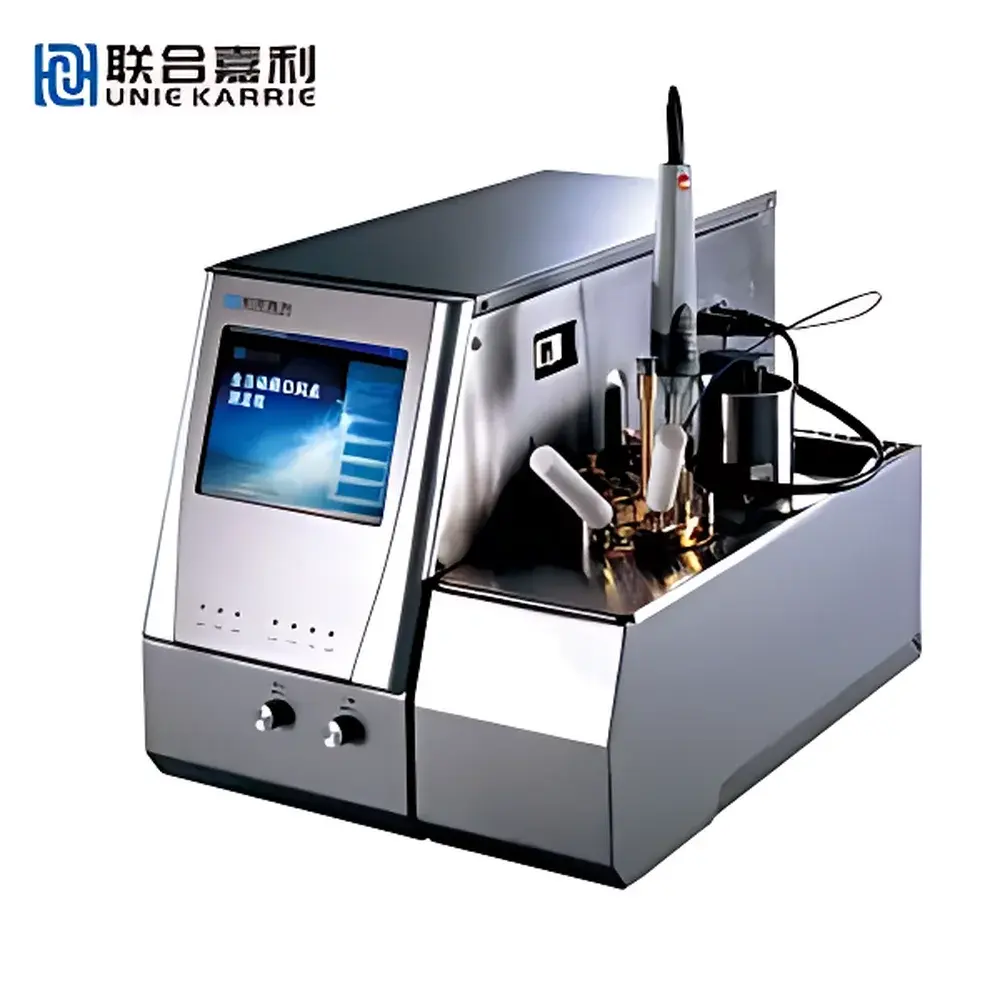
Karrie EFP110-L Fully Automated Low-Temperature Closed-Cup Flash Point Tester
| Brand | Karrie |
|---|---|
| Origin | Guangdong, China |
| Model | EFP110-L |
| Detection Method | Closed-Cup (Pensky-Martens) |
| Operation Mode | Fully Automatic |
| Temperature Range | −10 °C to 100 °C |
| Ignition Method | Electronic or Gas Ignition |
| Compliant Standards | GB/T 261, ISO 2719, ASTM D93 |
| Power Supply | AC 220 V, 50 Hz |
| Heating Power | 300 W |
| Total Power Consumption | 500 W |
| Operating Ambient Temperature | 0 °C to 28 °C |
| Storage Temperature | −20 °C to 50 °C |
| Display | 6.4″ Color TFT LCD (640 × 480) |
| Dimensions (W × D × H) | 478 × 319 × 322 mm |
| Weight | 25 kg |
Overview
The Karrie EFP110-L Fully Automated Low-Temperature Closed-Cup Flash Point Tester is engineered for precise, repeatable flash point determination of petroleum products, lubricants, biodiesel blends, and other volatile hydrocarbon-based liquids in accordance with internationally recognized closed-cup test methodologies. It implements the Pensky-Martens principle—where a sample is heated under controlled conditions in a sealed cup, and ignition is applied at predetermined temperature intervals—to identify the lowest temperature at which vapors above the liquid surface ignite momentarily when exposed to an ignition source. Designed specifically for low-temperature applications down to −10 °C, the instrument integrates an external low-temperature recirculating chiller (supplied), enabling accurate testing of light distillates, jet fuels, diesel fractions, and cold-climate formulations where conventional flash point instruments may lack resolution or thermal stability.
Key Features
- Dual-control architecture: A dedicated microcontroller manages real-time heating control and sensor signal acquisition (Pt100 oil temperature, flash detection), while a rugged industrial PC (256 MB RAM, 4 GB flash storage) runs Windows CE 5.0 for system-level coordination, data logging, and user interface—ensuring deterministic timing and immunity to OS-level corruption.
- True-color 6.4″ TFT touchscreen display (640 × 480 resolution) with intuitive graphical interface; supports on-screen curve visualization of temperature ramp (1–1.6 °C/min or 5–6 °C/min per ASTM D93/GB/T 261), real-time ignition event logging, and dynamic rate-of-rise monitoring.
- Modular mechanical design: Independent mounting of the gold-plated brass test cup assembly, flash sensor, and Pt100 temperature probe enables field-replaceable component service without recalibration—reducing downtime and supporting long-term metrological integrity.
- Dual ignition options: User-selectable electronic spark ignition or pressurized gas flame ignition—both validated to produce statistically equivalent results across the full operating range, eliminating method-dependent bias.
- Comprehensive self-diagnostic suite: Automated power-on verification of flash sensor continuity, Pt100 calibration offset, electronic igniter function, stirrer motor actuation, thermal fuse status, and chiller communication—faults trigger audible alerts and on-screen diagnostic messages (e.g., “Flash Sensor Disconnected” or “Chiller Communication Timeout”).
- Triple-tier thermal safety protocol: Pre-alarm activation at EFP + 10 °C, active alarm + continued operation at EFP + 20 °C, and automatic test termination with forced-air cooling at 150 °C—fully compliant with IEC 61010-1 requirements for laboratory electrical equipment safety.
Sample Compatibility & Compliance
The EFP110-L accommodates standard ASTM D93 / ISO 2719 / GB/T 261 test cups (50 mL capacity) and is validated for use with transparent and opaque petroleum distillates, synthetic lubricants, biofuels (e.g., FAME, hydrotreated esters), and solvent-based formulations exhibiting flash points between −10 °C and 100 °C. Its low-temperature capability ensures reliable detection of early volatility onset in aviation turbine fuels (Jet A-1, JP-8), ultra-low-sulfur diesel (ULSD), and winter-grade gasoline blends. All hardware and firmware comply with electromagnetic compatibility (EMC) directives per EN 61326-1 and carry CE marking for laboratory instrumentation. Data audit trails—including operator ID, test start/stop timestamps, atmospheric pressure corrections, and raw sensor outputs—support GLP and GMP traceability requirements.
Software & Data Management
The embedded Windows CE 5.0 platform hosts a native application with bilingual UI (English/Chinese toggle). Test data—including flash point, initial flash temperature, ignition count, ramp rate, ambient pressure, and pass/fail flags—are stored locally in non-volatile memory (≥10,000 records). Search functionality allows filtering by date range, sample ID, operator name, or custom metadata tags. Export is supported via USB mass storage (CSV or PDF report generation), RS-232 (ASCII protocol), or Ethernet (TCP/IP) for direct LIMS integration. Firmware updates are performed over USB without external tools. Optional FDA 21 CFR Part 11 compliance packages include electronic signature capture, role-based access control, and immutable audit logs—available upon configuration request.
Applications
- Quality control laboratories in refineries and fuel blending terminals verifying conformance of finished products to specification limits (e.g., ASTM D975 for diesel, ASTM D1655 for aviation turbine fuel).
- R&D departments evaluating volatility profiles of next-generation biofuels and alternative engine oils under sub-zero thermal conditions.
- Regulatory testing facilities conducting third-party certification for transportation fuel compliance (e.g., EN 590, ASTM D3699).
- Contract testing labs serving petrochemical, aviation, and marine sectors requiring auditable, standards-aligned flash point reporting.
- Academic and government research institutes performing fundamental flammability studies on novel hydrocarbon derivatives and low-viscosity synthetic base stocks.
FAQ
Does the EFP110-L meet ASTM D93 Annex A1 for low-temperature testing?
Yes—the instrument’s extended range (−10 °C to 100 °C) and integrated recirculating chiller satisfy the thermal control requirements specified in ASTM D93 Annex A1 for samples with flash points below 40 °C.
Can the system operate without the external chiller?
No—the chiller is mandatory for tests below ambient temperature; the base unit lacks internal refrigeration and relies on the supplied external unit for sub-zero thermal conditioning.
Is calibration traceable to NIST or national metrology institutes?
Factory calibration uses Pt100 sensors certified to ±0.1 °C accuracy against reference standards accredited to ISO/IEC 17025; end-user calibration verification kits (including certified reference oils) are available separately.
What maintenance is required for the gold-plated test cup assembly?
The cup and lid require only routine cleaning with lint-free cloths and analytical-grade solvent after each test; no polishing or re-plating is necessary under normal use due to the high-purity electroless gold coating’s oxidation resistance.
How does the system handle atmospheric pressure correction?
Barometric pressure input (manual entry or optional digital barometer interface) automatically adjusts reported flash point values using the algorithm defined in ASTM D93 Section 10.2.3, ensuring comparability across elevation zones.




