
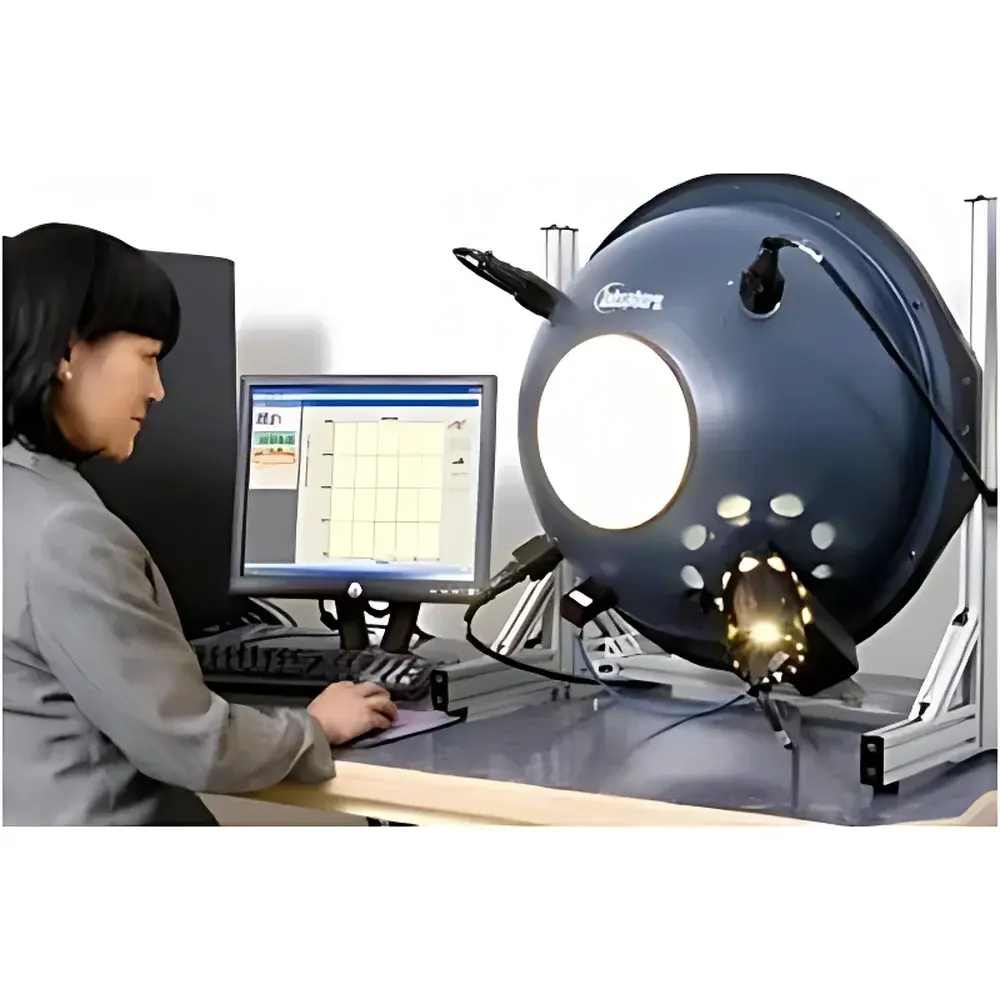
Labsphere USS-1200 Medium-Sized Uniform Source System
| Brand | Labsphere |
|---|---|
| Origin | USA |
| Model | USS-1200 |
| Luminance Range | 0–40,000 cd/m² |
| Uniformity | >98% |
| Coating | Spectraflect® (98% reflectance, near-Lambertian) |
| Calibration | NIST-traceable |
| Compliance | ISO 9001:2000 |
| Sphere Diameter | 12 in |
| Detector Ports | 2 |
| Lamp Ramp Time | 20 s |
| Adjustable Output | Motorized variable attenuator |
| Spectral Stability | Optimized lamp spectral matching |
Overview
The Labsphere USS-1200 Medium-Sized Uniform Source System is a precision-engineered optical calibration instrument designed to deliver spatially uniform spectral radiance and irradiance across defined visible and near-visible wavelength bands. Based on a 12-inch integrating sphere architecture, the system employs Spectraflect®—a proprietary barium sulfate-based diffuse coating with 98% hemispherical reflectance and near-perfect Lambertian scattering characteristics—to achieve radiance uniformity exceeding 98% over the full output aperture. The system operates on the principle of multiple diffuse reflections within a geometrically optimized sphere cavity, enabling highly reproducible, spatially stable, and spectrally neutral light fields essential for radiometric and photometric calibration traceable to NIST standards.
Key Features
- Motorized variable attenuator enabling continuous, repeatable luminance control from 0 to 40,000 cd/m² with high positional repeatability and minimal thermal drift.
- Spectraflect®-coated 12-inch integrating sphere offering long-term optical stability—maintaining consistent reflectance and angular response over extended operational lifetimes (typically >5 years under controlled lab conditions).
- Dual detector ports positioned at orthogonal locations on the sphere wall, supporting simultaneous spectral monitoring (e.g., via fiber-coupled spectroradiometers) and real-time feedback for closed-loop intensity stabilization.
- Thermally managed tungsten-halogen lamp assembly with programmable 20-second current ramp-up sequence, minimizing thermal shock and extending lamp life while ensuring stable color temperature (CCT ≈ 2856 K) across repeated on/off cycles.
- Interchangeable lamp modules with spectrally matched CCTs, enabling multi-lamp configurations without introducing significant chromatic deviation or spatial non-uniformity.
- Modular port configuration—including standardized SMA and flanged optical interfaces—allowing flexible integration of auxiliary sources, filters, or collimators to extend spectral range or modify beam geometry.
- Full NIST-traceable calibration certificate included, covering both radiometric (W·sr⁻¹·m⁻²) and photometric (cd·m⁻²) units across the CIE 1931 2° observer function, with uncertainty budgets reported per ISO/IEC 17025 guidelines.
Sample Compatibility & Compliance
The USS-1200 accommodates flat-panel detectors up to 100 mm in diameter at its primary output port, with optional adapter plates supporting standard M32, M42, and C-mount interfaces. It is compatible with CCD/CMOS imaging sensors, photodiode arrays, silicon photometers, and scanning spectroradiometers operating from 380 nm to 1050 nm. All systems are manufactured under an ISO 9001:2000 certified quality management system. Calibration procedures adhere to ASTM E308 (computing CIE tristimulus values), ISO 15739 (noise measurement of imaging systems), and ANSI/NIST Handbook 150-2G (radiometric calibration requirements). Documentation supports GLP-compliant audit trails and satisfies baseline requirements for FDA 21 CFR Part 11 when paired with validated data acquisition software.
Software & Data Management
While the USS-1200 operates as a standalone hardware system, it integrates seamlessly with third-party control platforms including LabVIEW, MATLAB, and Python-based automation frameworks via RS-232 or USB-to-serial interface. Motorized attenuator position, lamp voltage, and external detector signals can be logged synchronously using timestamped ASCII or HDF5-formatted datasets. Optional Labsphere-provided software tools support automated calibration routines—including uniformity mapping, temporal stability analysis (flicker index, RMS variation over 30 min), and spectral deviation reporting against reference spectra. All calibration metadata—including date, operator ID, environmental conditions (ambient temperature ±0.5°C, humidity <60% RH), and uncertainty contributors—is embedded in export files to meet ISO/IEC 17025 documentation mandates.
Applications
- Radiometric and photometric calibration of scientific-grade imaging systems—including satellite earth observation sensors, medical endoscopic cameras, and autonomous vehicle vision modules.
- Verification of MTF, SNR, dynamic range, and linearity performance in machine vision and industrial inspection cameras per EMVA 1288 standards.
- Reference source for display metrology—validating luminance, chromaticity, and viewing angle dependence of OLED, LCD, and microLED panels per ICDM and VESA DisplayHDR test protocols.
- Ground-truth illumination source in hyperspectral and multispectral sensor characterization, particularly where spectral fidelity and spatial uniformity must be decoupled from source artifacts.
- Supporting inter-laboratory comparison studies requiring transfer-standard-level consistency, especially in national metrology institutes and accredited calibration labs.
FAQ
What is the recommended warm-up time before achieving radiometric stability?
A minimum 30-minute thermal stabilization period is required after lamp ignition to ensure <±0.3% luminance drift over 10 minutes; full spectral stability (CCT ±15 K) is achieved within 45 minutes.
Can the USS-1200 be used for UV or IR spectral extension?
The standard Spectraflect® coating exhibits reduced reflectance below 380 nm and above 1050 nm; for UV applications, optional quartz-bulb + BaSO₄-coated spheres (USS-UV series) are available; for NIR, custom InGaAs-compatible coatings and filtered lamp options may be specified.
Is remote operation supported for unattended calibration sequences?
Yes—the motorized attenuator and lamp power supply accept TTL-triggered start/stop commands and analog voltage setpoints, enabling integration into fully automated test benches compliant with IEEE 12207 and MIL-STD-498 workflows.
How often is recalibration recommended?
Annual recalibration is advised under typical lab use (≤8 hrs/day); more frequent verification (quarterly) is recommended if operated >12 hrs/day or in environments with elevated particulate load or thermal cycling.
Does the system include spectral irradiance data for each calibration point?
Yes—each NIST-traceable certificate includes measured spectral radiance (nW·sr⁻¹·cm⁻²·nm⁻¹) at five discrete luminance levels spanning the full 0–40,000 cd/m² range, acquired using a calibrated double-monochromator spectroradiometer.





