
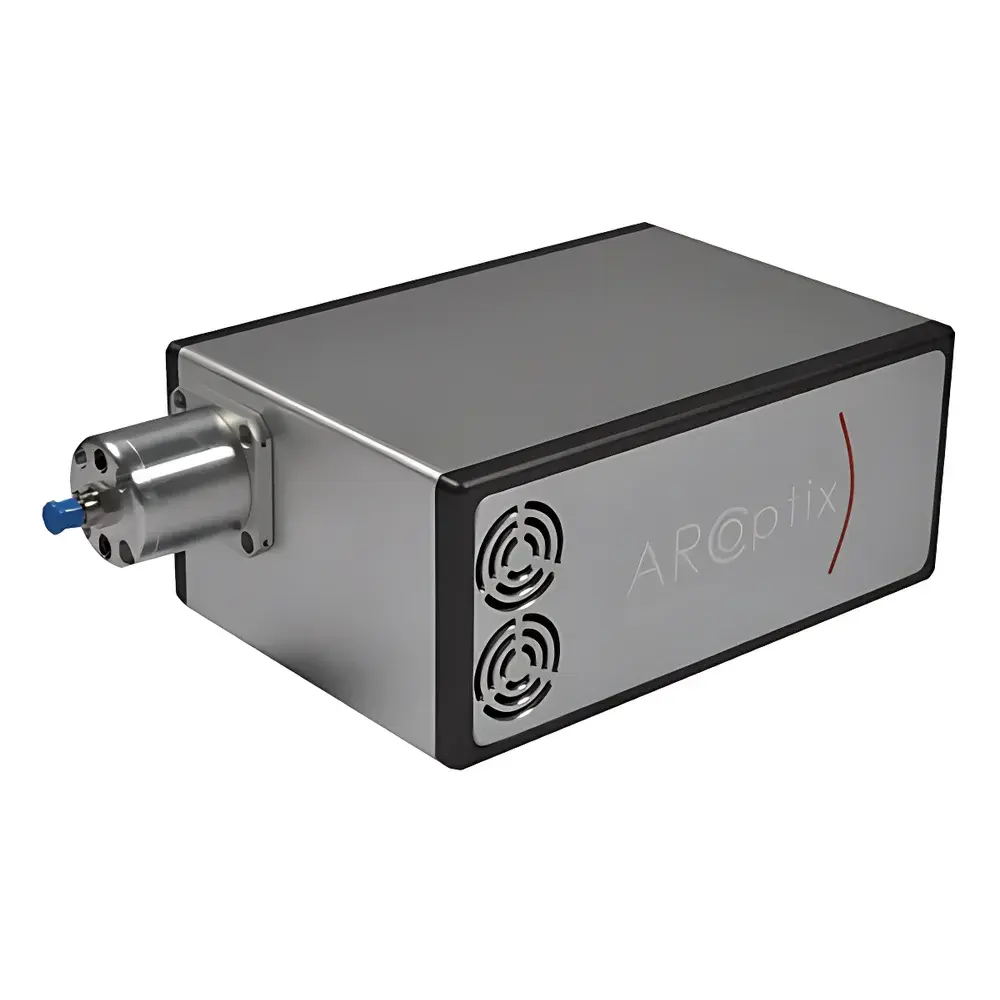
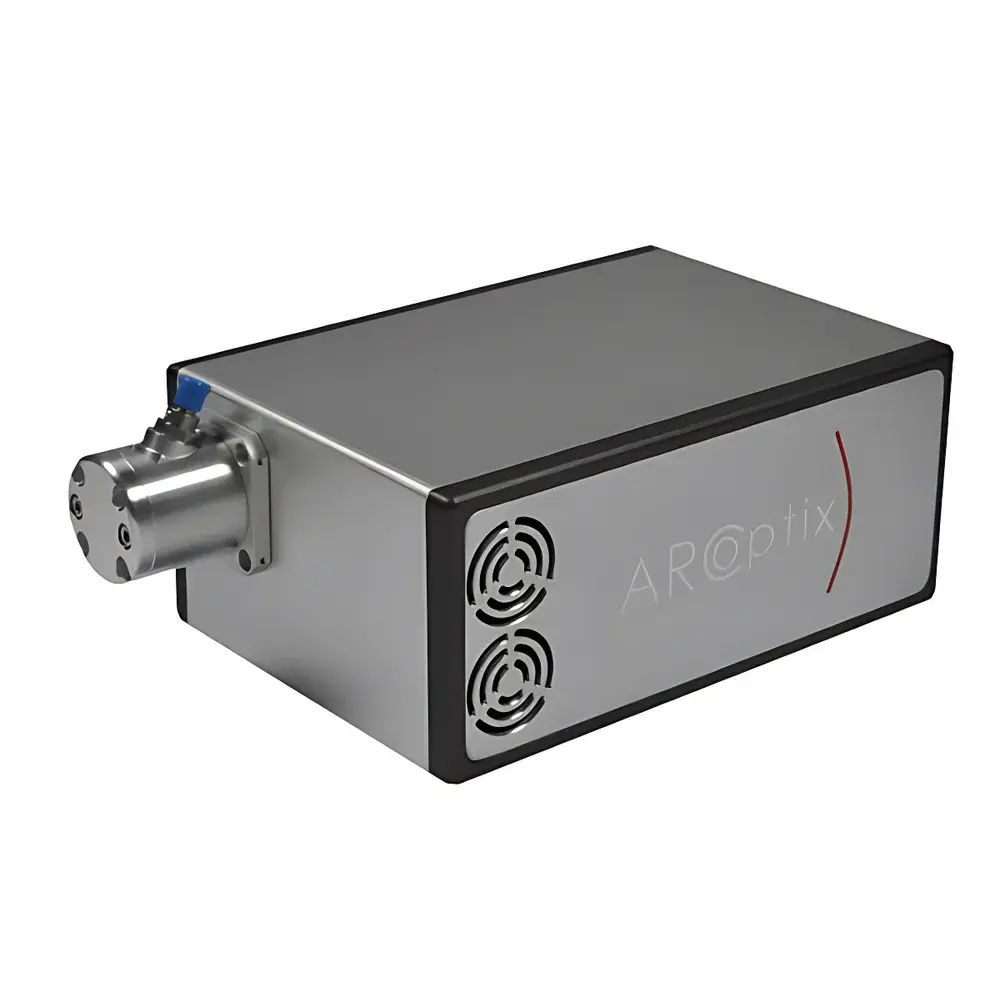
Arcoptix FT-IR 2-12 Fourier Transform Infrared Spectrometer
| Brand | Arcoptix |
|---|---|
| Origin | Switzerland |
| Instrument Type | Laboratory FT-IR |
| Spectral Range | 5000–830 cm⁻¹ |
| Resolution | 0.5 cm⁻¹ (standard 4 cm⁻¹, optional down to 0.5 cm⁻¹) |
| Signal-to-Noise Ratio | > 1:40,000 (at 8 cm⁻¹, 60 s acquisition) |
| Detector | Peltier-cooled MCT (4-stage TE), ZnSe beamsplitter |
| Interface | USB 2.0 |
| Dimensions | 180 × 160 × 80 mm |
| Weight | 1.8 kg |
| Operating Temperature | 10–40 °C |
Overview
The Arcoptix FT-IR 2-12 is a compact, laboratory-grade Fourier Transform Infrared (FT-IR) spectrometer engineered for high-stability spectral acquisition in mid-infrared (MIR) applications. Based on Michelson interferometry with a permanently aligned double retro-reflector design, the system eliminates mechanical drift and ensures long-term wavenumber accuracy (<10 ppm repeatability) without periodic realignment. Its core optical architecture integrates a temperature-stabilized solid-state reference laser (850 nm) and a 24-bit analog-to-digital converter, enabling precise phase correction and robust digitization of interferograms across dynamic ranges exceeding 10⁵. Designed for both free-space and fiber-coupled operation, the FT-IR 2-12 supports direct integration into custom optical setups—particularly suited for infrared source characterization, laser line profiling, gas-phase absorption studies, and process monitoring where spatial constraints or remote sensing are critical. Unlike dispersive IR systems, this instrument delivers inherent throughput (Jacquinot) and multiplex (Fellgett) advantages, resulting in superior signal fidelity per unit time—especially valuable in low-light or rapid-scan scenarios.
Key Features
- Permanently aligned interferometer with double retro-reflector geometry—no moving mirrors, zero maintenance alignment
- Peltier-cooled, 4-stage thermoelectric (TE) mercury cadmium telluride (MCT) detector optimized for 2–12 µm range, delivering high detectivity (D* > 2.5 × 10⁹ cm·Hz½/W)
- ZnSe beamsplitter providing broad spectral transmission from 5000 to 830 cm⁻¹ (2–12 µm), with minimal water vapor absorption artifacts in ambient lab environments
- Configurable resolution: standard 4 cm⁻¹ unapodized; optionally selectable down to 0.5 cm⁻¹ for fine-structure analysis of rotational-vibrational bands
- USB 2.0 interface with native Windows 7/10 support and comprehensive DLL-based API for automated control in MATLAB, Python, LabVIEW, or custom C/C++ applications
- Modular input options: free-space aperture (Ø12.7 mm, ±1.6° full acceptance angle) and detachable SMA 905 fiber port compatible with polycrystalline infrared (PIR) fibers (3–18 µm)
- Low-power consumption (12 V / 8 W) and compact footprint (180 × 160 × 80 mm) enable benchtop deployment or integration into OEM instrumentation platforms
Sample Compatibility & Compliance
The FT-IR 2-12 accommodates transmission, reflection, and attenuated total reflectance (ATR) configurations via external accessories—not integrated but fully compatible with industry-standard ATR crystals (e.g., diamond, ZnSe, Ge) and beam condensers. It supports gaseous, liquid, and solid samples when paired with appropriate sample cells (e.g., sealed gas cells with KBr windows, liquid cells with CaF₂ spacers). While not certified as a GMP-compliant analytical instrument out-of-the-box, its hardware architecture—including stable laser referencing, non-drifting interferometer mechanics, and traceable wavenumber calibration—meets foundational requirements for method validation under ISO 17025 and ASTM E1421. Data integrity is supported through timestamped spectral logging and metadata embedding (acquisition parameters, detector bias, ambient temperature), facilitating audit-ready documentation in GLP environments. Optional firmware updates may extend compliance readiness for FDA 21 CFR Part 11 when deployed with validated third-party software platforms.
Software & Data Management
The instrument ships with Arcoptix’s proprietary SpectraManager software, offering real-time interferogram visualization, apodization selection (Boxcar, Hamming, Blackman-Harris), phase correction, and Fourier transformation with baseline flattening and peak integration tools. Raw interferograms (.bin) and processed spectra (.spc, .csv) are stored with embedded acquisition metadata, ensuring traceability. The provided Windows DLL enables full programmatic control—including scan number, resolution, co-addition count, laser lock status, and detector bias adjustment—making it suitable for automated QA/QC workflows, inline process spectroscopy, or multi-instrument synchronization. Export formats comply with JCAMP-DX v5.1 standards, ensuring interoperability with commercial chemometric packages (e.g., Unscrambler, Pirouette) and open-source libraries (e.g., scikit-spectra, PyMca). No cloud dependency or subscription licensing is required; all processing occurs locally on the host PC.
Applications
- Infrared laser characterization: linewidth measurement, mode-hop detection, and wavelength stability assessment of quantum cascade lasers (QCLs) and interband cascade lasers (ICLs)
- Gas-phase quantitative analysis: CO₂, CH₄, NH₃, and NOₓ monitoring using Beer-Lambert modeling with pre-calibrated reference spectra
- Material identification: polymer fingerprinting (e.g., PE, PP, PET), pharmaceutical excipient verification, and contaminant screening in packaging films
- Research-grade MIR spectroscopy: vibrational mode assignment in coordination compounds, hydrogen-bonding studies in biomolecules, and surface adsorbate analysis via in-situ DRIFTS
- OEM integration: embedded spectral engine for handheld analyzers, environmental sensors, and industrial combustion monitors requiring rugged, low-SWaP IR detection
FAQ
Is the FT-IR 2-12 compliant with FDA 21 CFR Part 11 for regulated laboratories?
The hardware provides essential data integrity features (timestamped spectra, parameter logging, detector bias tracking), but full Part 11 compliance requires validated software implementation—including electronic signatures, audit trails, and role-based access control—which must be achieved using third-party validated platforms integrated via the DLL API.
Can I use standard silica optical fiber with this spectrometer?
No—silica fibers absorb strongly beyond ~2.5 µm. Only chalcogenide (CIR) or polycrystalline (PIR) infrared fibers are compatible; recommended PIR fiber core diameter ≤1 mm, NA ≤0.3.
What is the minimum achievable resolution, and how does it affect scan time?
The lowest unapodized resolution is 0.5 cm⁻¹, requiring longer mirror travel and thus increasing single-scan time. At 0.5 cm⁻¹, maximum continuous acquisition rate drops to ~1 spectrum per 4 seconds; higher speeds are attainable at coarser resolutions.
Does the system include wavenumber calibration standards?
Yes—a factory-installed polystyrene film reference is included for routine wavenumber validation per ASTM E1421; users may also load custom calibration files for application-specific traceability.
Is vacuum purging supported to reduce atmospheric water vapor interference?
The optical bench is sealed but not vacuum-compatible; however, the ZnSe beamsplitter and MCT detector exhibit inherently low sensitivity to ambient humidity, and spectral post-processing (e.g., water vapor subtraction algorithms) is supported in SpectraManager.
Related Products




