
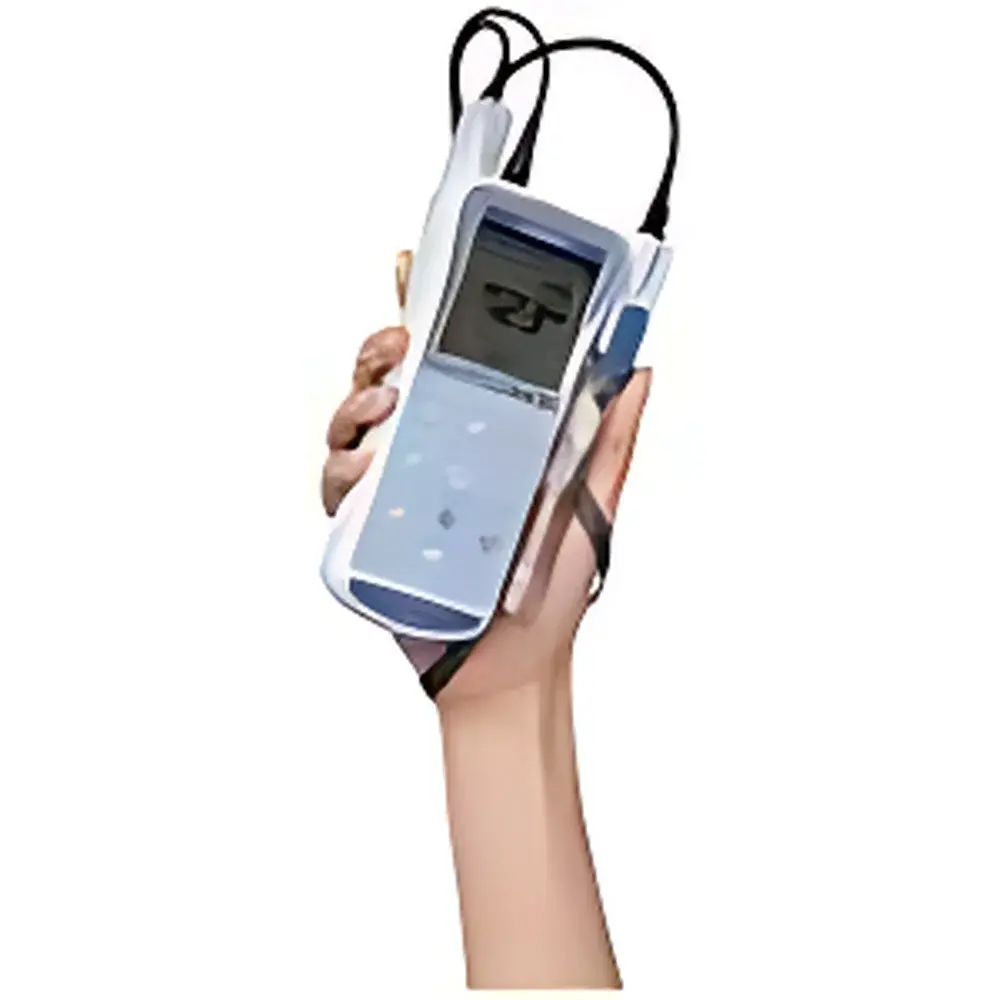
HORIBA D-54 Portable Multi-Parameter Water Quality Analyzer
| Brand | HORIBA |
|---|---|
| Origin | Japan |
| Model | D-54 |
| Measurement Principles | Glass Electrode (pH/ORP), Thermistor (Temperature), Conductivity Cell (Conductivity) |
| pH Range | 0.00–14.00 (Resolution: 0.01 pH) |
| ORP Range | −1999 to +1999 mV (Resolution: 1 mV) |
| Temperature Range | 0.0–100.0 °C (Resolution: 0.1 °C) |
| Conductivity Ranges | 0.000 mS/m – 19.99 S/m (K = 100 m⁻¹), 0.0 µS/m – 1.999 S/m (K = 10 m⁻¹), 0.00 mS/m – 199.9 S/m (K = 1000 m⁻¹) |
| Conductivity Resolution | 0.05% of Full Scale |
| Accuracy (pH) | ±0.01 pH ±1 digit |
| Accuracy (ORP) | ±1 mV ±1 digit |
| Accuracy (Temp) | ±0.1 °C ±1 digit |
| Accuracy (Conductivity) | ±0.5% F.S. ±1 digit |
| Power Supply | DC 3 V (2 × AA/LR6 batteries) |
| Weight | Approx. 330 g |
| Data Interface | RS-232C |
| Optional Accessories | AC Adapter, RS-232C Printer Interface |
| IP Rating | IP67 (Waterproof Enclosure) |
| Auto-diagnostic Function | Yes |
| Internal Data Logging | Yes |
| Dual-Channel Simultaneous Measurement | Yes |
| Display | Backlit LCD with High-Contrast Numeric Readout |
Overview
The HORIBA D-54 Portable Multi-Parameter Water Quality Analyzer is an engineered field-deployable instrument designed for reliable, on-site assessment of critical water quality parameters in environmental monitoring, wastewater treatment, aquaculture, and drinking water distribution systems. Built upon proven electrochemical sensing principles—including glass electrode-based potentiometric measurement for pH and ORP, precision thermistor-based temperature compensation, and four-electrode or two-electrode conductivity cell configurations—the D-54 delivers traceable, repeatable data under variable ambient conditions. Its compact, ruggedized housing conforms to IP67 ingress protection standards, enabling operation in rain, high humidity, dust-laden environments, and temporary submersion—making it suitable for both laboratory benchtop verification and extended field campaigns. The device supports dual-channel concurrent measurement, allowing simultaneous acquisition of two independent parameter sets (e.g., pH + conductivity in one channel, ORP + temperature in another), thereby reducing sampling time and minimizing cross-contamination risk during sequential testing.
Key Features
- IP67-rated waterproof enclosure with reinforced electrode interface ports for long-term outdoor deployment
- Dual-channel measurement architecture supporting synchronized or independent parameter acquisition
- Auto-diagnostic self-check routine at power-on and during operation, validating sensor integrity, cable continuity, and internal circuit stability
- High-contrast backlit LCD display with intuitive icon-driven menu navigation—optimized for gloved-hand operation and low-light conditions
- Internal non-volatile memory capable of storing up to 1,000 timestamped measurement records with user-defined sample IDs
- RS-232C serial interface compliant with EIA/TIA-232-F specifications for direct connection to PCs, data loggers, or thermal printers
- Modular electrode compatibility across standard K=0.1, 1.0, and 10.0 cm⁻¹ conductivity cells, enabling precise range selection based on expected sample conductivity
- Battery-powered operation (2 × AA/LR6, 3 V DC) with >100 hours of continuous use; optional AC adapter available for stationary applications
Sample Compatibility & Compliance
The D-54 is validated for use with natural waters (rivers, lakes, groundwater), treated effluents, process streams, and potable supplies. Its glass electrode system meets ASTM D1293 (Standard Test Methods for pH of Water) and ISO 10523 (Water Quality — Determination of pH). Conductivity measurements adhere to ASTM D1125 and ISO 7888, with automatic temperature compensation (ATC) applied per NIST-traceable algorithms. The instrument’s design supports GLP-compliant workflows: all stored data include date/time stamps, operator ID fields (via manual entry), and sensor calibration history logs. While not inherently 21 CFR Part 11 compliant due to lack of electronic signature capability, audit trails generated via RS-232C export satisfy basic FDA and EPA documentation requirements for field-collected environmental data.
Software & Data Management
Data transfer is performed via standard RS-232C protocol using terminal emulation software (e.g., Tera Term, PuTTY) or HORIBA-provided utilities. Exported files follow ASCII-delimited format (.csv or .txt), containing columns for timestamp, channel ID, measured value, unit, temperature reading, and calibration status flag. No proprietary drivers are required; the D-54 appears as a virtual COM port under Windows, macOS, and Linux. Users may integrate output directly into LIMS platforms, Excel-based QA/QC templates, or GIS-linked environmental databases. Firmware updates—when released—are delivered as HEX files compatible with common bootloader tools, ensuring long-term serviceability without hardware replacement.
Applications
- Regulatory compliance monitoring per EPA Method 150.1 (pH), 150.2 (conductivity), and 150.3 (ORP)
- Real-time profiling of stratified reservoirs and sediment porewater interfaces
- Pre- and post-filtration validation in decentralized water treatment units
- Calibration verification of fixed online sensors in SCADA-integrated networks
- Educational fieldwork for university environmental science programs
- Rapid response assessment during spill events or algal bloom investigations
FAQ
Does the D-54 support automatic temperature compensation for conductivity measurements?
Yes—built-in thermistor continuously monitors sample temperature and applies linear or non-linear (user-selectable) compensation algorithms per ISO 7888 Annex B.
Can I perform calibration verification in the field without returning to the lab?
Yes—the device includes a dedicated calibration check mode that compares current sensor output against stored reference values from recent calibrations.
Is the RS-232C interface optically isolated?
No—electrical isolation is not integrated; users deploying in electrically noisy industrial sites should employ externally isolated USB-to-RS232 adapters.
What is the recommended recalibration frequency for field electrodes?
HORIBA recommends daily two-point pH calibration and single-point conductivity verification when operating in variable matrices; weekly full calibration is sufficient for stable, low-turbidity samples.
Are replacement electrodes and conductivity cells supplied with NIST-traceable calibration certificates?
Yes—certified reference electrodes and K=1.0 conductivity standards are available with individual CoC documentation upon request.
Related Products







