
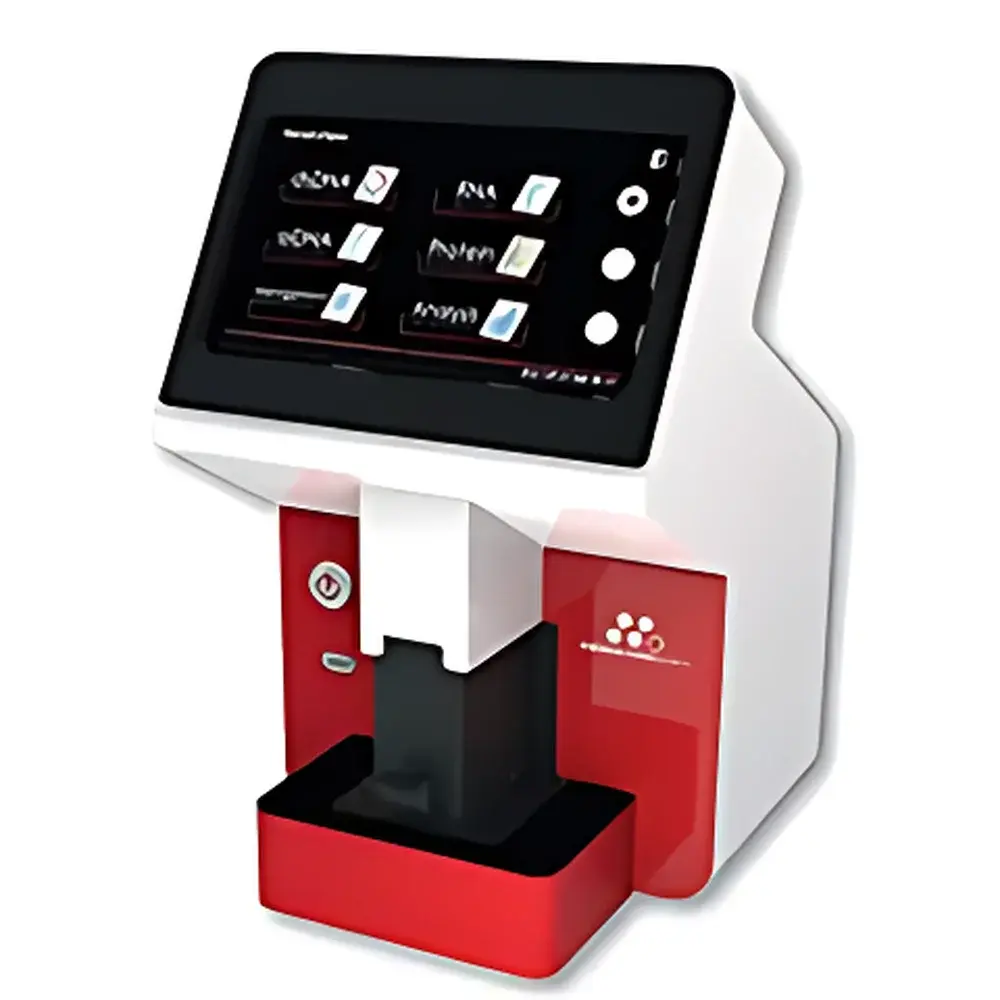
MaestroGen MaestroNano Ultra-Micro Spectrophotometer
| Brand | MaestroGen |
|---|---|
| Origin | USA |
| Manufacturer Type | Authorized Distributor |
| Product Category | Imported Instrument |
| Model | MaestroNano |
| Detection Samples | DNA, Proteins |
| Sample Holder | Integrated Fixed-Pathlength Capillary-Based Measurement Zone |
| Optical Design | Non-Fiber, Direct-Beam Path |
| Wavelengths | Fixed 230 nm, 260 nm, 280 nm, 320 nm (Reference) |
| Display & Output | Built-in Touchscreen Interface + Thermal Printer |
| Compliance | Meets ISO/IEC 17025 calibration traceability requirements for nucleic acid and protein quantification |
| Sample Volume | 0.5–2 µL |
| Pathlength | Fixed 1.0 mm (optical path calibrated at factory) |
| Data Export | USB port for CSV export |
Overview
The MaestroGen MaestroNano Ultra-Micro Spectrophotometer is an engineered solution for rapid, accurate quantification and quality assessment of nucleic acids and proteins in life science laboratories. Operating on the principle of direct-beam UV-Vis absorbance spectroscopy, the instrument eliminates reliance on fiber-optic light transmission—thereby removing a common source of long-term signal drift and calibration uncertainty associated with aging optical fibers. Its fixed-wavelength configuration (230 nm, 260 nm, 280 nm, and 320 nm reference) ensures reproducible measurement conditions aligned with standard nucleic acid (A260/A280, A260/A230) and protein (A280, A205) analysis protocols. With a fixed 1.0 mm optical pathlength and minimal sample volume requirement (0.5–2 µL), the MaestroNano delivers high sensitivity without dilution or concentration steps—critical for precious, low-yield samples generated from microscale extractions, single-cell workflows, or next-generation sequencing library preparations.
Key Features
- Integrated all-in-one architecture featuring a responsive 7-inch capacitive touchscreen interface and embedded thermal printer—enabling fully standalone operation without external computers or software installation.
- Non-fiber optical path design: Light travels directly from LED source to photodiode detector across a precisely aligned air gap, eliminating coupling losses, spectral distortion, and degradation over time.
- Dedicated sample loading platform with hydrophobic surface treatment and removable stainless-steel pedestal—designed for rapid cleaning between runs and resistance to carryover contamination.
- Factory-calibrated fixed pathlength (1.0 mm) ensures consistent Beer-Lambert law application across instruments and user sites, supporting inter-laboratory comparability and method transfer.
- On-device calculation engine automatically computes concentration (ng/µL for DNA/RNA; mg/mL for proteins), purity ratios (A260/A280, A260/A230), and % recovery estimates based on user-defined extinction coefficients.
- USB data export supports CSV-formatted reports compatible with LIMS integration and downstream statistical analysis packages (e.g., GraphPad Prism, R).
Sample Compatibility & Compliance
The MaestroNano accommodates native, unpurified, and column-eluted nucleic acid and protein samples—including genomic DNA, plasmid preps, PCR amplicons, RNA isolates, and purified recombinant proteins. It complies with foundational performance criteria outlined in ISO 8655-7 (volumetric accuracy of micropipettes used in sample delivery) and supports laboratory adherence to GLP and GMP documentation standards through timestamped, printer-generated hardcopy reports. While not FDA 21 CFR Part 11–validated out-of-the-box, its audit-ready output format and immutable report generation enable straightforward validation by end users under internal SOPs. The instrument meets traceability requirements per ISO/IEC 17025 when operated within specified environmental conditions (20–25°C, <60% RH) and calibrated using NIST-traceable reference standards.
Software & Data Management
No host computer or proprietary software is required for routine operation. All firmware, measurement logic, and report generation reside onboard. Firmware updates are delivered via USB flash drive and include version-controlled changelogs and calibration verification logs. Each measurement record includes instrument ID, date/time stamp, operator ID (optional entry), sample ID, raw absorbance values at all four wavelengths, derived metrics, and pass/fail flags against user-configurable purity thresholds (e.g., A260/A280 ≥ 1.8 for DNA). Exported CSV files contain column headers compliant with MIAME and MIAPE metadata conventions, facilitating integration into ELN systems and automated QC pipelines.
Applications
- Pre-sequencing QC of fragmented DNA and RNA libraries prior to Illumina or Oxford Nanopore loading.
- Routine verification of CRISPR gRNA integrity and concentration in gene-editing workflows.
- Quantification of low-volume eluates from FFPE tissue extractions where sample conservation is critical.
- Monitoring protein expression yield and buffer exchange efficiency during purification scale-up.
- Educational labs requiring robust, low-maintenance instrumentation for undergraduate molecular biology courses.
- QC release testing in contract research organizations supporting biopharma clients under cGMP-aligned procedures.
FAQ
Does the MaestroNano require regular recalibration by the user?
No. The fixed-pathlength, non-fiber optical system is factory calibrated and designed for long-term stability. Users perform only periodic verification using supplied quartz cuvette blanks or certified reference solutions—typically every 6 months or per internal QA schedule.
Can I measure samples containing high concentrations of guanidine or EDTA?
Yes. The 320 nm reference channel compensates for turbidity and background absorbance from chaotropic agents, enabling reliable A260/A230 assessment even in residual lysis buffer.
Is the thermal printer replaceable or serviceable in the field?
Yes. The printer module is modular and field-replaceable using standard Torx tools; replacement parts and consumables (thermal paper rolls) are stocked globally through MaestroGen’s distributor network.
What is the minimum detectable dsDNA concentration?
At 260 nm, the practical lower limit is ~2 ng/µL for a 1.0 µL sample—assuming optimal pipetting technique and clean optical surfaces. This corresponds to an absorbance of ~0.02 AU, well within the linear dynamic range of the photodiode detector.
How does the MaestroNano handle viscous or glycerol-containing samples?
The hydrophobic sample stage minimizes residual film formation; users are advised to aspirate and dispense slowly and vertically. For >10% glycerol, a post-measurement rinse with 70% ethanol is recommended to maintain baseline stability across sequential runs.





