
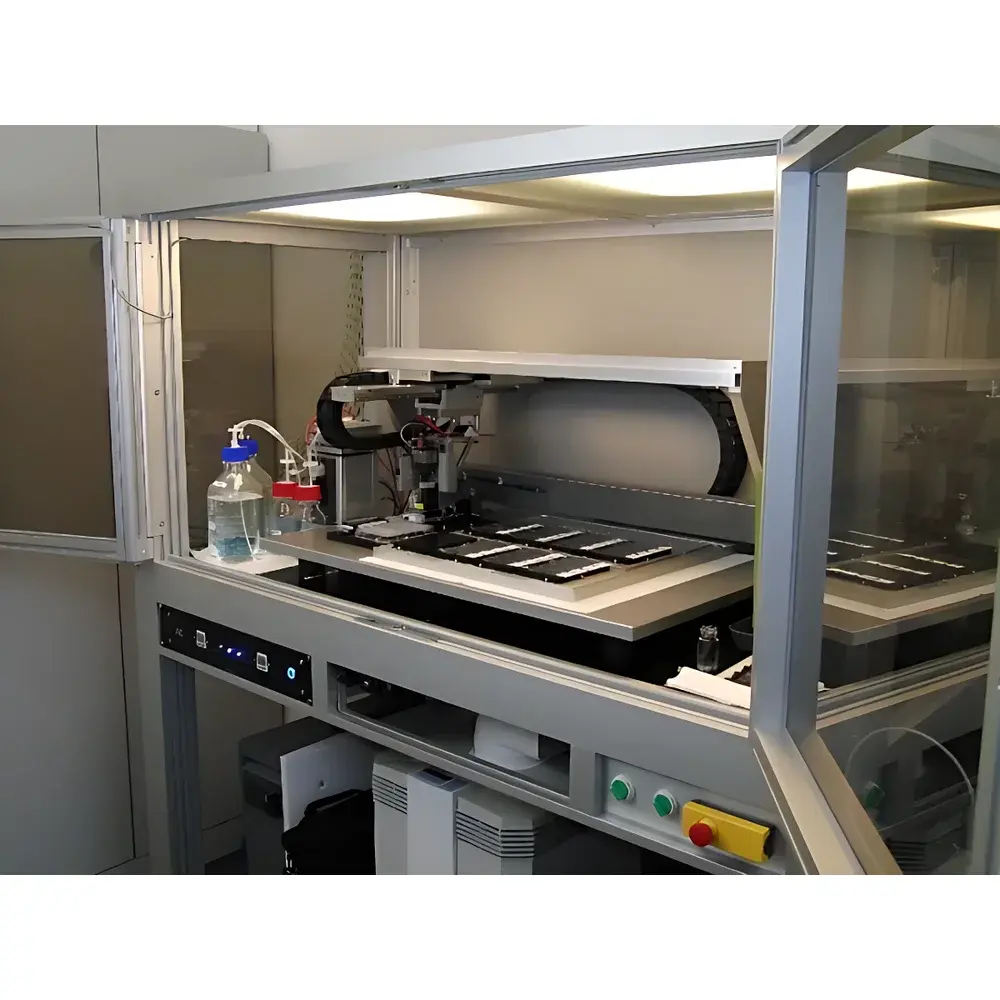
M2 Automation iONE-600 Non-Contact Microarray Spotting System
| Brand | M2 Automation |
|---|---|
| Origin | Germany |
| Model | iONE-600 |
| Spotting Technology | Non-contact piezoelectric dispensing |
| Maximum Spotting Rate | 1000 spots/sec |
| Spot Volume Range | 30 pL to 1 µL |
| Positioning Repeatability | ±3 µm |
| Maximum Stage Speed | 100 cm/s |
| Slide/Plate Capacity | 80 standard microscope slides (75 × 25 mm) |
| Spotting Precision (CV) | < 2% |
| Integrated Bubble Removal & Filtration | Yes |
| Onboard Quality Control Cameras | Top-view and droplet-view imaging |
| Environmental Control | Humidity and temperature stabilization module available |
Overview
The M2 Automation iONE-600 is a high-precision, non-contact microarray spotting system engineered for reproducible, low-volume deposition of biomolecular reagents onto diverse solid-phase substrates. Based on piezoelectric drop-on-demand (DOD) dispensing technology, the iONE-600 delivers controlled nanoliter-to-microliter volume transfers without physical contact between nozzle and substrate—eliminating cross-contamination, surface damage, and carryover risks inherent in pin-based contact spotting. Its core architecture integrates high-dynamics linear motion stages with sub-micron closed-loop positioning feedback, enabling robust spatial fidelity across large-format slide arrays. Designed for GLP-compliant laboratory environments, the system supports traceable, audit-ready operation through synchronized timestamped metadata logging and hardware-level environmental monitoring.
Key Features
- Non-contact piezoelectric dispensing platform with real-time droplet visualization via integrated high-speed liquid-jet camera
- Dual-camera QC system: top-mounted optical camera for post-spot morphology assessment and inline droplet imaging for jet integrity verification prior to deposition
- Onboard degassing and inline filtration modules ensure bubble-free sample delivery, minimizing nozzle clogging and improving spot uniformity (CV < 2%)
- Modular head compatibility: supports interchangeable dispensing technologies—including pL-range piezo nozzles, nL-scale M2MD heads, solenoid valves, and multi-channel contact pins—within a single instrument frame
- Environmental control option: programmable temperature and relative humidity regulation inside the spotting chamber to stabilize evaporation kinetics during high-density array fabrication
- High-throughput stage design accommodates up to 80 standard microscope slides (75 × 25 mm) or mixed-format microplates (96-, 384-, and 1536-well) without manual intervention
Sample Compatibility & Compliance
The iONE-600 accepts a broad spectrum of substrates including silanized glass slides, nitrocellulose membranes, polymer films, microfluidic chips, and Petri-style discs. Sample containers include standard PCR tubes, rack-mounted tube strips, and SBS-compliant microplates. All fluidic pathways are constructed from chemically inert, USP Class VI-certified materials compatible with aqueous buffers, organic solvents, and viscous glycerol-based reagents. The system complies with ISO 13485 design controls for medical device manufacturing and meets key requirements for FDA 21 CFR Part 11 compliance when configured with electronic signature and audit trail modules. Full traceability is maintained through per-spot metadata capture—including timestamp, coordinate, volume command, and QC image hash—supporting ISO/IEC 17025 and CLIA laboratory accreditation workflows.
Software & Data Management
Controlled via M2 Automation’s SpotManager™ v4.x software suite, the iONE-600 provides intuitive graphical workflow configuration, including drag-and-drop layout design, dynamic grid generation, and conditional spotting logic (e.g., skip failed wells, repeat low-intensity spots). Raw image data from both QC cameras are stored in TIFF format with embedded EXIF metadata; processed spot metrics (diameter, intensity, circularity) are exported as CSV or HDF5 for integration with downstream analysis pipelines (e.g., R/Bioconductor, Python/scikit-image). The software supports LIMS integration via RESTful API and includes built-in report generation templates aligned with ISO 15189 and CAP checklist requirements. Audit trails record all user actions, parameter changes, and calibration events with immutable timestamps.
Applications
- High-density DNA, RNA, and peptide microarray fabrication for genomics and proteomics screening
- Antibody and antigen array production for immunoassay development and clinical biomarker validation
- Cell-based assay substrates, including printed extracellular matrix (ECM) patterns for 2D/3D co-culture studies
- Microfluidic device priming and reagent pre-loading for point-of-care diagnostic cartridge manufacturing
- Quality-controlled deposition of CRISPR guide RNA libraries or siRNA pools for functional genomics platforms
- Reference material printing for metrology labs performing inter-laboratory comparison studies under ISO Guide 34
FAQ
What types of substrates can the iONE-600 spot onto?
Standard glass microscope slides, functionalized membranes (e.g., PVDF, nitrocellulose), polymer films (e.g., PMMA, PDMS), microfluidic chips, and disposable Petri-style discs.
Does the system support regulatory-compliant documentation?
Yes—when equipped with optional 21 CFR Part 11 modules, it provides electronic signatures, role-based access control, and tamper-evident audit trails meeting FDA, EMA, and PMDA requirements.
Can I switch between contact and non-contact spotting modes during a single run?
No—mode switching requires mechanical head replacement and recalibration; however, multiple heads may be pre-installed on a toolchanger turret for automated head selection between batches.
Is environmental control mandatory for routine operation?
Not mandatory, but strongly recommended for applications involving volatile solvents or low-surface-tension reagents where ambient humidity fluctuations impact spot drying kinetics and morphology.
How is spot volume accuracy verified and maintained over time?
Through daily automated gravimetric calibration using certified reference weights and periodic nozzle performance validation using fluorescent dye droplet imaging and photometric quantification.





