
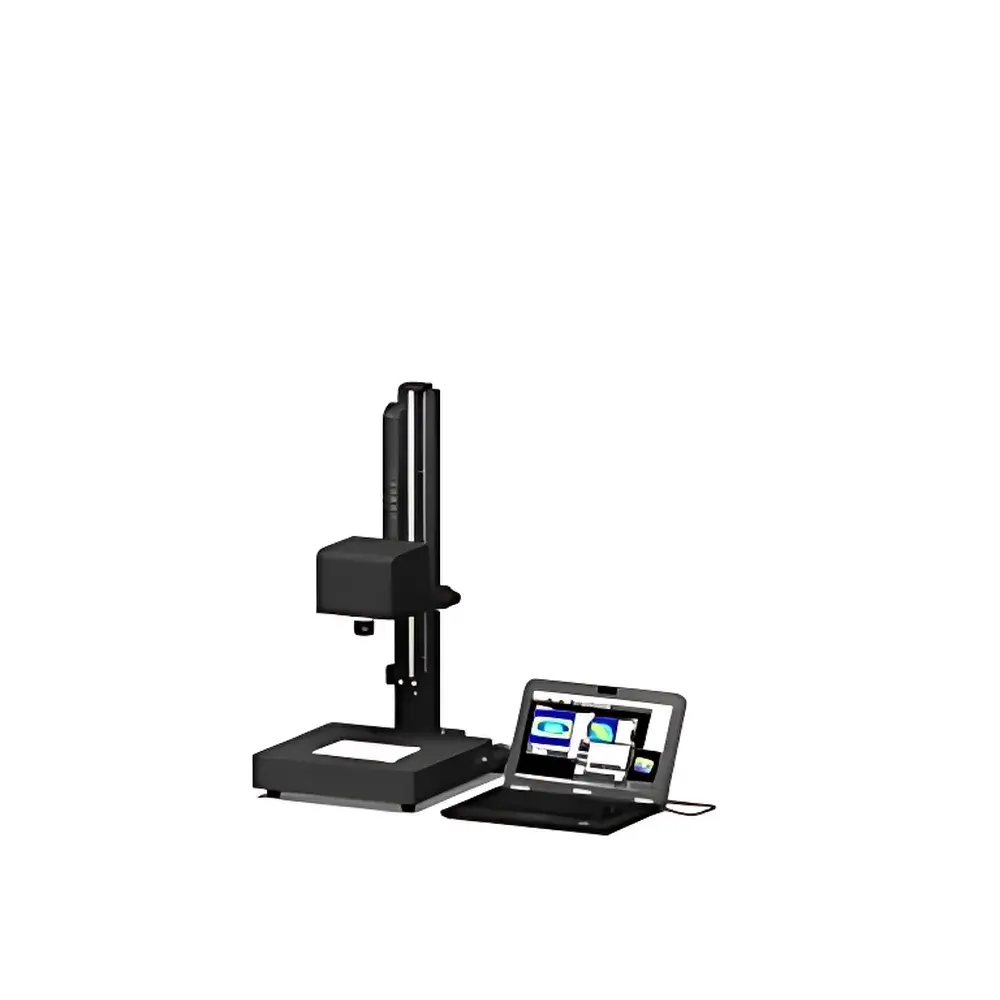
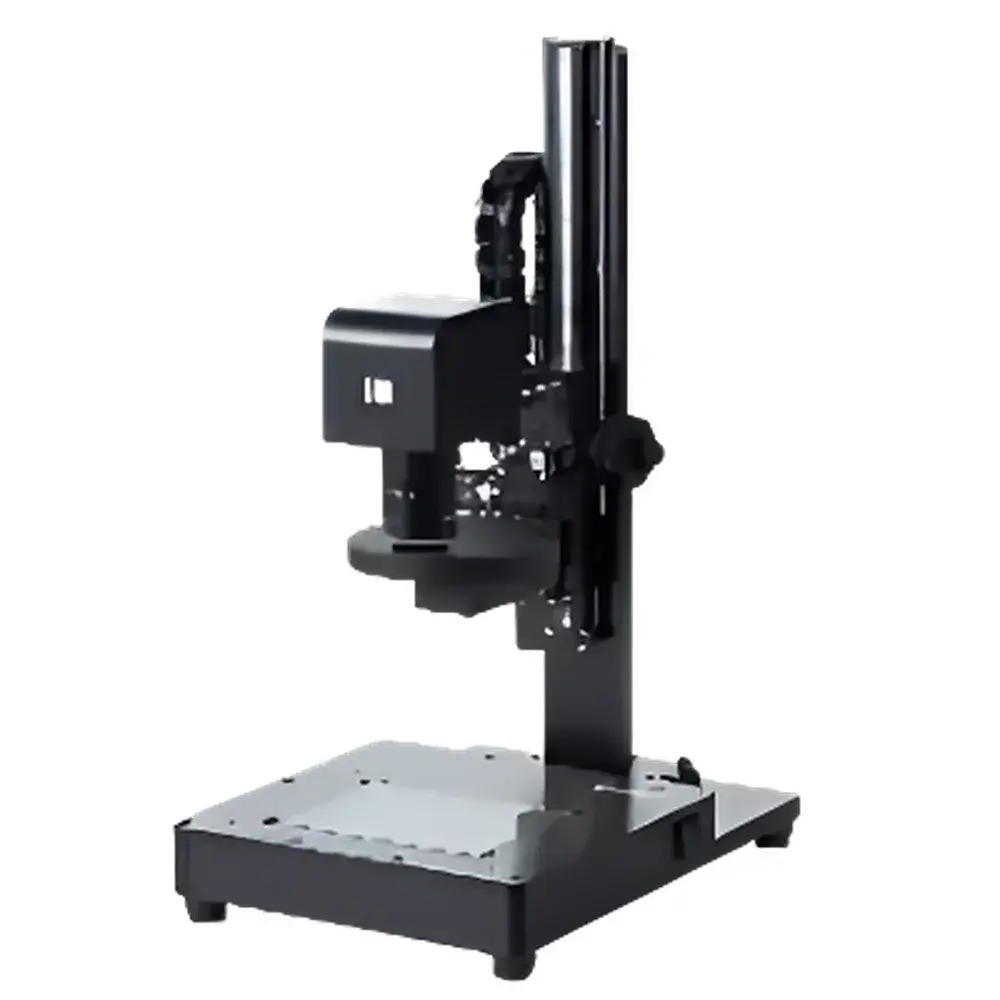
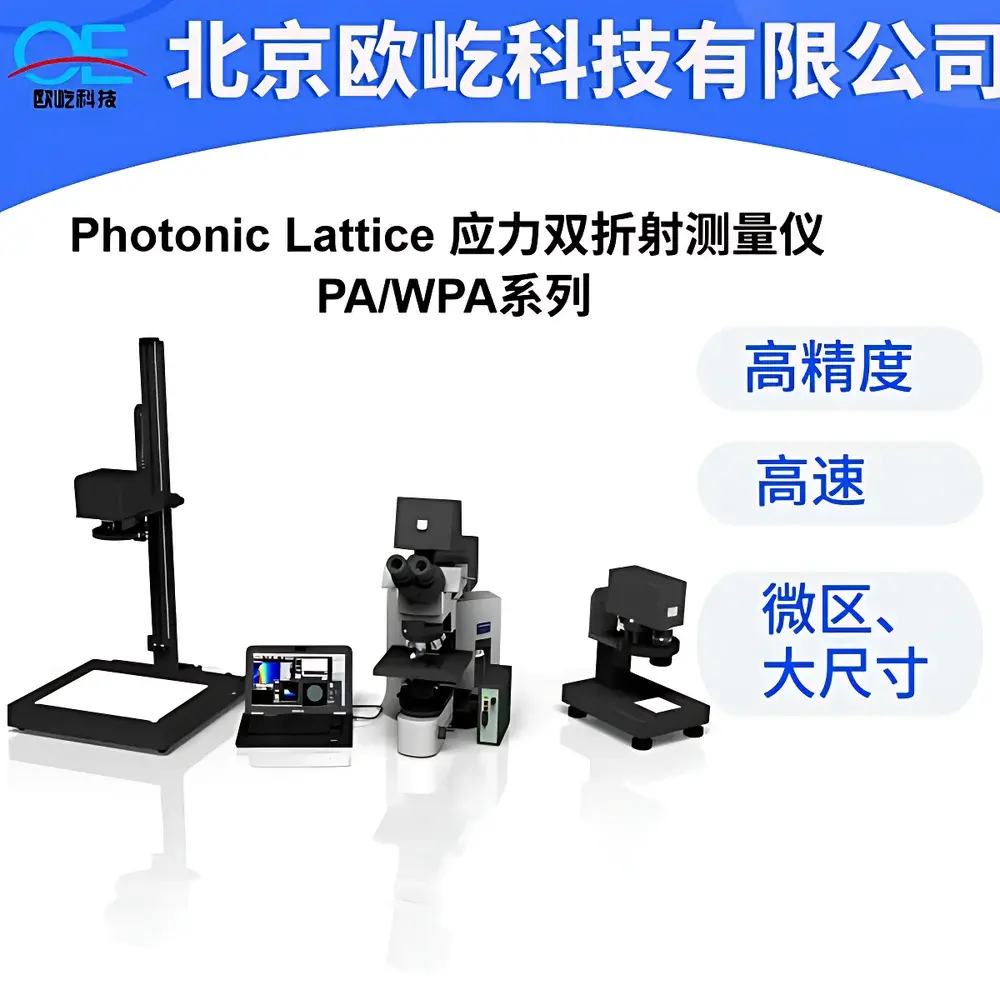
Photonic Lattice WPA-200 and WPA-200-L Full-Field Photoelastic Stress Analyzer
| Brand | Photonic Lattice |
|---|---|
| Origin | Japan |
| Model | WPA-200, WPA-200-L |
| Measurement Range | 0–3500 nm |
| Repeatability | <0.1 nm |
| Pixel Resolution | 384 × 288 |
| Measurement Wavelengths | 523 nm, 543 nm, 575 nm |
| Field of View | 100 × 136 mm (WPA-200), 250 × 340 mm (WPA-200-L) |
| Dimensions | 310 × 466 × 605.5 mm (WPA-200), 450 × 593 × 915.5 mm (WPA-200-L) |
| Weight | 20 kg (WPA-200), 26 kg (WPA-200-L) |
| Data Interface | GigE (camera), RS232C (motor control) |
| Power Supply | AC 100–240 V, 50/60 Hz |
| Software | WPA-View |
Overview
The Photonic Lattice WPA-200 and WPA-200-L are full-field, quantitative photoelastic stress analyzers engineered for high-resolution, non-contact measurement of birefringence-induced phase retardation in transparent and semi-transparent materials. Based on advanced polarization interferometry and proprietary photonic crystal optical filtering technology, these instruments operate on the principle of wavelength-resolved retardation mapping—capturing spatially resolved retardation values across the entire field of view in a single acquisition. Unlike point-scanning or slit-based systems, the WPA series employs a fixed-wavelength, multi-channel polarimetric imaging architecture that delivers simultaneous acquisition at three discrete laser wavelengths (523 nm, 543 nm, and 575 nm), enabling robust phase unwrapping and accurate quantification up to 3500 nm of optical path difference (OPD). This makes the system particularly suited for characterizing residual stress in optically isotropic materials where mechanical deformation induces transient birefringence—such as tempered glass, injection-molded polymer optics, and thin-film coated substrates.
Key Features
- Full-field, single-shot retardation mapping with 384 × 288 pixel resolution and sub-nanometer repeatability (<0.1 nm)
- Dual-model configuration: WPA-200 (100 × 136 mm FOV) and WPA-200-L (250 × 340 mm FOV) for scalable inspection of small precision optics or large-area substrates
- Triple-wavelength illumination (523 nm, 543 nm, 575 nm) optimized for dispersion-compensated phase analysis and unambiguous retardation determination beyond 2π
- Integrated motorized rotation stage with RS232C interface for automated azimuthal alignment and multi-angle stress tensor reconstruction
- Gigabit Ethernet camera interface ensuring low-latency, high-throughput image transfer compatible with industrial machine vision environments
- Robust mechanical design with vibration-damped optical baseplate and temperature-stabilized LED/laser hybrid illumination module
Sample Compatibility & Compliance
The WPA-200 series is validated for use with flat or gently curved transparent specimens up to 25 mm thickness, including soda-lime and borosilicate glass, polycarbonate, PMMA, PET films, fused silica wafers, and crystalline optical components (e.g., YAG, sapphire, calcite). It supports ISO 11146-compliant beam profiling workflows when used with calibrated reference samples and meets the optical metrology requirements outlined in ASTM C148–22 (Standard Test Method for Thermal Shock Resistance of Glass Containers) and JIS R3203 (Optical Glass Stress Birefringence Testing). The system’s measurement traceability is anchored to NIST-traceable waveplate standards, and its software architecture supports audit-ready data logging aligned with GLP and GMP documentation practices—including timestamped metadata, user authentication, and immutable raw image archiving.
Software & Data Management
WPA-View is a dedicated Windows-based application providing real-time visualization, quantitative analysis, and export functionality. It enables direct generation of 2D retardation heatmaps, line-profile extraction, vector field plotting of principal stress orientation, and CSV/TIFF export of calibrated retardation matrices. The software implements ISO/IEC 17025-aligned uncertainty estimation per pixel using propagation-of-error models derived from photon shot noise, detector readout variance, and wavelength calibration drift. Data integrity is maintained through built-in checksum validation and optional integration with enterprise LIMS via OPC UA or RESTful API extensions. All measurement sessions include embedded EXIF-like metadata (exposure time, wavelength ID, motor position, ambient temperature) to support FDA 21 CFR Part 11 compliance when configured with electronic signature modules.
Applications
- Residual stress mapping in smartphone cover glass post-cutting and edge grinding to optimize tool life and prevent microcrack propagation
- Quality screening of HUD combiner lenses and AR waveguide substrates for uniformity of birefringence-induced image distortion
- In-process monitoring of annealing homogeneity in float-glass substrates prior to ITO sputtering
- Stress gradient evaluation in molded acrylic light guides and optical diffusers used in automotive lighting
- Failure root-cause analysis of delamination in multilayer polymer film stacks under thermal cycling
- Pre-bonding stress assessment of silicon-on-insulator (SOI) wafers and bonded quartz substrates
FAQ
What types of materials can be measured with the WPA-200 series?
Transparent and semi-transparent dielectrics exhibiting stress-induced birefringence—including optical glasses, thermoplastics, crystals, and thin-film-coated substrates—with thicknesses ranging from 0.1 mm to 25 mm.
Does the system require sample preparation or coating?
No surface treatment, etching, or coating is required. Measurements are performed in transmission mode with minimal sample handling.
Can the WPA-200-L accommodate curved or non-planar samples?
It supports gently curved surfaces (radius > 500 mm) within the depth-of-field tolerance; for highly aspheric parts, optional telecentric lens adapters are available.
Is calibration traceable to international standards?
Yes—factory calibration uses NIST-traceable quarter-wave and half-wave reference plates; annual recalibration services include uncertainty reporting per ISO/IEC 17025.
How is measurement data secured and archived?
Raw images and processed maps are stored with SHA-256 hash signatures; WPA-View supports encrypted database export and configurable retention policies compliant with 21 CFR Part 11 Annex 11 requirements.



