
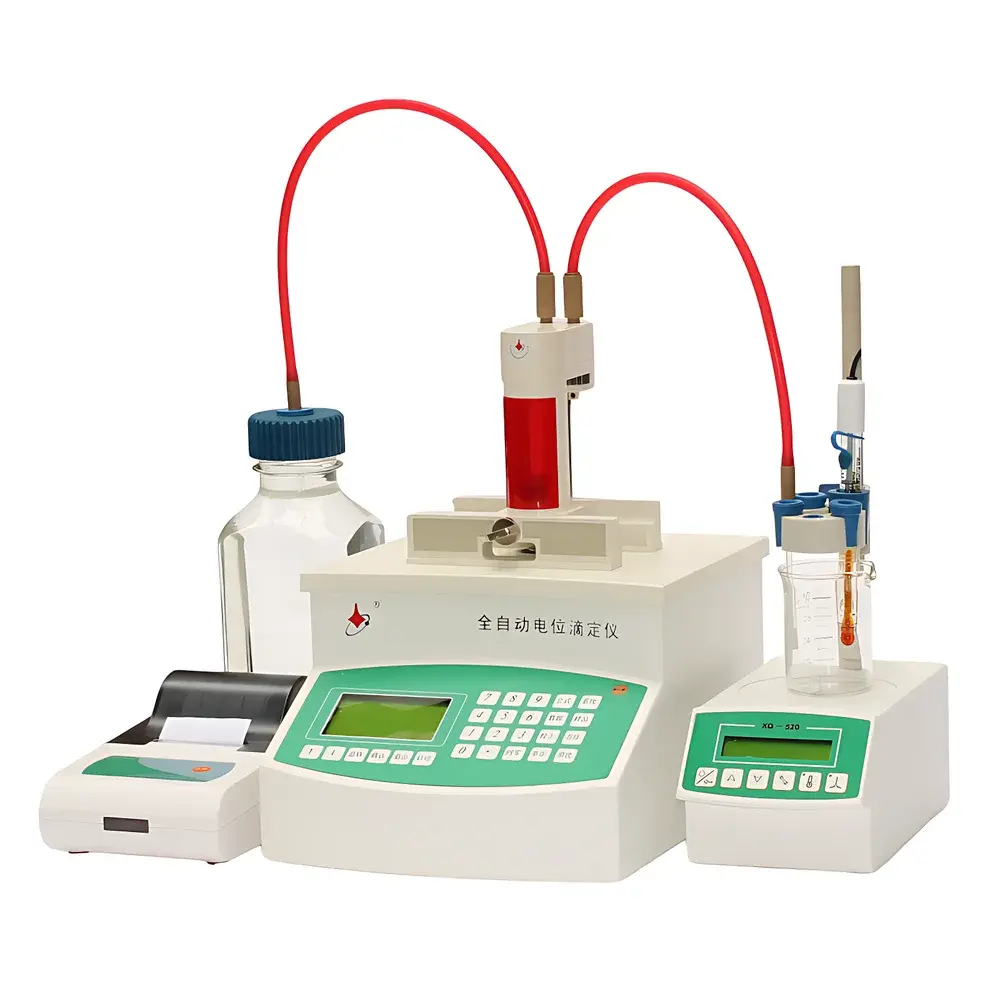
Forerunner ZDJ-3Y Automatic Dead-Stop Titration System
| Brand | Forerunner |
|---|---|
| Origin | Beijing, China |
| Manufacturer Type | Authorized Distributor |
| Instrument Type | General-Purpose Potentiometric Titrator |
| Application Scope | Universal |
| Measurement Range | −1999.0 to +1999.0 mV |
| Meter Accuracy | ±0.2% of full scale |
| Meter Resolution | 1 mV (mV mode) |
| Titration Accuracy | ±0.3 mV ±1 digit over 3 h |
| Titration Resolution | 1/20000 |
| Regulatory Compliance | Certified per JJG 814–2015 (Chinese National Metrological Verification Regulation), GMP-compliant design |
Overview
The Forerunner ZDJ-3Y Automatic Dead-Stop Titration System is a precision electrochemical endpoint detection instrument engineered for reproducible, high-throughput volumetric analysis in regulated and research laboratory environments. Unlike conventional potentiometric titrators that rely on inflection-point detection in continuous potential curves, the ZDJ-3Y implements the dead-stop (biamperometric) principle: it applies a constant low voltage (typically 10–50 mV) across two identical platinum indicator electrodes immersed in the analyte solution and monitors the resulting current. At the equivalence point—such as in Karl Fischer water determination, nitrite titration, or diazotization reactions—the abrupt change in redox species concentration causes a sharp, irreversible current rise, triggering automatic termination of titrant delivery. This method delivers superior endpoint discrimination for reactions with shallow or asymmetric potential transitions where traditional potentiometric detection may yield ambiguous results.
Key Features
- Integrated dual-platinum electrode system with optimized geometry for stable current baseline and rapid response to redox discontinuities
- Microprocessor-controlled titration drive with 1/20000 syringe resolution, enabling precise reagent dosing down to 0.05 µL increments (when paired with standard 10 mL burette)
- Real-time mV/pH monitoring with simultaneous dual-channel display (potential vs. time; current vs. time) for endpoint validation
- Onboard data management: stores up to 200 complete titration records with timestamp, sample ID, operator code, endpoint value, and titrant consumption
- Three-minute average analysis cycle time per sample under standard conditions (including electrode rinsing, dosing, and endpoint stabilization)
- Hermetically sealed reagent delivery path with PTFE-coated valves and gas-tight couplings—validated for use with hygroscopic or volatile titrants including Karl Fischer reagents
- Fully Chinese-language UI with UTF-8 compliant character rendering, supporting GB18030 encoding for technical terminology and regulatory documentation
Sample Compatibility & Compliance
The ZDJ-3Y accommodates aqueous, non-aqueous, and mixed-solvent matrices across pharmaceutical, food, petrochemical, and environmental testing workflows. It is routinely deployed for pharmacopeial methods requiring dead-stop detection—including USP Water Determination (Karl Fischer), EP 2.5.12 Nitrite Assay, and ISO 12929:2012 for residual chloramine quantification. The system meets JJG 814–2015 metrological verification requirements for automatic titrators and incorporates design elements aligned with GMP Annex 11 principles: audit-trail-capable operation logs, user-level access control (three-tier privilege model), and electronic signature support via optional USB keyboard integration. While not pre-certified to FDA 21 CFR Part 11, its architecture supports validation protocols required for regulated environments through configurable event logging and immutable record export (CSV/USB).
Software & Data Management
Data acquisition and reporting are handled by embedded firmware with no external PC dependency. All measurements are timestamped using an internal RTC (real-time clock) backed by non-volatile memory. The instrument supports direct thermal printing of calibration reports, titration curves (mV/time or current/time), and statistical summaries—including mean, SD, RSD, and confidence intervals—for up to 20 parallel samples within a single batch. Export functionality enables transfer of raw and processed datasets to external systems via USB mass storage mode. Firmware updates are performed offline using FAT32-formatted USB drives, ensuring operational continuity during QA/QC maintenance cycles.
Applications
- Karl Fischer coulometric and volumetric water content determination in APIs, excipients, and lyophilized products
- Nitrite and nitrate quantification in meat products and drinking water per AOAC 973.42 and EPA Method 353.2
- Diazotization titrations for aromatic amine assays in dye intermediates and polymer precursors
- Redox titrations involving Ce⁴⁺/Fe²⁺, I₂/ascorbic acid, or KBrO₃/bromide systems where endpoint current jumps exceed 5 nA
- In-process control of electroplating bath composition (e.g., nickel sulfamate, copper pyrophosphate)
FAQ
What distinguishes dead-stop titration from potentiometric titration?
Dead-stop titration uses constant-voltage biamperometry to detect current discontinuity at the equivalence point, offering higher sensitivity for reactions with weak potential gradients—where potentiometric methods may misidentify endpoints due to slow electrode response or junction potential drift.
Is the ZDJ-3Y suitable for GLP-compliant laboratories?
Yes—its built-in audit trail, sample traceability features, and GMP-aligned hardware architecture support GLP validation when implemented with documented SOPs and periodic performance verification per ISO/IEC 17025 clause 6.4.
Can the instrument be integrated into LIMS environments?
Direct LIMS integration is not supported out-of-the-box; however, exported CSV files contain all metadata required for manual or scripted ingestion into common LIMS platforms (e.g., LabWare, Thermo SampleManager).
Does the system require routine calibration with certified reference materials?
Yes—electrode zero-current offset verification and mV linearity checks using NIST-traceable buffer solutions (e.g., pH 4.01, 7.00, 10.01) are recommended before each analytical batch per ASTM E2064.




