
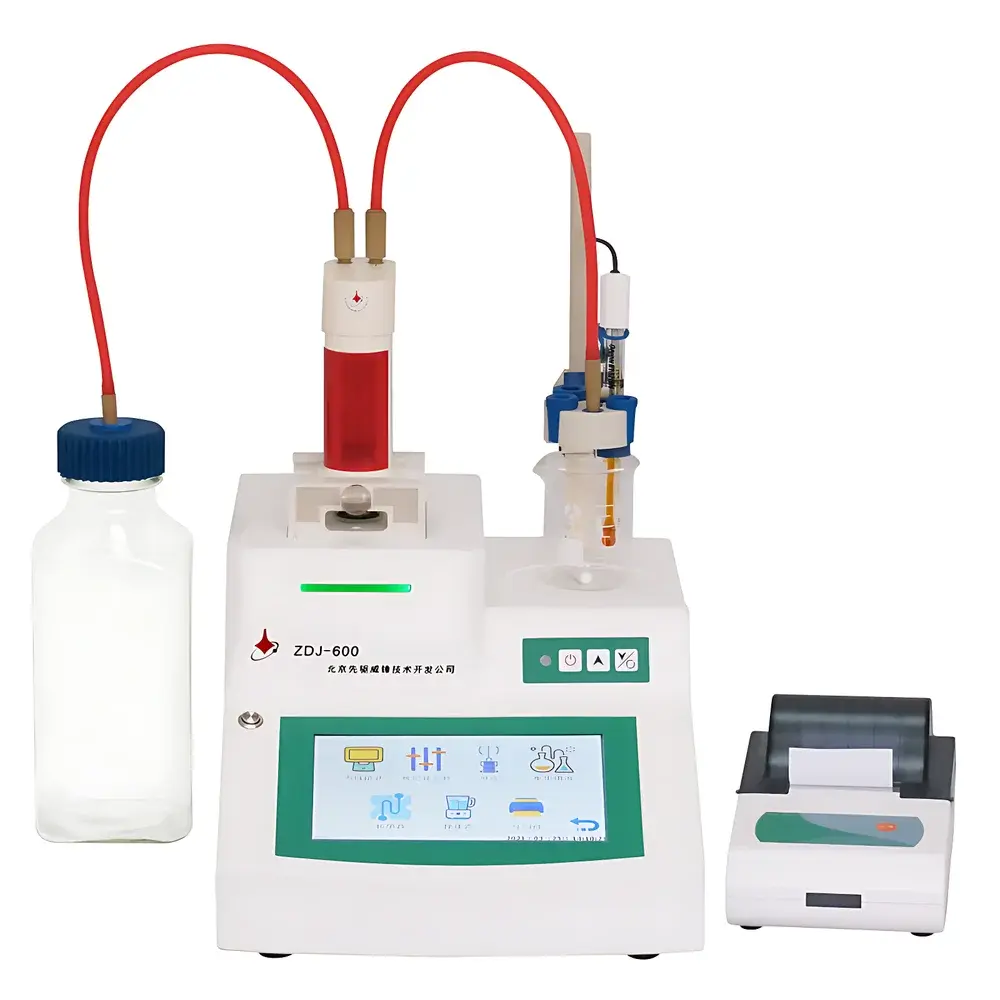
Forerunner ZDJ-600 Automatic Potentiometric Titrator
| Brand | Forerunner |
|---|---|
| Origin | Beijing, China |
| Model | ZDJ-600 |
| Measurement Range | ±2400 mV / ±20 pH |
| Meter Accuracy | 0.01 mV / 0.001 pH |
| Meter Resolution | 0.01 mV / 0.001 pH |
| Titration Accuracy | ±10 µL (at 10 mL) |
| Titration Resolution | 1/20000 |
| Overall Accuracy | ±0.1% |
| Precision | ≤0.1% |
| Input Impedance | ≥3×10¹² Ω |
| Input Current | ≤1×10⁻¹² A |
| Temperature Range | 0–125 °C |
| Temperature Resolution | 0.1 °C |
| Temperature Accuracy | ±0.3 °C |
| Humidity Range | 10–85% RH |
| Humidity Resolution | 1% RH |
| Humidity Accuracy | ±5% RH |
| Titration Speed | 1–99 mL/min (adjustable) |
| Titration Tube Mounting | Tool-free replacement |
Overview
The Forerunner ZDJ-600 Automatic Potentiometric Titrator is an integrated, GxP-ready electrochemical analysis platform engineered for precision, traceability, and multi-modal titration in regulated laboratory environments. It operates on the fundamental principle of potentiometric endpoint detection—measuring the potential difference between a reference electrode and an indicator electrode as titrant is incrementally delivered into the analyte solution. This voltage shift, governed by the Nernst equation, enables quantitative determination of equivalence points with high reproducibility across acid-base, redox, complexometric, precipitation, and non-aqueous titrations. Unlike legacy analog systems, the ZDJ-600 embeds digital signal acquisition at the electrode interface, eliminating analog-to-digital conversion losses and supporting simultaneous real-time monitoring of pH, mV, ion activity, and temperature. Its architecture complies with core metrological requirements defined in ISO 8655-2 (volumetric apparatus) and JJG 814 (titrator verification), while its hardware and firmware design align with the data integrity expectations of FDA 21 CFR Part 11, EU Annex 11, and ICH GCP/GLP frameworks.
Key Features
- Digital electrode interface with BNC, banana jack, and aviation connector support—compatible with analog and digital pH, redox, ion-selective, photometric, and thermometric sensors from global manufacturers
- High-precision borosilicate glass burette with low thermal expansion coefficient; delivers volumetric accuracy of ±10 µL at 10 mL (equivalent to ≤0.1% relative error), exceeding ISO 8655-2 Class A tolerances
- 1/20000 volumetric resolution enabled by ceramic-based high-integration control circuitry and closed-loop stepper motor actuation
- 7-inch capacitive color touchscreen running Windows CE embedded OS—supports multi-language UI (English, Chinese, Spanish, German), customizable workflow icons, and password-protected user roles with biometric login option
- Real-time adaptive titration algorithms including Dynamic Endpoint Titration (DET), Metrological Endpoint Titration (MET), Set-Endpoint Titration (SET), and Manual Titration (MAT)
- On-device audit trail generation: every action—including method execution, parameter change, result acceptance/rejection, and data export—is timestamped, user-attributed, and cryptographically secured without external PC dependency
Sample Compatibility & Compliance
The ZDJ-600 supports diverse sample matrices—from aqueous buffers and organic solvents to viscous pharmaceutical suspensions and industrial effluents—through configurable titration parameters and interchangeable electrode modules. It accommodates standard ASTM E2087 (potentiometric titration of acids/bases), ISO 9001-certified calibration protocols, and USP pH measurement guidelines. All electronic records adhere to ALCOA+ principles (Attributable, Legible, Contemporaneous, Original, Accurate, Complete, Consistent, Enduring, Available) and support full GMP/GxP validation packages, including IQ/OQ/PQ documentation, electronic signature workflows, and role-based access control (RBAC) with session timeout and password expiration policies.
Software & Data Management
Data acquisition, processing, and reporting are fully embedded within the instrument’s local OS—no host PC required for routine operation. Raw sensor signals undergo dual-precision floating-point computation and high-frequency digital filtering to suppress noise and preserve significant figures. Statistical evaluation includes mean, SD, RSD, confidence intervals, and outlier detection per ICH Q2(R2). Reports export natively to PDF, TXT, DOCX, XLSX, and WPS formats and can be saved to USB storage, network shares (via RJ45/WLAN), or directly to LIMS through HL7 or ASTM E1384-compliant interfaces. Audit logs are immutable, searchable by operator, date range, method ID, or sample ID, and exportable in CSV for third-party review or regulatory submission.
Applications
- Pharmaceutical QC: assay of active ingredients (e.g., aspirin hydrolysis, amine salt quantification), residual solvent titration, and excipient purity verification
- Food & Beverage: titratable acidity in dairy, wine, and fruit juices; chloride content via argentometric titration; peroxide value in oils
- Environmental Testing: alkalinity and hardness profiling in wastewater; cyanide and fluoride determination using ion-selective electrodes
- Chemical Manufacturing: catalyst concentration control, acid number (AN) and base number (BN) in lubricants per ASTM D974/D664
- Academic Research: kinetic endpoint studies, multi-step titration curves, and method development for novel electrode configurations
FAQ
Does the ZDJ-600 comply with FDA 21 CFR Part 11 requirements for electronic records and signatures?
Yes—the system implements built-in electronic signatures, audit trail logging, user authentication (password + optional biometric), and data immutability without requiring external software or server infrastructure.
Can it interface directly with laboratory information management systems (LIMS)?
Yes—via Ethernet (RJ45), WLAN, or RS232/RS485 serial protocols using ASTM E1384, HL7, or custom ASCII-delimited formats.
What electrode types are supported out of the box?
Standard pH glass electrodes, Ag/AgCl reference electrodes, platinum redox electrodes, silver/sulfide ISEs, and photometric flow cells—all connected via BNC or dedicated analog/digital ports.
Is method validation support included?
Yes—the instrument ships with pre-validated IQ/OQ protocols, calibration templates aligned with ISO/IEC 17025, and traceable reference standards documentation for GMP audits.
How is temperature compensation handled during pH and ion measurements?
Integrated Pt1000 RTD sensor provides real-time temperature input; automatic Nernst slope correction is applied per IUPAC recommendations, with configurable linear or non-linear compensation models.





