
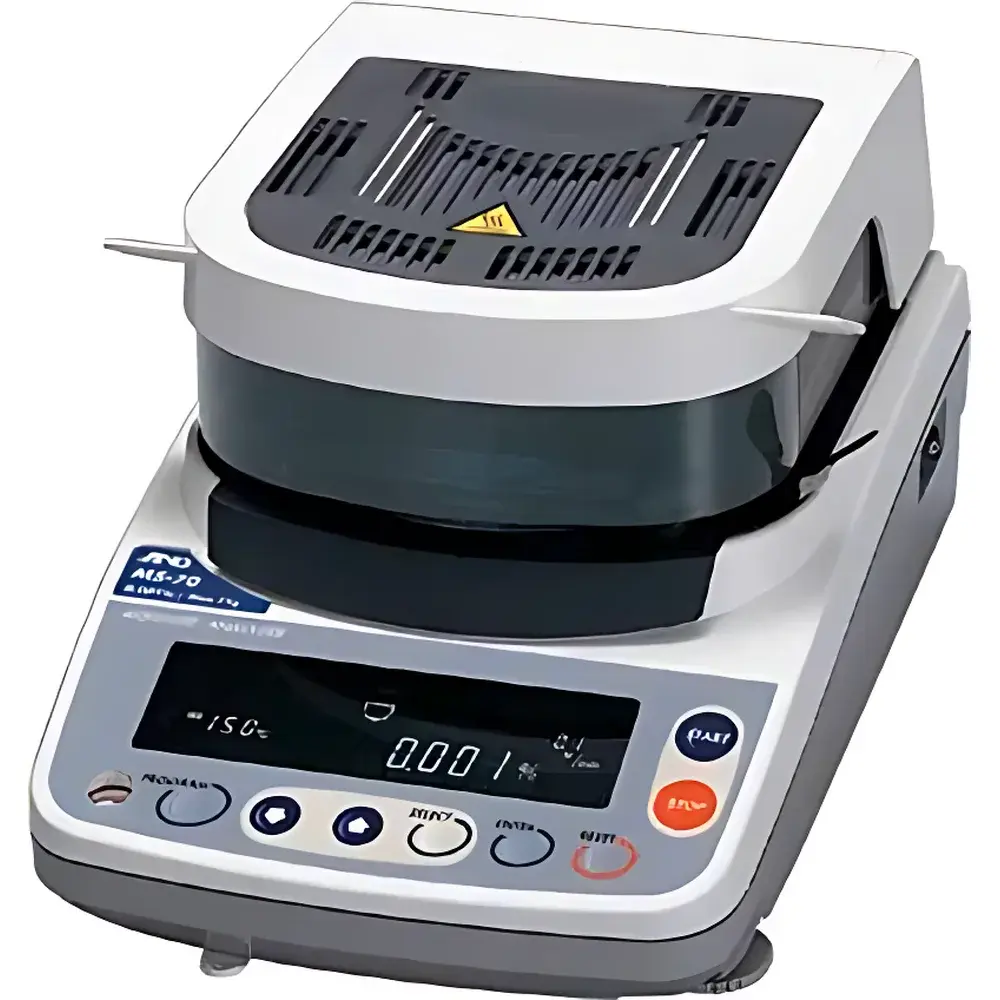
A&D MS-70 Halogen Moisture Analyzer
| Brand | A&D |
|---|---|
| Origin | Japan |
| Model | MS-70 |
| Heating Source | 400 W Halogen Lamp |
| Weighing Range | 71 g |
| Readability | 0.0001 g |
| Moisture Content Resolution | 0.001 % / 0.01 % / 0.1 % |
| Temperature Range | 30–200 °C |
| Sample Pan Diameter | 85 mm |
| Dimensions (W×D×H) | 215 × 320 × 173 mm |
| Weight | 6.0 kg |
| Compliance | GLP/GMP/ISO-compliant data logging, RS-232 interface, WinCT-Moisture software support |
Overview
The A&D MS-70 Halogen Moisture Analyzer is a precision laboratory instrument engineered for rapid, gravimetric determination of moisture content in solid, granular, powdered, pasty, and liquid samples. It operates on the loss-on-drying (LOD) principle: a pre-weighed sample is heated under controlled halogen lamp irradiation; mass loss due to volatilization of water and other volatile components is continuously monitored by a high-resolution electromagnetic force compensation balance. The final moisture content is calculated as a percentage of the initial mass, with results traceable to certified reference materials such as disodium tartrate dihydrate (15.66 % ± 0.3 / −0.1 % H₂O). Designed and manufactured in Japan, the MS-70 integrates SRA (Secondary Radiation Auxiliary) technology—comprising a linear halogen tube and optimized reflector geometry—to deliver uniform thermal distribution across the sample surface, minimizing thermal gradients and improving repeatability. Its 400 W halogen heating system enables fast ramp-up and stable temperature maintenance within ±1 °C accuracy over the full 30–200 °C operating range.
Key Features
- SRA-enhanced halogen heating system ensures rapid, homogeneous sample drying—reducing typical measurement time by up to 40 % compared to conventional infrared heaters.
- SHS (Super High Sensitivity) electromagnetic force compensation weighing sensor with 0.0001 g readability supports accurate moisture quantification even for sub-gram samples (minimum sample mass: 0.1 g).
- Five programmable measurement modes: Standard (adaptive endpoint detection), Automatic (termination upon user-defined moisture change rate threshold), Rapid (200 °C preheat for first 3 min), Timer-based, and Manual.
- Four drying profile options: Standard, Progressive (stepwise ramp), Stepwise (multi-stage temperature sequencing), and Quick (200 °C burst followed by target temperature hold).
- Onboard storage for up to 20 customized test methods and 100 measurement records—with timestamp, operator ID, calibration history, and environmental metadata embedded per entry.
- Ergonomic wing-style lid handle and heat-resistant sample pan grip minimize operator exposure during hot-sample handling.
- Modular design allows field replacement of halogen lamp (rated lifetime: ~5,000 h) without instrument downtime or recalibration.
Sample Compatibility & Compliance
The MS-70 accommodates diverse physical forms—including powders (e.g., pharmaceutical excipients), pellets (e.g., animal feed), viscous suspensions (e.g., paint bases), and low-viscosity liquids (e.g., solvents)—within its 85 mm diameter stainless-steel sample pan. All measurements adhere to internationally recognized gravimetric standards referenced in ASTM D4457, ISO 15512, and USP . Data integrity is maintained through GLP/GMP-compliant audit trails: each report includes date/time stamp, user ID, calibration certificate ID, ambient temperature/humidity (when connected to optional external sensors), and full raw mass-vs.-time datasets. Instrument validation documentation supports 21 CFR Part 11 readiness when paired with WinCT-Moisture software and networked PC environments.
Software & Data Management
WinCT-Moisture software (included on CD-ROM) provides real-time graphical visualization of mass loss kinetics, enabling empirical optimization of drying parameters for unknown matrices. Users can overlay multiple curves, annotate inflection points, and export CSV/TXT/Excel-compatible reports with embedded metadata. Software-generated certificates conform to ISO/IEC 17025 reporting requirements, including uncertainty estimation per GUM guidelines. Bidirectional RS-232 communication permits remote instrument control, automated method deployment, and scheduled data archiving—critical for centralized QC laboratories operating under regulated quality systems.
Applications
The MS-70 serves analytical workflows across regulated and industrial sectors: moisture verification of active pharmaceutical ingredients (APIs) and tablet granules per USP ; residual solvent analysis in polymer resins; water activity screening in cereal-based food products; consistency control of lithium-ion battery electrode slurries; and incoming raw material inspection for catalysts, pigments, and mineral concentrates. Its ability to resolve moisture differences down to 0.001 % makes it suitable for R&D applications requiring high-resolution kinetic profiling—such as studying dehydration mechanisms in hydrogels or starch gelatinization onset temperatures.
FAQ
What reference standard is used for accuracy verification?
Disodium tartrate dihydrate (C₄H₄Na₂O₆·2H₂O), certified at 15.66 % ± 0.3 / −0.1 % moisture content, is supplied with each MS-70 unit for routine performance checks.
Is temperature calibration supported?
Yes—optional AX-MX-43 temperature calibration kit enables NIST-traceable verification and generates GLP/GMP-compliant calibration reports.
Can the MS-70 connect to LIMS or ERP systems?
Via RS-232 serial interface and WinCT-Moisture’s ASCII output protocol, raw data and summary reports can be integrated into enterprise data management platforms using standard middleware.
What maintenance is required beyond lamp replacement?
No periodic mechanical recalibration is needed; only routine cleaning of the heating chamber and sample pan with lint-free wipes and isopropyl alcohol is recommended between analyses.
Does the instrument meet FDA 21 CFR Part 11 requirements?
When deployed with WinCT-Moisture v3.0+ on a validated Windows OS environment—including electronic signatures, audit trail review functions, and role-based access controls—the system satisfies core Part 11 criteria for electronic records and signatures.




