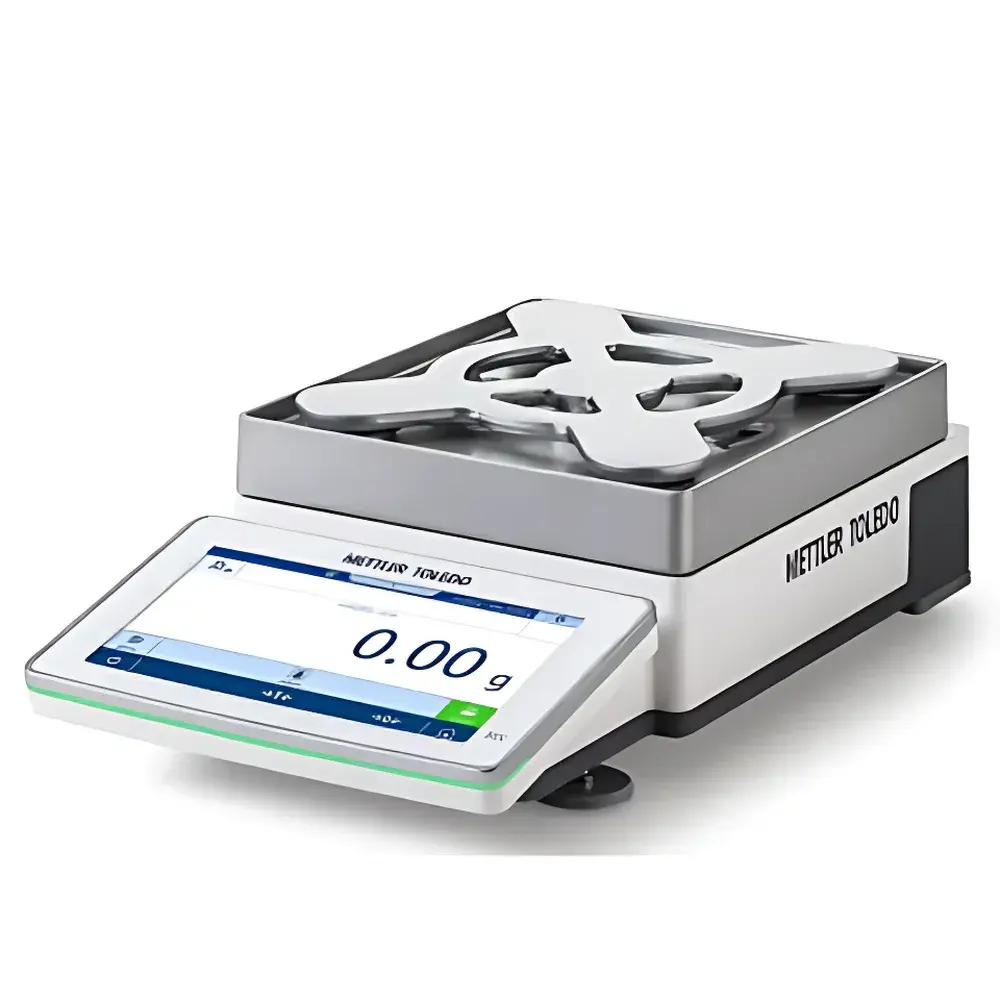
METTLER TOLEDO MX6002 Precision Balance
| Brand | METTLER TOLEDO |
|---|---|
| Max Capacity | 32 kg |
| Readability | 1 mg |
| Protection Class | IP54 |
| Compliance | GxP-ready, FDA 21 CFR Part 11 compatible (with optional software), ISO/IEC 17025 support |
| Connectivity | RS232, USB, Ethernet, Bluetooth (optional) |
Overview
The METTLER TOLEDO MX6002 Precision Balance is an industrial-grade analytical weighing instrument engineered for laboratories and quality control environments requiring high repeatability, traceable accuracy, and regulatory compliance. Utilizing a high-stability electromagnetic force compensation (EMFC) sensor architecture, the MX6002 delivers consistent 1 mg readability across its full 32 kg capacity range—optimized for applications demanding both macro-scale mass determination and fine-grained resolution. Its design integrates core metrological principles defined in OIML R 76 and ASTM E898, ensuring performance stability under variable ambient conditions. The balance operates within a temperature-compensated measurement loop, minimizing drift due to thermal gradients, and features built-in diagnostics that continuously monitor sensor health and mechanical integrity.
Key Features
- SmartPan™ Technology: A patented draft shield-integrated weighing pan system that dampens air currents and floor vibrations, reducing settling time by up to 40% compared to conventional platforms—critical for high-throughput QC labs operating near HVAC units or shared lab floors.
- StatusLight™ Visual Feedback System: A three-color LED ring surrounding the display provides at-a-glance confirmation of operational status (green = ready, yellow = warning, red = error), eliminating ambiguity during multi-user workflows.
- GxP-Ready Firmware Architecture: Supports role-based user access control, electronic signatures, and audit-trail generation for all critical events—including calibration, adjustment, test execution, and data export—aligned with FDA 21 CFR Part 11 requirements when used with LabX® or MT-SICS software.
- Automated Internal Test Scheduling: Users define custom periodic verification protocols (e.g., daily zero check, weekly linearity test) based on internal SOPs or ISO/IEC 17025 clause 6.5.2; the balance triggers alerts and logs outcomes automatically.
- Multi-Protocol Connectivity: Native RS232, USB Device/Host, and Ethernet interfaces enable seamless integration with LIMS, ELN, and MES systems; optional Bluetooth 5.0 module supports wireless connection to mobile tablets for decentralized documentation.
- Energy-Efficient Design: Configurable power management includes adaptive sleep mode, scheduled shutdown, and low-power standby—reducing annual energy consumption by ~35% versus legacy models without compromising warm-up stability.
Sample Compatibility & Compliance
The MX6002 accommodates diverse sample forms—from bulk powders and granular solids to packaged reference standards and wet containers—thanks to its large 220 mm × 220 mm stainless steel pan and optional draft shield configurations. It meets IP54 ingress protection standards, offering resistance to dust accumulation and incidental water splashes during routine cleaning. Regulatory alignment includes full support for ISO/IEC 17025:2017 (clause 6.4 on equipment validation), USP and for pharmaceutical weighing, and EU Annex 11 for computerized system validation. Calibration certificates are traceable to NIST and PTB standards via METTLER TOLEDO’s accredited service network.
Software & Data Management
When paired with METTLER TOLEDO’s LabX® software, the MX6002 enables centralized method deployment, real-time data capture, and automated report generation compliant with ALCOA+ principles (Attributable, Legible, Contemporaneous, Original, Accurate, Complete, Consistent, Enduring, Available). All weighing events—including tare, net weight, statistics, and pass/fail decisions—are timestamped, user-identified, and cryptographically signed. Raw data exports support CSV, PDF, XML, and SDMX formats, with configurable metadata fields for batch ID, sample ID, location, and environmental conditions (when connected to external sensors).
Applications
- Pharmaceutical formulation: Active pharmaceutical ingredient (API) dispensing, excipient blending verification, and stability study sample preparation per ICH Q5C guidelines.
- Chemical manufacturing: Catalyst charge verification, reagent proportioning in batch reactors, and raw material receipt inspection against ASTM D6300 specifications.
- Food & beverage QA: Net content compliance testing per FDA 21 CFR 101.105, moisture loss monitoring during drying trials, and portion control validation.
- Academic research: Gravimetric analysis in materials science labs, catalyst loading quantification in heterogeneous catalysis studies, and standard reference material (SRM) handling.
- Contract testing organizations (CTOs): Method transfer support with documented uncertainty budgets and inter-instrument comparability reports.
FAQ
What is the recommended calibration frequency for the MX6002 in a GLP environment?
Calibration intervals must be risk-assessed per ISO/IEC 17025:2017 clause 6.5.2; typical practice involves daily verification using certified weights and full recalibration every 3–6 months, depending on usage intensity and process criticality.
Does the MX6002 support direct connection to ERP systems like SAP or Oracle?
Yes—via Ethernet or RS232 with middleware integration (e.g., OPC UA or custom API wrappers); LabX® also provides native SAP ECC and S/4HANA connectors for automated master data synchronization.
Can the SmartPan™ function be disabled for specialized weighing fixtures?
SmartPan™ is hardware-integrated and cannot be disabled, but its algorithm adapts dynamically to non-standard pans or fixtures mounted on the platform, preserving stability performance.
Is internal calibration available on the MX6002 model?
No—the MX6002 relies on external calibration weights; internal motorized calibration is available only on higher-tier XP and XSE series balances.
How does the MX6002 handle electrostatic interference during powder weighing?
It incorporates active electrostatic discharge (ESD) compensation circuitry and recommends use with grounded anti-static mats and ionizers per ASTM D257; the EMFC sensor design inherently minimizes charge-induced drift.