
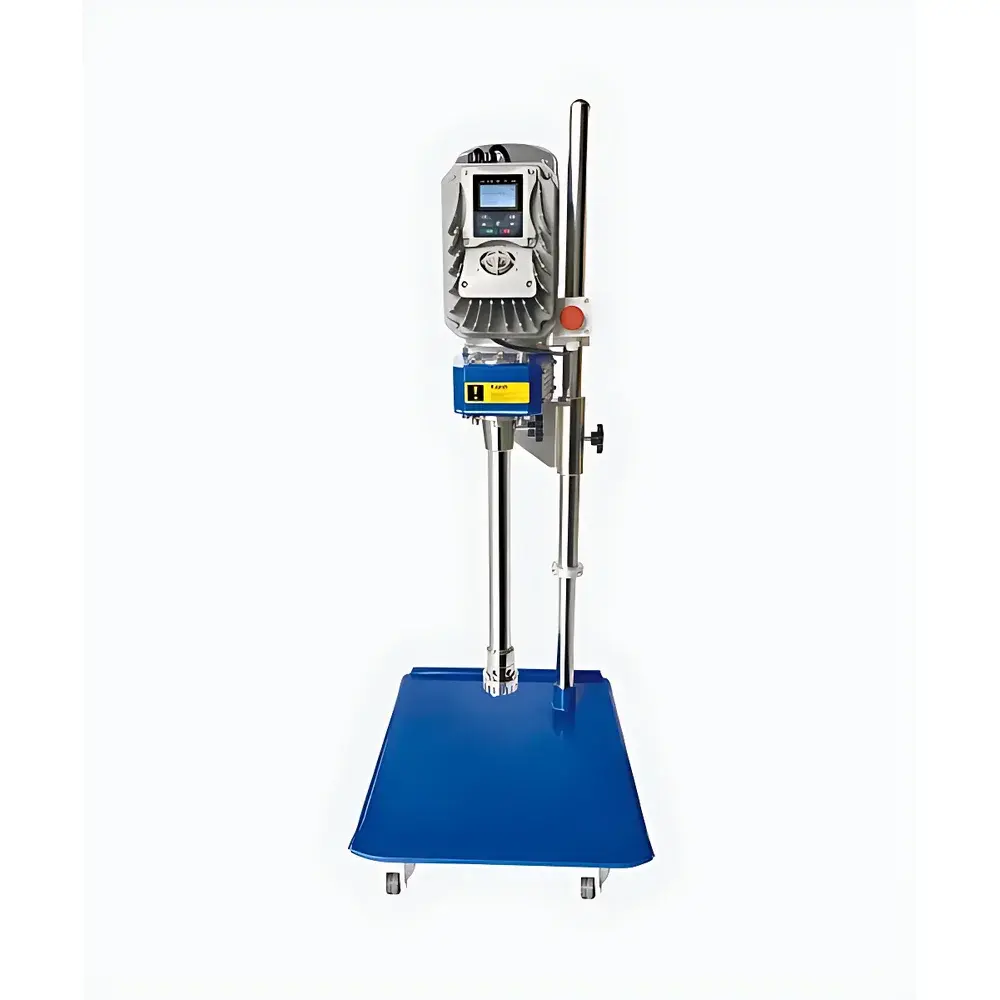
FLUKO FA60PRO Pilot-Scale High-Shear Dispersing Emulsifier
| Brand | FLUKO |
|---|---|
| Origin | Shanghai, China |
| Model | FA60PRO |
| Input Power | 3000 W |
| Output Power | 2500 W |
| Processing Volume | 2–50 L (H₂O) |
| Speed Range | 1000–9500 rpm |
| Speed Accuracy | ±0.3% |
| Tip Speed | 28.8 m/s |
| Viscosity Limit | 5000 cP |
| Standard Workhead | 60DG |
| Noise Level (no dispersing head) | 75 dB(A) |
| Dimensions | 440 × 260 × 492 mm |
| Weight | 35 kg |
| Power Supply | 220 V, 50/60 Hz, Single-Phase |
| Speed Control | Variable-Frequency Drive (VFD), Stepless |
| Speed Display | LCD Digital |
| Protection | Automatic Overload Protection with Error Code Feedback |
| Accessories | Six Interchangeable Stator-Rotor Configurations, Temperature- and Corrosion-Resistant Options Available |
Overview
The FLUKO FA60PRO is a pilot-scale high-shear dispersing emulsifier engineered for laboratory-to-production transition environments. It operates on the principle of rotor-stator hydrodynamic shear, where rotational energy is converted into intense mechanical stress at the interface between the rotating and stationary elements. This generates turbulent flow, cavitation, and extensional deformation—key mechanisms for breaking down agglomerates, reducing droplet/particle size distribution, and achieving thermodynamically stable dispersions and emulsions. Designed for reproducible scale-up from benchtop R&D to small-batch manufacturing, the FA60PRO bridges the gap between analytical-scale homogenization and industrial processing—supporting process validation, formulation development, and quality-by-design (QbD) workflows in compliance with GLP and early-stage GMP-aligned practices.
Key Features
- High-performance variable-frequency drive enabling precise, stepless speed control from 1000 to 9500 rpm with ±0.3% repeatability—critical for correlating lab-scale kinetics with pilot outcomes.
- Maximum tip speed of 28.8 m/s achieved with the standard 60DG workhead, delivering sufficient energy density for sub-micron emulsification and nanosuspension stabilization without requiring ultrasonic or high-pressure homogenization.
- Six interchangeable stator-rotor geometries (including fine-gap, high-flow, and recirculation configurations) allow systematic optimization of shear intensity, residence time distribution, and energy input per unit mass—enabling method transfer across viscosity ranges up to 5000 cP.
- Integrated digital LCD display provides real-time rpm readout, error code logging (e.g., overload, thermal cutoff, phase imbalance), and fault diagnostics—facilitating audit-ready operational records per FDA 21 CFR Part 11 Annex 11 expectations for electronic data integrity.
- Robust cast-aluminum housing with vibration-damped base and IP54-rated electrical enclosure ensures stability during extended operation and compatibility with controlled-environment labs (e.g., ISO Class 7 cleanrooms).
- Automatic electronic overload protection with instantaneous torque-limiting response prevents motor stall and mechanical damage during high-viscosity transitions or solid loading events—reducing unplanned downtime and extending service life.
Sample Compatibility & Compliance
The FA60PRO accommodates aqueous, solvent-based, and semi-solid systems—including polymer solutions, ceramic slurries, pharmaceutical suspensions, cosmetic emulsions, and battery electrode pastes. All wetted parts are constructed from AISI 316 stainless steel as standard; optional Hastelloy C-276, PTFE-coated rotors, and chemically resistant elastomer seals support aggressive media (e.g., organic solvents, acidic electrolytes, alkaline slurries). The system complies with IEC 61000-6-2 (EMC immunity) and IEC 61000-6-4 (EMC emissions), and meets CE marking requirements for machinery safety (2006/42/EC). When operated under documented SOPs, it supports data traceability frameworks aligned with ISO/IEC 17025, ASTM D3244 (emulsion stability), and USP (lipid emulsion droplet size analysis).
Software & Data Management
While the FA60PRO operates as a standalone instrument with local digital control, its analog output (0–10 V / 4–20 mA) and RS-485 Modbus RTU interface enable integration into centralized SCADA or MES platforms. Users may log speed profiles, runtime duration, and error events via external PLCs or LabArchives-compatible acquisition modules. Audit trails—including timestamped parameter changes and system status flags—are retained in non-volatile memory for ≥10,000 cycles. Optional FLUKO ProcessLink software (v3.2+) adds CSV export, trend visualization, and comparative batch analysis—supporting root-cause investigation during process deviations per ICH Q5A and Q5C guidelines.
Applications
- Pharmaceutical: Preparation of nanoemulsions for oral delivery, microcrystalline cellulose suspensions, and sterile-filterable liposomal precursors.
- Materials Science: Exfoliation of 2D materials (e.g., graphene oxide), dispersion of carbon nanotubes in polymer matrices, and homogenization of quantum dot inks.
- Food & Beverage: Cold-process mayonnaise and dressing emulsification, plant-protein microparticulation, and functional ingredient encapsulation.
- Electrochemical Energy: Slurry deagglomeration for Li-ion cathode/anode coatings, conductive additive dispersion in solid-state electrolyte formulations.
- Coatings & Inks: Pigment deagglomeration below 200 nm, rheology modifier activation, and VOC-free waterborne resin homogenization.
FAQ
What is the maximum recommended processing volume for continuous operation?
For thermal stability and consistent shear delivery, continuous operation is validated at 30–50 L with adequate cooling and appropriate workhead selection (e.g., 60DG or 80DG). Batch volumes below 10 L require speed reduction to maintain laminar-to-turbulent transition thresholds.
Can the FA60PRO be used for sterile applications?
Yes—when equipped with autoclavable stator-rotor sets (Class VI-certified elastomers) and operated within validated cleanroom protocols, it supports aseptic processing of biopharmaceutical excipients and vaccine adjuvant dispersions.
Is calibration traceable to national standards?
RPM calibration is performed using NIST-traceable tachometric reference instruments prior to shipment; certificate of conformance includes uncertainty budget per ISO/IEC 17025 Annex A.
How does the FA60PRO compare to high-pressure homogenizers for nanoemulsion generation?
It achieves comparable d90 values (<200 nm) for oil-in-water systems below 30% phase volume, with lower energy consumption and no risk of valve clogging—but requires optimization of rotor geometry and pass number rather than pressure cycling.
Does FLUKO provide IQ/OQ documentation templates?
Yes—validated installation and operational qualification templates compliant with ASTM E2500-13 and EU Annex 15 are available upon request for regulated environments.



