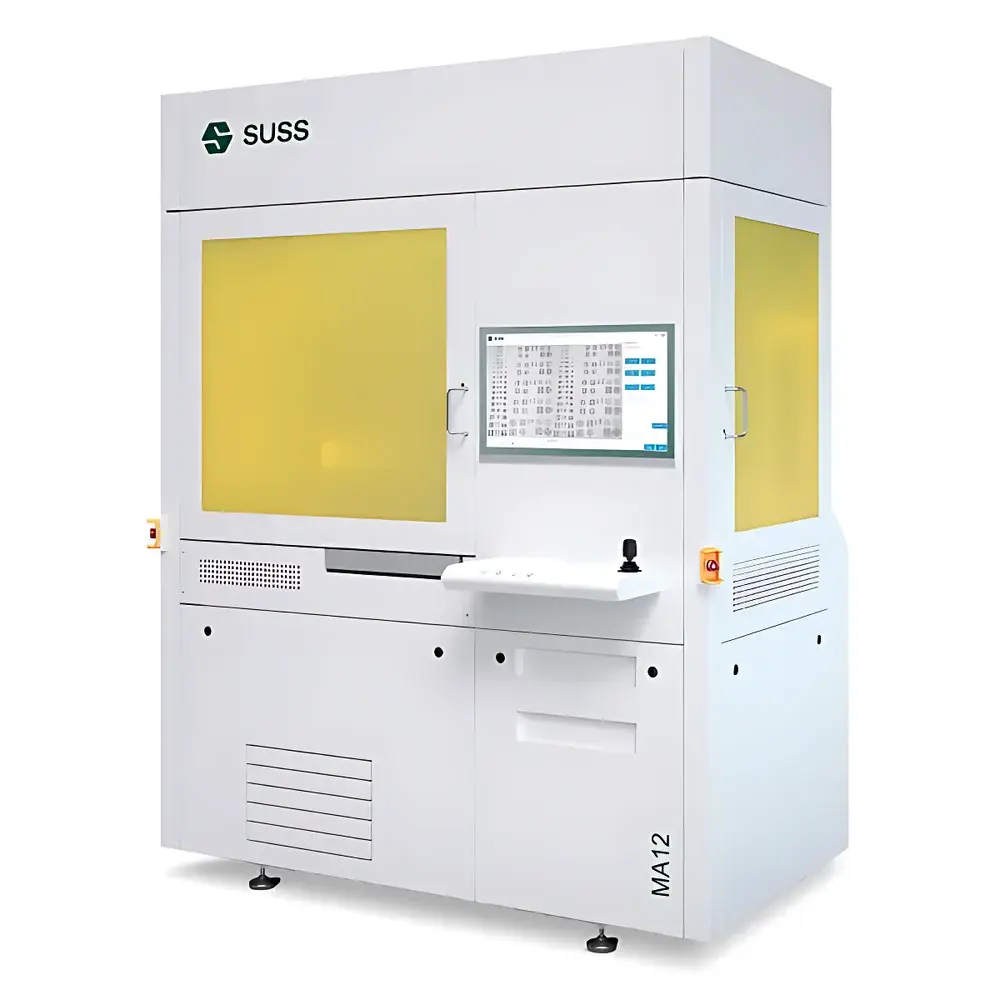
SUSS MA12 Gen3 Semi-Automatic Mask Aligner
| Brand | SUSS |
|---|---|
| Origin | Germany |
| Model | MA12 Gen3 |
| Type | Semi-Automatic Mask Aligner for Photolithography |
| Application Scope | Mask & Reticle Manufacturing, Wafer-Level Packaging, MEMS, R&D Prototyping |
| Alignment Accuracy | ≤ 1.0 µm (Optical, Off-Axis/IR Options Available) |
| Maximum Substrate Size | 200 mm |
| Max. Wafer Bow Tolerance | ±2 mm |
| Resolution | ≤ 2 µm (Line/Space, with Optimized Resist & Process) |
| Exposure Source | Broadband UV (i-line, g-line, h-line) |
| Numerical Aperture (NA) | Adjustable |
| DOF | Up to 150 µm (Configurable) |
| Software Compliance | Supports Audit Trail, User Access Levels, and Electronic Signature per FDA 21 CFR Part 11 Requirements |
Overview
The SUSS MA12 Gen3 Semi-Automatic Mask Aligner is an engineered photolithography platform designed for high-precision mask-to-wafer alignment and contact/proximity exposure in semiconductor R&D, mask shop qualification, reticle verification, and low-volume advanced packaging prototyping. Unlike projection-based scanners, the MA12 Gen3 employs a collimated broadband UV optical system operating across i-line (365 nm), g-line (436 nm), and h-line (405 nm) spectra, enabling flexible resist compatibility and process optimization for thick-film lithography, stencil patterning, and mask metrology support. Its mechanical architecture integrates motorized X/Y/θ alignment stages, precision Z-gap control (down to 5 µm proximity mode), and real-time video-based alignment with sub-micron overlay capability—ensuring repeatable registration between photomask and substrate without reliance on automated wafer handling. The system is purpose-built for environments where flexibility, traceability, and process transparency outweigh full automation requirements—such as university cleanrooms, foundry process development labs, and mask fabrication quality assurance workflows.
Key Features
- Optical alignment accuracy of ≤ 1.0 µm (3σ), supported by off-axis and infrared (IR) backside alignment options for opaque or bonded substrates
- Motorized, programmable gap control enabling both hard-contact and proximity exposure modes (5–50 µm adjustable)
- Broadband UV illumination with integrated spectral filtering and uniformity correction optics (≥95% intensity uniformity over 200 mm field)
- Adjustable numerical aperture (NA) optics to balance resolution (≤2 µm L/S) and depth-of-focus (up to 150 µm)
- Robust mechanical design accommodating substrates up to 200 mm diameter with bow tolerance of ±2 mm
- Integrated vibration-damped granite base and air-isolated optical column for long-term alignment stability
- Compliant with ISO 14644-1 Class 5 cleanroom integration standards; optional nitrogen purge interface for oxygen-sensitive resists
Sample Compatibility & Compliance
The MA12 Gen3 supports silicon, fused silica, quartz, glass, SiC, and compound semiconductor wafers and masks—enabling use in mask writing verification, reticle defect review correlation, and hybrid bonding alignment metrology. It complies with SEMI S2/S8 safety standards and meets electromagnetic compatibility (EMC) requirements per EN 61326-1. For regulated environments, the system’s firmware and control software support audit trail logging, role-based user authentication, electronic signatures, and data integrity safeguards aligned with FDA 21 CFR Part 11 and EU Annex 11 expectations. All alignment and exposure parameters are timestamped, version-controlled, and exportable in CSV or XML formats for GLP/GMP documentation workflows.
Software & Data Management
The MA12 Gen3 runs on SUSS’ proprietary LithoMaster Gen3 software suite, offering intuitive graphical alignment workflow navigation, multi-point overlay calibration routines, and real-time image correlation analytics. Exposure recipes—including dose, gap, focus offset, and filter selection—are stored with metadata tagging (operator ID, timestamp, substrate ID). The software supports secure remote diagnostics via encrypted TLS channels and integrates with factory MES systems through standardized SECS/GEM interfaces. Full system logs—including stage position history, lamp energy monitoring, and environmental sensor readings (temperature/humidity)—are retained for ≥12 months and configurable for automated archival to network-attached storage.
Applications
- Photomask and reticle qualification prior to stepper/scanner deployment
- Process development for fan-out wafer-level packaging (FOWLP) and redistribution layer (RDL) patterning
- MEMS device fabrication requiring thick photoresist (>50 µm) and low-stress alignment
- Research-scale fabrication of microfluidic devices, optoelectronic interposers, and heterogeneous integration test vehicles
- Backside alignment for through-silicon via (TSV) processing and 3D stacking validation
- Educational training in lithographic principles, mask alignment mechanics, and UV exposure physics
FAQ
What substrates can the MA12 Gen3 accommodate?
It handles 100 mm, 150 mm, and 200 mm wafers—including silicon, quartz, glass, and SiC—with maximum bow of ±2 mm and thickness ranging from 200 µm to 2 mm.
Is the system compatible with standard photomasks?
Yes—it accepts industry-standard 5-inch and 7-inch quartz masks with chrome or MoSi coatings, and supports mask holders with vacuum clamping and edge alignment fiducials.
Does the MA12 Gen3 support automated recipe transfer from DSC300 Gen3 systems?
While not directly interoperable at the hardware level, exposure parameters (dose, NA, wavelength, focus offset) are cross-referenced via SUSS’ unified LithoMaster parameter library, enabling consistent process translation between contact aligners and projection scanners.
Can the system be integrated into a Class 100 cleanroom environment?
Yes—the MA12 Gen3 meets ISO 14644-1 Class 5 specifications when installed with appropriate HVAC interface and optional nitrogen purging; full installation qualification (IQ/OQ) documentation is available upon request.
What service and calibration support is provided?
SUSS offers annual preventive maintenance contracts including optical alignment verification, stage calibration, UV intensity mapping, and software update management—traceable to NIST-certified reference standards.