
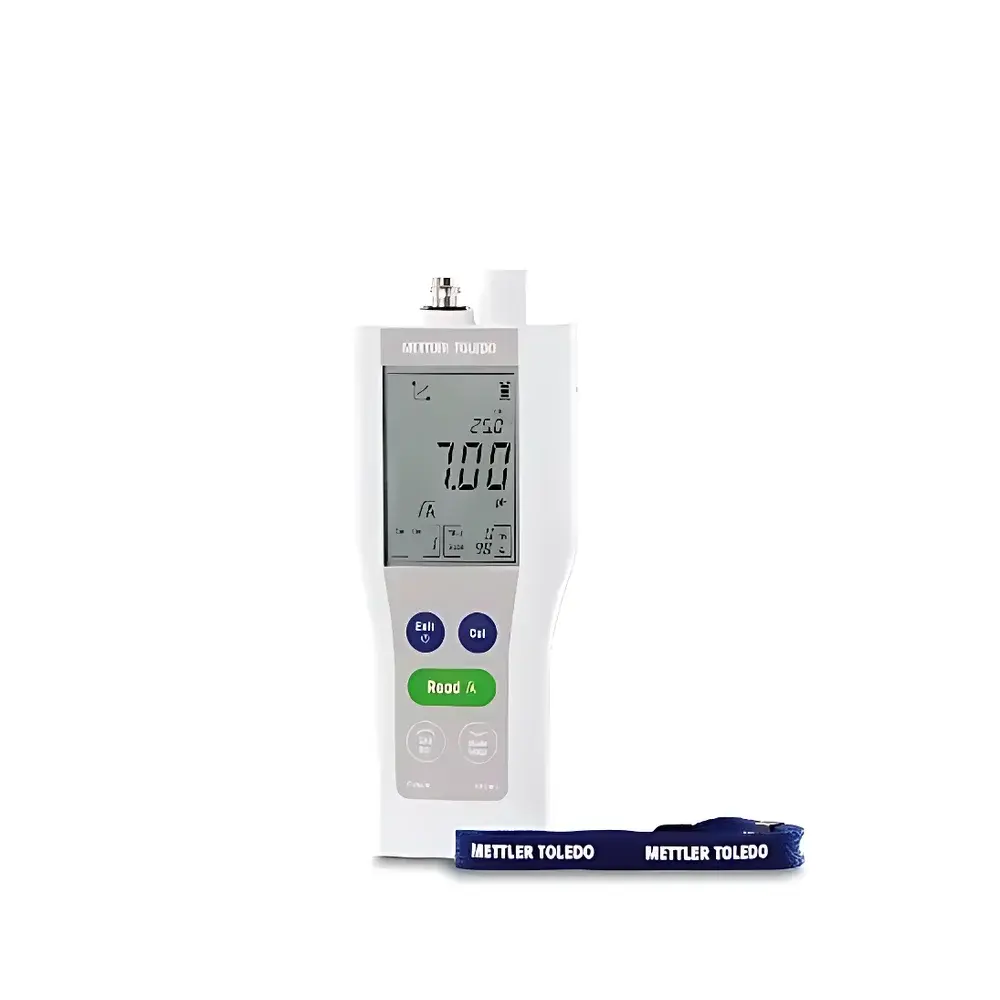
METTLER TOLEDO FiveGo F3 Portable Conductivity Meter
| Brand | METTLER TOLEDO |
|---|---|
| Origin | Switzerland |
| Model | F3 |
| Instrument Type | Portable |
| Measurement Range | Conductivity: 0.00 µS/cm to 200 mS/cm |
| TDS | 0.01 mg/L to 200 g/L |
| Temperature | 0 °C to 100 °C |
| Resolution | Conductivity (auto-ranging), Temperature: 0.1 °C |
| Accuracy | Conductivity: ±0.5 %, Temperature: ±0.5 °C |
| Endpoint Detection | Auto/Manual with audible and visual indication |
| Temperature Compensation | Linear, 0.00–10.00 %/°C |
| Reference Temp | 20 °C or 25 °C |
| Calibration | 1-point, with 3 pre-stored standard solutions |
| Data Storage | 200 measurement records |
| Electrode Interface | LTW 7-pin |
| IP Rating | IP67 |
| Power Supply | 4 × AAA batteries (>200 h operation) |
| Display | 3.1-inch segment LCD |
| Housing Material | ABS |
| Dimensions/Weight | 188 × 77 × 33 mm / 0.26 kg |
Overview
The METTLER TOLEDO FiveGo F3 Portable Conductivity Meter is an engineered solution for field-deployable, high-reliability electrical conductivity (EC) and total dissolved solids (TDS) measurements in aqueous samples. Based on four-electrode or two-electrode conductivity cell principles—depending on the connected sensor—the F3 applies precise AC excitation to minimize polarization effects and electrode fouling, ensuring stable readings across a broad dynamic range (0.00 µS/cm to 200 mS/cm). Its integrated temperature sensor enables automatic temperature compensation using user-selectable linear coefficients (0.00–10.00 %/°C) referenced to either 20 °C or 25 °C—compliant with ISO 7888 and ASTM D1125 standards for conductivity reporting. Designed for rugged outdoor use, the F3 meets IP67 ingress protection requirements, guaranteeing full dust-tightness and resistance to immersion in water up to 1 meter for 30 minutes—making it suitable for environmental monitoring, wastewater screening, aquaculture, and industrial process checks where portability and robustness are non-negotiable.
Key Features
- Intuitive single-button operation for rapid initiation of conductivity, TDS, or temperature measurements—minimizing training time and operational error.
- Ergonomic handheld form factor with symmetrical grip geometry, optimized for both large and small hand sizes; includes foldable rear stand for stable benchtop viewing.
- Segment LCD display (3.1-inch) with high-contrast segments ensures legibility under direct sunlight or low-light field conditions.
- Auto-ranging conductivity resolution eliminates manual range selection; temperature resolution fixed at 0.1 °C for consistent thermal tracking.
- Endpoint detection with dual confirmation—audible beep and on-screen “✓” icon—ensures measurement stability before data logging.
- IP67-rated ABS housing provides mechanical durability and environmental resilience without compromising weight (0.26 kg) or compact footprint (188 × 77 × 33 mm).
- Extended battery life (>200 hours on four AAA cells) supports multi-day field campaigns without recharging infrastructure.
Sample Compatibility & Compliance
The F3 is compatible with METTLER TOLEDO’s suite of LTW-series conductivity sensors—including stainless steel, graphite, and platinum electrodes—enabling accurate measurements in low-conductivity ultrapure water, mid-range drinking water, and high-salinity brines or industrial effluents. Its 1-point calibration workflow supports traceable verification against three factory-predefined standard solutions (e.g., 84 µS/cm, 1413 µS/cm, 12.88 mS/cm), aligning with routine QC protocols under ISO/IEC 17025-accredited laboratories. While the instrument itself does not provide full GLP audit trails or electronic signatures, its 200-record internal memory stores timestamped values (date/time, conductivity, TDS, temperature, unit, and calibration status), supporting basic data integrity requirements for field reports compliant with EPA Method 120.1 and WHO Guidelines for Drinking-water Quality.
Software & Data Management
Data export is accomplished via manual transcription or optional IR interface (with compatible METTLER TOLEDO IR adapter). The F3 does not support Bluetooth, USB, or PC synchronization natively; however, its structured internal log—comprising measurement ID, date/time stamp, parameter values, and calibration metadata—facilitates efficient post-collection compilation into spreadsheets or LIMS-compatible formats. All stored entries retain their original units and temperature-compensation settings, preserving metrological traceability during secondary analysis. No firmware updates or configuration changes require proprietary software—setup remains entirely menu-driven via physical keys, eliminating dependency on host systems or driver installations.
Applications
- Environmental field surveys: river, lake, and groundwater EC profiling for salinity mapping and contamination screening.
- Drinking water distribution networks: rapid verification of disinfectant residual impact on conductivity and compliance with local regulatory thresholds.
- Aquaculture and hydroponics: real-time monitoring of nutrient solution strength and osmotic balance.
- Industrial cooling tower and boiler feedwater management: trend analysis of scaling potential and corrosion risk indicators.
- Educational laboratories: undergraduate electrochemistry experiments emphasizing sensor fundamentals, temperature effects, and calibration best practices.
FAQ
What types of conductivity sensors are compatible with the FiveGo F3?
The F3 interfaces exclusively with METTLER TOLEDO LTW-series 7-pin conductivity probes—including InLab® Conductivity, InLab® Cond, and InLab® Trace models—designed for specific ranges and matrix challenges.
Does the F3 support automatic temperature compensation with non-linear algorithms?
No—it implements only linear temperature compensation (0.00–10.00 %/°C), which is appropriate for most natural waters and industrial streams per ISO 7888 Annex B recommendations.
Can measurement data be exported directly to a computer?
Not natively; data must be manually recorded or transferred via optional infrared (IR) link using the METTLER TOLEDO IR-USB adapter (sold separately).
Is the F3 suitable for use in explosive atmospheres?
No—the device is not ATEX, IECEx, or UL HazLoc certified; it is rated for general-purpose field environments only.
How often does the instrument require recalibration?
Calibration frequency depends on application stringency and regulatory requirements; daily verification is recommended for critical applications, while weekly calibration suffices for routine environmental screening when using stable reference standards.







