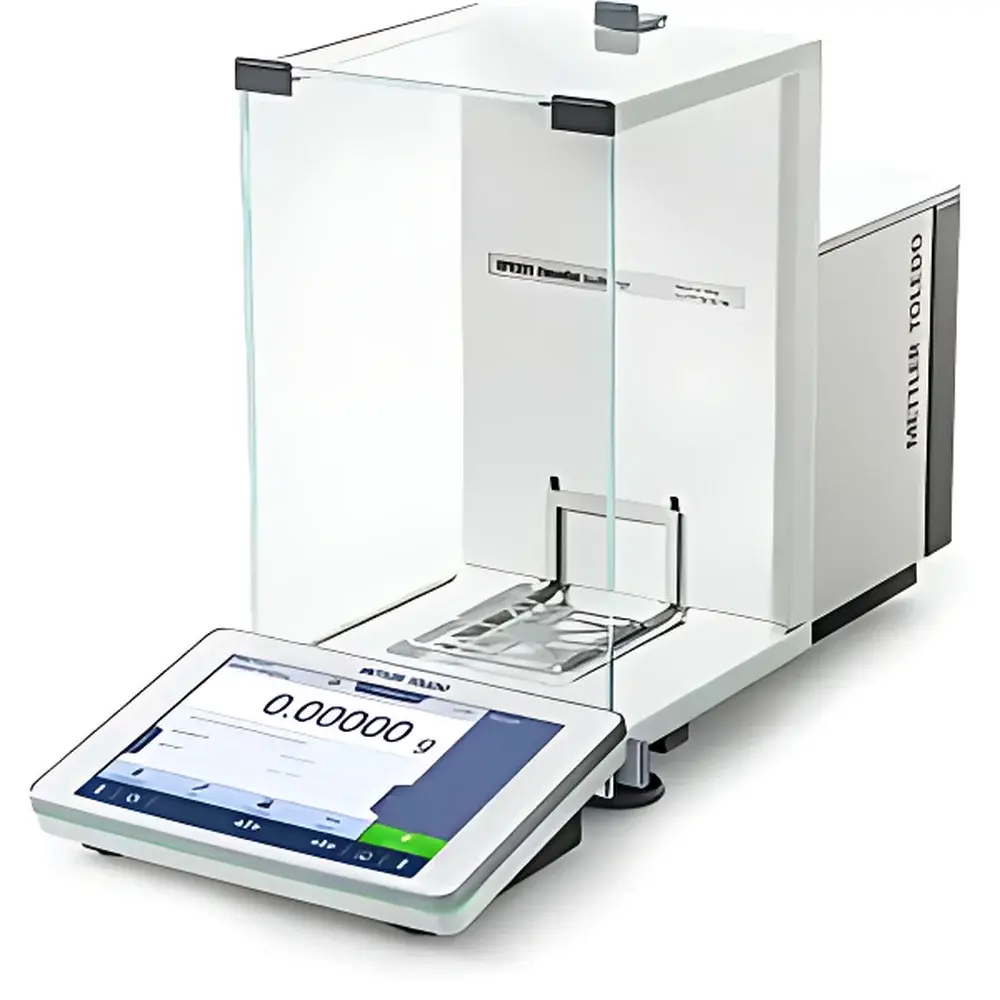
METTLER TOLEDO XPR104DUE/AC Advanced Analytical Balance
| Brand | METTLER TOLEDO |
|---|---|
| Origin | Switzerland |
| Instrument Type | Analytical Balance |
| Maximum Capacity | 120 g / 81 g (dual-range) |
| Readability | 1 mg / 0.1 mg |
| Repeatability (typ.) | 0.04 mg |
| Minimum Weight (U=1%, k=2, typ.) | 8.2 mg |
| Minimum Weight (USP <41>, 0.1% tolerance, typ.) | 82 mg |
| Stabilization Time | 1.5 s |
| Calibration | Internal, fully automatic (FACT) |
| Interfaces | RS232 (optional), USB-A, USB-B (device connection), Ethernet, Bluetooth (optional) |
| Display | 7-inch color TFT touchscreen |
| User Management | Password-protected, unlimited users, configurable permissions |
| Pan Dimensions (W × D) | 78 mm × 73 mm |
| Dimensions (H × W × D) | 292 mm × 195 mm × 456 mm |
| Certified Compliance | Yes (ISO/IEC 17025 traceable, USP <41> compliant) |
| Regulatory Support | 21 CFR Part 11 ready (LabX-compatible) |
| Static Detection | Not integrated |
| Series | XPR Essential |
| Recommended Industries | Chemical, Food & Beverage |
Overview
The METTLER TOLEDO XPR104DUE/AC is a dual-range advanced analytical balance engineered for precision mass measurement in regulated and high-throughput laboratory environments. Operating on electromagnetic force compensation (EMFC) principle, it delivers high reproducibility and long-term stability across its two selectable weighing ranges: 120 g at 1 mg readability and 81 g at 0.1 mg readability. This dual-range architecture enables seamless transition between routine QC checks and ultra-sensitive analytical tasks—without compromising resolution or compliance readiness. Designed and manufactured in Switzerland, the XPR104DUE/AC conforms to ISO 9001 quality management systems and supports traceability to national metrological standards via factory calibration certificates accredited to ISO/IEC 17025. Its robust mechanical architecture—including monolithic sensor design and draft shield-integrated weighing chamber—minimizes environmental drift and vibration sensitivity, ensuring consistent performance under typical lab conditions (20–25 °C, <60% RH).
Key Features
- Dual-range weighing capability (120 g / 1 mg and 81 g / 0.1 mg) optimizes flexibility for method-specific requirements without hardware reconfiguration.
- FACT (Fully Automatic Calibration Technology) ensures temperature-triggered internal recalibration, maintaining accuracy across ambient fluctuations without manual intervention.
- 7-inch full-color TFT capacitive touchscreen with intuitive icon-based navigation supports glove-compatible operation and multilingual UI (English, German, French, Spanish, Chinese, Japanese).
- Comprehensive user management system allows role-based access control, audit trail generation, and password-protected method locking—critical for GLP/GMP-aligned workflows.
- Integrated connectivity suite includes USB-A (for flash drive data export), USB-B (for direct PC/LabX integration), Ethernet (for networked instrument management), and optional RS232 and Bluetooth modules.
- Compact footprint (195 mm wide × 456 mm deep) and optimized height (292 mm) facilitate installation under fume hoods or within constrained benchtop spaces.
Sample Compatibility & Compliance
The XPR104DUE/AC accommodates standard analytical sample containers—including weighing boats, vials, crucibles, and filter papers—via its 78 mm × 73 mm stainless-steel pan. Its draft shield design meets ISO 17025 environmental control recommendations for analytical balances, minimizing convective air currents during low-mass measurements. The balance satisfies USP requirements for minimum weight determination: at 0.1% tolerance, the typical minimum weighable quantity is 82 mg; at 1% uncertainty (k = 2), it is 8.2 mg. All calibration and verification records—including FACT logs, user actions, and time-stamped weight events—are stored internally with tamper-resistant timestamps. When paired with LabX software, the system supports full 21 CFR Part 11 compliance, including electronic signatures, audit trail review, and secure data archiving.
Software & Data Management
The XPR104DUE/AC operates natively with METTLER TOLEDO’s LabX laboratory software platform, enabling centralized instrument control, automated report generation (PDF/CSV), and seamless integration into LIMS or ERP systems via ODBC or REST API. Local data storage retains up to 1,000 weighing records with metadata (operator ID, timestamp, method name, environmental conditions). USB-A port allows direct export of raw data and audit logs to encrypted external drives. All user interactions—including login attempts, parameter changes, and calibration events—are logged with immutable timestamps and operator attribution. Optional LabX Direct mode permits real-time data streaming to Excel or custom applications without middleware installation.
Applications
This balance serves critical functions across regulated and research-intensive domains: quantitative preparation of reference standards in pharmaceutical QC labs; formulation of active pharmaceutical ingredients (APIs) per ICH Q5C guidelines; moisture content analysis via gravimetric loss-on-drying protocols; precise dispensing of catalysts and reagents in fine chemical synthesis; and nutritional labeling compliance testing in food & beverage QA departments. Its dual-range functionality is especially advantageous in laboratories performing both bulk ingredient verification (e.g., 100 g excipient batches) and microgram-level assay standardization (e.g., 0.1 mg reference substance dilutions).
FAQ
Does the XPR104DUE/AC support USP compliance for minimum weight determination?
Yes—the balance calculates and documents minimum weight values in accordance with USP criteria (0.1% tolerance, k = 2), with typical values of 82 mg and 8.2 mg respectively.
Is internal calibration traceable to national standards?
Yes—FACT calibration is performed using internal reference masses certified traceable to SI units through METTLER TOLEDO’s ISO/IEC 17025-accredited calibration laboratory.
Can multiple users be assigned distinct permission levels?
Yes—administrator-defined roles govern access to calibration, method editing, data export, and audit trail review functions.
What regulatory frameworks does the balance support out-of-the-box?
It provides foundational features for GLP, GMP, ISO/IEC 17025, and FDA 21 CFR Part 11 compliance when used with LabX software and appropriate procedural controls.
Is static charge detection built into this model?
No—static charge compensation is not integrated; users handling insulating samples should employ external ionizers or antistatic tools as part of their SOPs.