
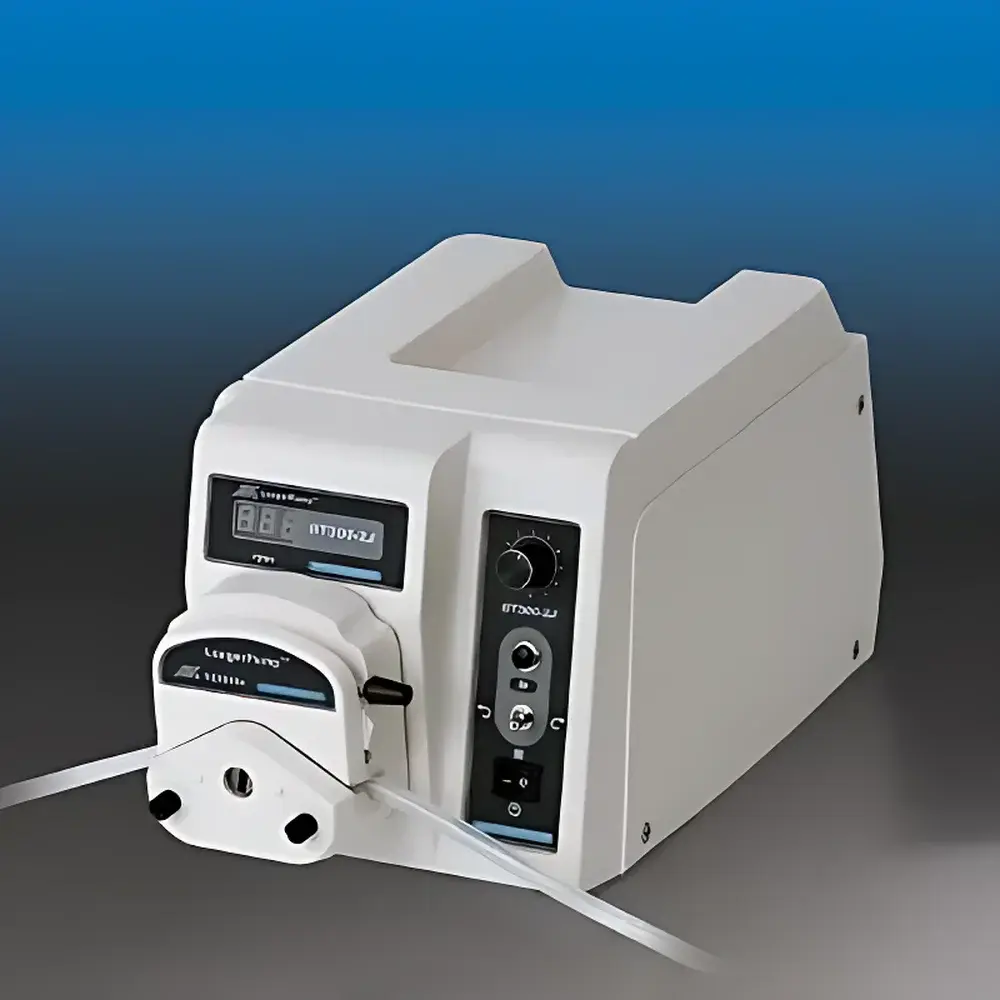
LongerPump BT300-2J Precision Peristaltic Pump for Laboratory Applications
| Brand | LongerPump |
|---|---|
| Origin | Hebei, China |
| Manufacturer Type | Direct Manufacturer |
| Product Category | Domestic |
| Model | BT300-2J |
| Pump Type | Peristaltic Pump |
| Flow Rate Range | 0.07–1140 mL/min |
| Speed Range | 1–300 rpm |
| Speed Resolution | 1 rpm |
| Control Interface | Manual knob + push buttons, RS485, analog (0–5 V / 0–10 V), pulse (0–10 kHz) |
| Display | 3-digit LED |
| Power Supply | AC 90–260 V, 48 W |
| Dimensions (L×W×H) | 285 × 207 × 180 mm |
| Weight | 3.6 kg |
| IP Rating | IP31 |
| Operating Temperature | 0–40 °C |
| Relative Humidity | < 80 % RH |
| Auto-restart after power loss | Yes |
| Full-speed (MAX) mode | Yes |
| Reversible rotation | Yes |
Overview
The LongerPump BT300-2J is a high-precision, dual-channel peristaltic pump engineered for demanding laboratory fluid handling applications requiring accurate, contamination-free, and pulseless flow delivery. Based on the positive displacement principle of peristalsis—where rollers compress flexible tubing to propel fluid without contact between the pump mechanism and the medium—the BT300-2J ensures complete fluid isolation, eliminating cross-contamination risks and enabling safe transfer of aggressive, sterile, or shear-sensitive solutions. Designed for benchtop integration in analytical chemistry, bioprocessing, cell culture media preparation, reagent dispensing, and continuous-flow synthesis setups, this pump delivers calibrated flow rates from 0.07 mL/min up to 1140 mL/min across multiple interchangeable pump heads. Its robust architecture supports extended unattended operation under controlled laboratory conditions, with built-in safeguards including overtemperature protection and automatic state recovery after power interruption.
Key Features
- Wide dynamic flow range (0.07–1140 mL/min) achieved via four compatible pump head options: YZ1515X, YZ2515X, YZII15, and YZII25—each optimized for specific tube diameters and pressure tolerances
- Precise speed control from 1 to 300 rpm with 1-rpm resolution, adjustable locally via intuitive rotary knob and push-button interface
- Dual-mode operation: local manual control and remote programmable control via RS485 serial communication (Modbus RTU protocol supported)
- Flexible external signal compatibility: analog voltage (0–5 V / 0–10 V) and frequency pulse (0–10 kHz) inputs for start/stop, direction reversal, and real-time speed modulation
- Three-digit LED display provides immediate visual feedback of current rotational speed
- Power-loss memory function retains operational parameters (speed, direction, status) and resumes pre-interruption state upon re-energization
- Dedicated MAX key enables instant full-speed operation for rapid system priming, line purging, or reservoir filling
- IP31-rated enclosure ensures protection against vertically falling drips and solid objects ≥2.5 mm—suitable for standard ISO Class 5–8 laboratory environments
- Compliant with IEC 61000-6-3 (EMI emission) and IEC 61000-6-2 (immunity) standards for electromagnetic compatibility in shared lab infrastructure
Sample Compatibility & Compliance
The BT300-2J is not a sample analysis instrument but a fluid transfer platform; therefore, compatibility is defined by tubing material selection and mechanical interface integrity. Users must select chemically resistant, USP Class VI-certified silicone or fluoropolymer tubing (e.g., PharMed BPT, Tygon® E-3603, or Masterflex® L/S® series) matched to the installed pump head’s roller geometry and occlusion settings. Tube inner diameters ranging from 0.13 mm to 4.8 mm are supported depending on pump head configuration. The pump itself meets CE marking requirements for electrical safety (IEC 61010-1) and carries no intrinsic explosion-proof rating; it is explicitly unsuitable for outdoor, hazardous area, or non-ventilated enclosures. For regulated environments—including GLP, GMP, or FDA-regulated QC labs—the device supports audit-ready operation when integrated with validated control systems that implement 21 CFR Part 11-compliant electronic signatures and data integrity protocols.
Software & Data Management
While the BT300-2J operates autonomously without proprietary software, its RS485 interface enables seamless integration into centralized laboratory automation frameworks. Third-party SCADA platforms (e.g., LabVIEW, MATLAB, Python-based PySerial control scripts, or industrial PLCs) can issue Modbus RTU commands to read real-time status registers (e.g., actual speed, direction flag, fault codes) and write setpoints with millisecond-level latency. Analog and pulse inputs allow synchronization with external triggers—for instance, initiating pump motion only during HPLC fraction collection windows or coordinating multi-pump sequences in continuous bioreactor feed systems. All control events—including speed changes, direction toggles, and MAX activation—are logged internally as timestamped state transitions, forming the basis for traceable process records when paired with host-system logging.
Applications
- Automated reagent dispensing in ELISA, PCR setup, and microplate washing stations
- Continuous feeding of nutrients or inducers in microbial fermentation and mammalian cell culture bioreactors
- Gradient elution support in preparative chromatography and column regeneration workflows
- Controlled infusion in pharmacokinetic simulation rigs and dialysis loop testing
- Integration with FK-1C volumetric fill controllers for repeatable single-use vial or syringe filling (±1% volumetric repeatability achievable with calibrated tubing and stable backpressure)
- Low-shear transfer of fragile biological suspensions—including exosome isolates, organoid cultures, and enzyme solutions—where centrifugal or diaphragm pumps risk denaturation
FAQ
Is the BT300-2J suitable for sterile or aseptic processing?
Yes—provided users install sterilizable tubing (e.g., gamma-irradiated silicone or ETFE) and validate the entire fluid path per ISO 13408 or USP <71>. The pump body itself is not autoclavable.
Can it operate continuously for 24/7 applications?
Yes—under ambient lab conditions (≤40 °C, <80% RH) and with appropriate tubing fatigue management. Recommended maximum duty cycle is 85% to ensure thermal stability and roller bearing longevity.
Does it support flow calibration against gravimetric or volumetric standards?
Not natively—but flow accuracy is directly proportional to rotational speed and tubing geometry. Users may perform traceable calibration using NIST-traceable balances or certified glassware per ASTM D3417 or ISO 8504-2.
What maintenance is required?
Biannual inspection of roller alignment and tubing compression; replacement of tubing at intervals determined by chemical exposure and runtime (typically 100–500 hours depending on material and speed). No lubrication or internal servicing is required.
Is firmware upgrade capability available?
No—the controller uses fixed-function embedded logic. Functionality expansion requires hardware revision or external controller integration.



