
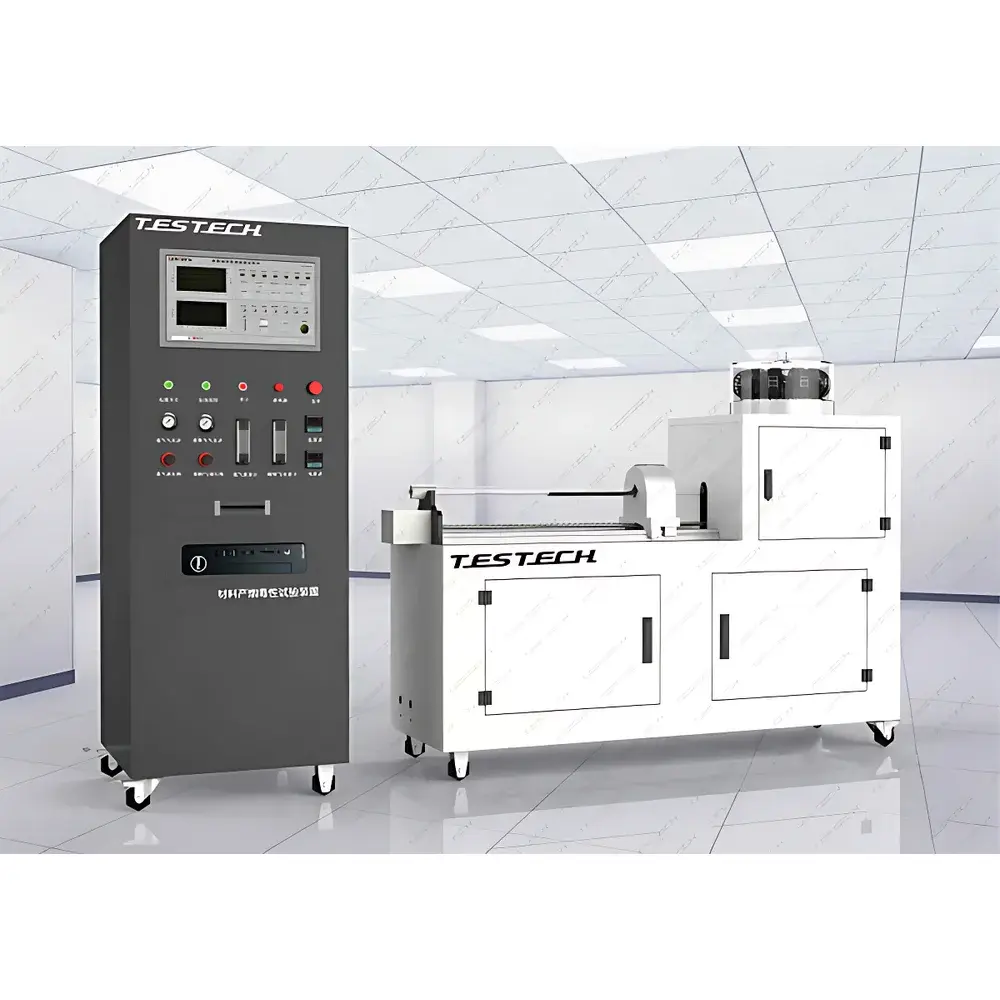
TESTech TTech-GBT20285 Building Material Smoke Toxicity Testing System
| Brand | TESTech |
|---|---|
| Origin | Jiangsu, China |
| Manufacturer Type | Direct Manufacturer |
| Model | TTech-GBT20285 |
| Applicable Standard | GB/T 20285–2006, DIN 53436, JIS K 1321 |
| Temperature Control Range | 300–1000 °C (±1 °C stability for >2 min |
| Furnace Tube ID | Ø47⁺¹₋₁ mm, Length: 100⁺¹⁰₋₅ mm |
| Furnace Translation Speed | 10 ± 0.1 mm/min |
| Air Flow Rate | 0–20 L/min (adjustable) |
| Power Supply | 1.5 kW (heating power: 800–1000 W) |
| Data Acquisition | Real-time angular velocity logging of rodent activity wheel, automated smoke concentration & smoke production rate calculation |
| Control System | PC-based with PID temperature regulation, motorized furnace positioning, dual-gas mixing (carrier + dilution), multi-chamber exhaust switching |
Overview
The TESTech TTech-GBT20285 Building Material Smoke Toxicity Testing System is a rigorously engineered bench-scale combustion toxicity assessment platform designed to quantify the acute toxicological impact of smoke generated during controlled thermal decomposition of construction materials. It operates on the principle of dynamic pyrolysis under ventilated conditions—aligning with the mechanistic framework of DIN 53436—and integrates continuous rodent behavioral monitoring via a calibrated rotating activity wheel, as specified in JIS K 1321. The system enables precise control over material decomposition kinetics through programmable furnace translation and stable temperature ramping within a quartz-lined cylindrical reactor. By maintaining steady-state smoke generation across defined thermal profiles (300–1000 °C), it supports quantitative derivation of smoke production rate (SPR, g·m⁻²·s⁻¹) and smoke concentration (mg·L⁻¹), both critical parameters for hazard classification per GB/T 20285–2006. Unlike static chamber methods, this system decouples thermal input from airflow dynamics, permitting reproducible simulation of real-world fire growth scenarios where ventilation-limited and fuel-controlled regimes coexist.
Key Features
- Motor-driven axial furnace translation mechanism enabling precise control of sample exposure time and pyrolysis zone progression at 10 ± 0.1 mm/min
- High-stability PID temperature control with K-type armored thermocouple (1 mm diameter) and real-time time–temperature curve validation against physical calibration data
- Dual-gas delivery architecture supporting independent adjustment of carrier air (0–20 L/min) and dilution air, ensuring homogeneous smoke dispersion prior to animal exposure
- Integrated quartz reaction tube (Ø47⁺¹₋₁ mm × 100⁺¹⁰₋₅ mm) resistant to thermal shock and halogen-induced corrosion during polymer decomposition
- Automated calculation engine for smoke concentration, smoke production rate, and relative toxicity index based on rodent locomotor suppression metrics
- PC-based control interface with timestamped data logging, configurable test protocols, and export-ready datasets compliant with GLP documentation requirements
- Manual and automatic furnace jog functions, along with selectable exhaust routing across multiple exposure chambers for parallel or sequential testing
Sample Compatibility & Compliance
The TTech-GBT20285 accommodates flat-sheet, particulate, or molded specimens up to 100 mm × 100 mm × 20 mm, including rigid PVC, phenolic foams, bituminous membranes, fiber-cement composites, and intumescent coatings. Its operational envelope satisfies the procedural mandates of GB/T 20285–2006 (China), DIN 53436 (Germany), and JIS K 1321 (Japan), making it suitable for regulatory submission dossiers requiring cross-jurisdictional harmonization. All thermal and gas-flow calibrations are traceable to national metrology institutes. The system architecture supports audit-ready data integrity: electronic signatures, user-access levels, and immutable event logs meet foundational expectations of ISO/IEC 17025 and FDA 21 CFR Part 11 when deployed in accredited laboratories.
Software & Data Management
The embedded Windows-based software provides synchronized acquisition of furnace position, thermocouple voltage, airflow sensor output, and rotational encoder signals from the rodent activity wheel. Raw data streams are stored in binary format with metadata headers (operator ID, test ID, calibration timestamps). Post-acquisition, users may generate standardized reports containing smoke yield curves, LC₅₀ estimates (via probit analysis), and comparative toxicity indices across material batches. Export options include CSV, PDF, and XML formats compatible with LIMS integration. Audit trails record all parameter modifications, file exports, and system logins—enabling full traceability for internal QA reviews or external accreditation assessments.
Applications
- Classification of building products under China’s mandatory fire performance grading system (GB 8624)
- Development and validation of low-smoke, low-toxicity formulations for cable jacketing, ceiling tiles, and insulation boards
- Comparative toxicity screening of halogen-free flame retardants versus brominated alternatives
- Supporting technical documentation for CE marking (EN 13501-1) and UL 723/ASTM E84 equivalency studies
- Academic research into structure–toxicity relationships of pyrolyzates from bio-based composites and recycled polymers
FAQ
What standards does the TTech-GBT20285 explicitly support?
It is fully aligned with GB/T 20285–2006, DIN 53436, and JIS K 1321 for smoke toxicity evaluation using rodent behavioral endpoints.
Can the system be used without live animal testing?
No—the core measurement relies on quantified locomotor inhibition in mice or rats, as required by the referenced standards; it is not a surrogate analytical instrument.
Is quartz tube replacement included in routine maintenance?
Yes, quartz reactor tubes are consumables subject to thermal fatigue and soiling; spares are supplied with initial commissioning and recommended replacement after 200 test cycles.
How is temperature uniformity verified across the heating zone?
Via multi-point calibration using NIST-traceable thermocouples inserted at axial intervals; verification reports are generated pre-test and archived with each dataset.
Does the system support remote monitoring or networked operation?
Local Ethernet connectivity allows secure remote desktop access for supervision; however, no cloud-based telemetry or IoT integration is provided to preserve data sovereignty and regulatory compliance.



