
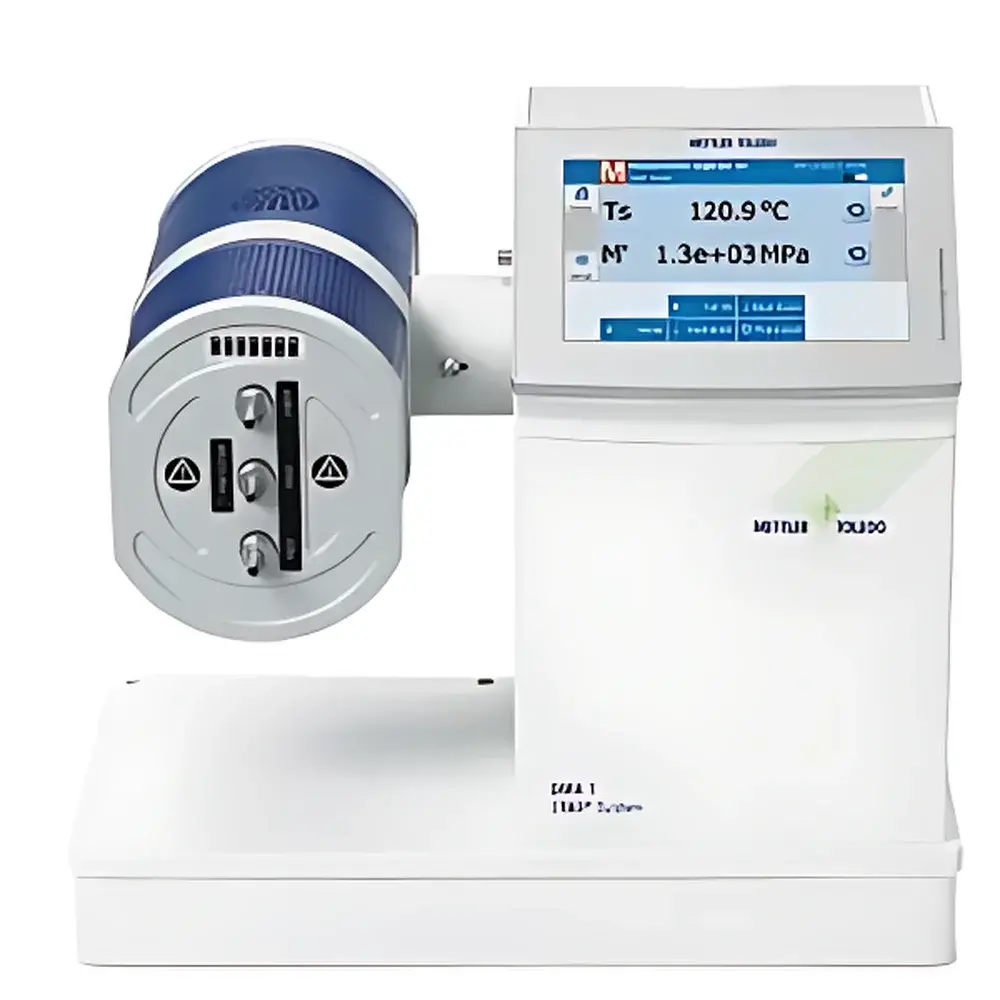
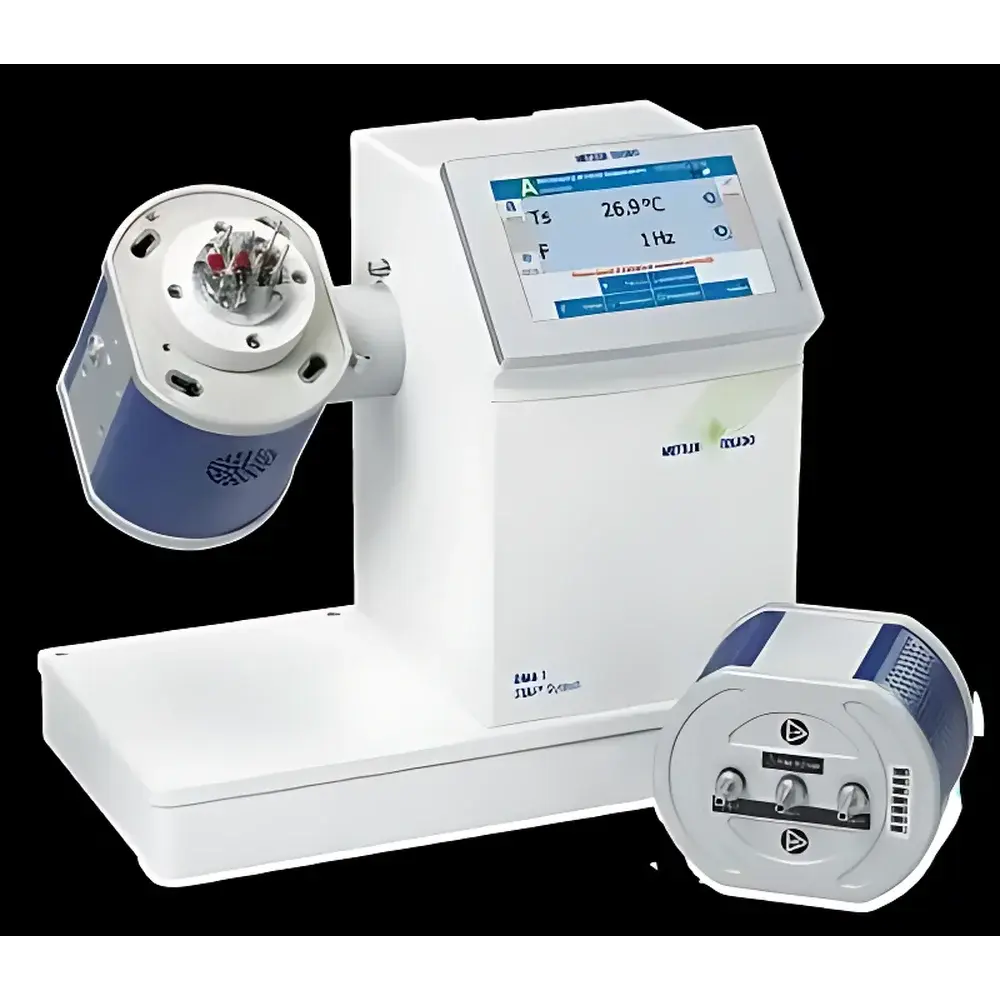
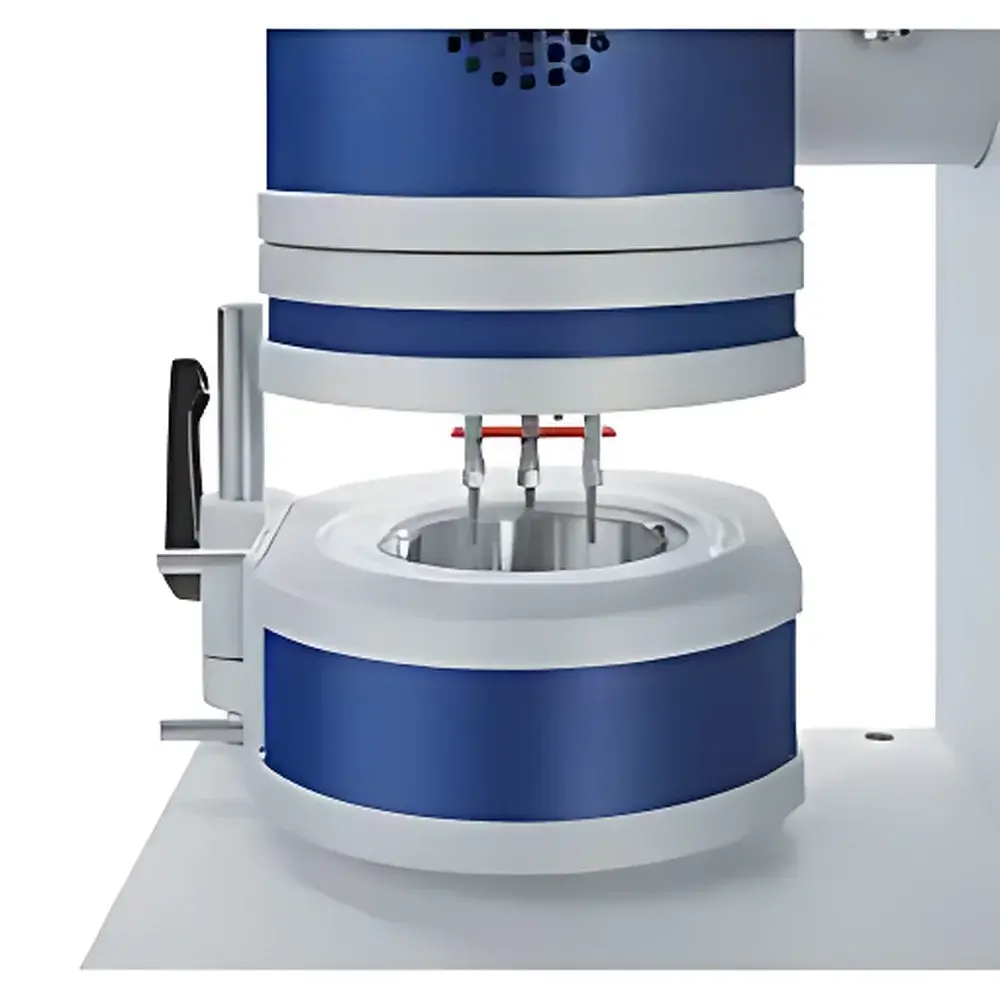
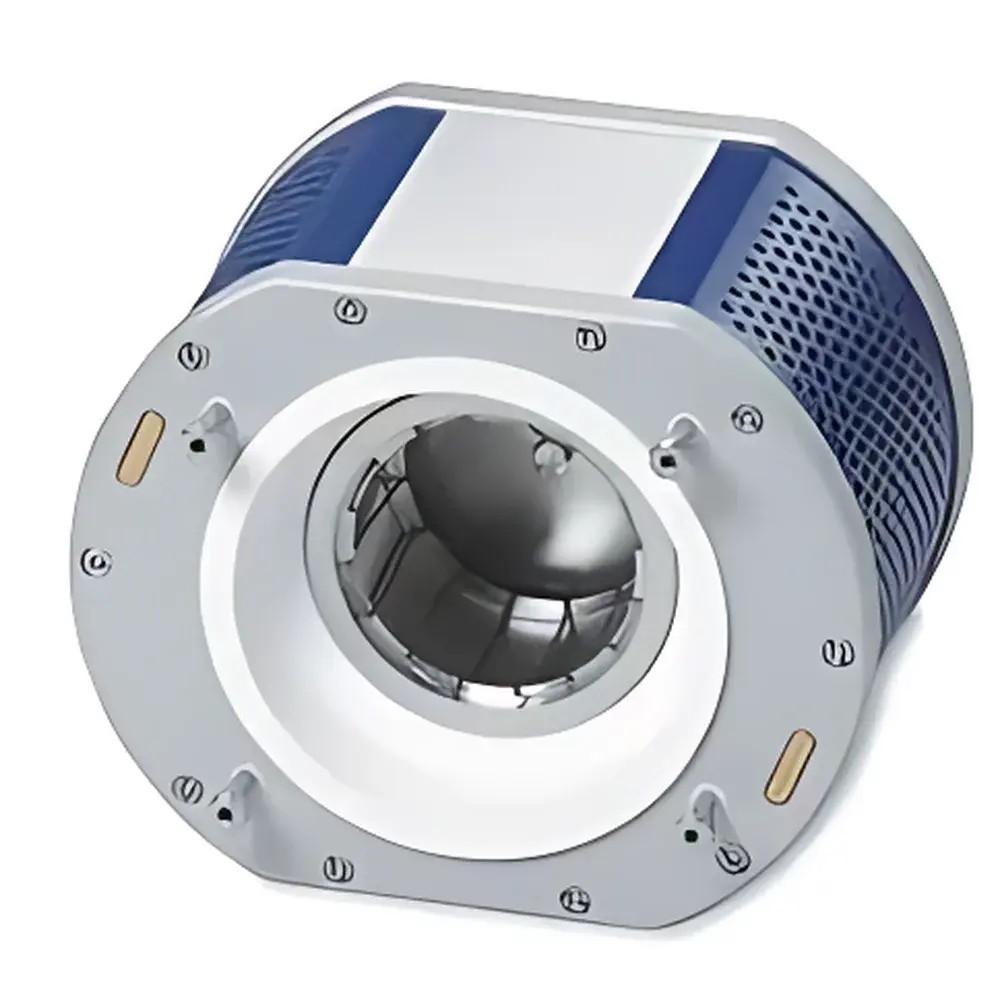
METTLER TOLEDO DMA1 Advanced Dynamic Mechanical Analyzer
| Brand | METTLER TOLEDO |
|---|---|
| Origin | Switzerland |
| Model | DMA1 |
| Temperature Range | −190 °C to 600 °C |
| Force Range | ±0.001 N to ±10 N |
| Displacement Range | ±1 mm |
| Frequency Range | 0.001 Hz to 300 Hz |
| Stiffness Range | 50 N/m to 10⁵ N/m |
| Tan δ Range | 0.0001 to 50 |
Overview
The METTLER TOLEDO DMA1 is an advanced dynamic mechanical analyzer engineered for high-precision viscoelastic characterization of solid and semi-solid materials under controlled thermal, mechanical, and environmental conditions. Based on the principle of forced oscillatory deformation—applying a sinusoidal stress or strain while measuring the resulting strain or stress response—the instrument quantifies storage modulus (E′), loss modulus (E″), and damping factor (tan δ) as functions of temperature, time, frequency, and ambient environment. Unlike conventional thermomechanical analyzers limited to uniaxial expansion or creep, the DMA1 implements a true dual-mode architecture: it supports both dynamic oscillatory testing (DMA mode) and static force-controlled measurements (TMA-like mode), including isothermal creep, stress relaxation, and coefficient of linear expansion (CTE) determination. Its modular design integrates cryogenic cooling (down to −190 °C) and high-temperature heating (up to 600 °C) within a single furnace assembly, enabling seamless transitions across extreme thermal regimes without hardware reconfiguration.
Key Features
- Fully rotatable test head with motorized positioning—enables rapid switching between tension, compression, bending, shear, and dual-cantilever modes without manual realignment;
- Integrated liquid immersion stage—supports direct DMA testing of samples submerged in solvents, electrolytes, or biological media under inert atmosphere or controlled humidity;
- Optional RH-controlled environmental chamber—facilitates hygroscopic swelling, moisture-induced relaxation, and adsorption/desorption kinetics studies per ISO 29463 and ASTM D5229;
- High-resolution electrodynamic transducer system—capable of sub-micron displacement resolution (±0.1 µm) and nanonewton-level force control (±0.001 N), ensuring reproducible measurement of low-modulus elastomers and soft biomaterials;
- 7-inch capacitive touchscreen interface with context-aware workflow guidance—streamlines method setup, sample mounting verification, and real-time parameter monitoring;
- Energy-efficient liquid nitrogen cooling system—reduces LN₂ consumption by up to 40% compared to legacy systems, minimizing operational cost and boil-off waste during prolonged low-temperature runs.
Sample Compatibility & Compliance
The DMA1 accommodates diverse sample geometries—including films, fibers, rods, powders (in cured matrix), coatings on substrates, and viscous pastes—without requiring custom fixtures. Its open-stage architecture allows in situ coupling with FTIR, Raman, or dielectric spectroscopy accessories. From a regulatory standpoint, the system complies with ISO 6721 (Plastics – Determination of dynamic mechanical properties), ASTM D4065 (Standard Practice for Plastics: Dynamic Mechanical Properties), and USP (Viscoelasticity of Pharmaceutical Solids). Audit trail functionality, electronic signatures, and 21 CFR Part 11–compliant data security modules are available via optional software packages for GMP/GLP environments.
Software & Data Management
STARe (Scientific Thermal Analysis Software) v15.x serves as the unified platform for instrument control, method development, and multi-dimensional data analysis. It includes automated baseline correction, master curve generation using Time–Temperature Superposition (TTS), Williams–Landel–Ferry (WLF) modeling, and Arrhenius activation energy calculation. Raw data files adhere to ASTM E1447-compliant .qdx format, ensuring long-term archival integrity and third-party interoperability. All measurement metadata—including calibration history, sensor drift compensation, and environmental logs—are embedded directly into each dataset, supporting full traceability required in regulated quality control laboratories.
Applications
- Characterization of glass transition (Tg), secondary relaxations (β, γ), and crosslink density in thermosets and thermoplastics;
- Creep compliance and stress relaxation profiling of structural adhesives, sealants, and composite interphases;
- Humidity-dependent modulus mapping for hydrophilic polymers used in medical devices and packaging;
- Thermal stability assessment of battery electrode binders and solid polymer electrolytes;
- Viscoelastic fingerprinting of pharmaceutical amorphous dispersions and excipient blends;
- Dynamic fatigue behavior of elastomeric seals, gaskets, and automotive NVH components under thermal cycling.
FAQ
Can the DMA1 perform measurements in liquid media?
Yes—the instrument supports fully submersible testing configurations using corrosion-resistant fixtures and sealed environmental enclosures compatible with water, ethanol, saline, and common organic solvents.
Is humidity control integrated or optional?
Relative humidity control is provided via an accessory RH chamber (model HUM-200), offering programmable setpoints from 10% to 95% RH at ±1% accuracy, with simultaneous temperature regulation.
Does the system support GLP-compliant reporting?
When equipped with STARe Security Pack, the DMA1 delivers full audit trails, user access levels, electronic signatures, and locked report templates compliant with FDA 21 CFR Part 11 and EU Annex 11 requirements.
What is the typical calibration frequency for force and displacement sensors?
METTLER TOLEDO recommends annual recalibration by certified service engineers; however, daily verification using NIST-traceable reference standards is supported through built-in self-test routines.
Can TMA-mode data be exported separately from DMA-mode results?
Yes—STARe allows independent export of CTE, expansion coefficient, and dimensional change curves in CSV, Excel, or PDF formats, with customizable units and statistical summaries.



