
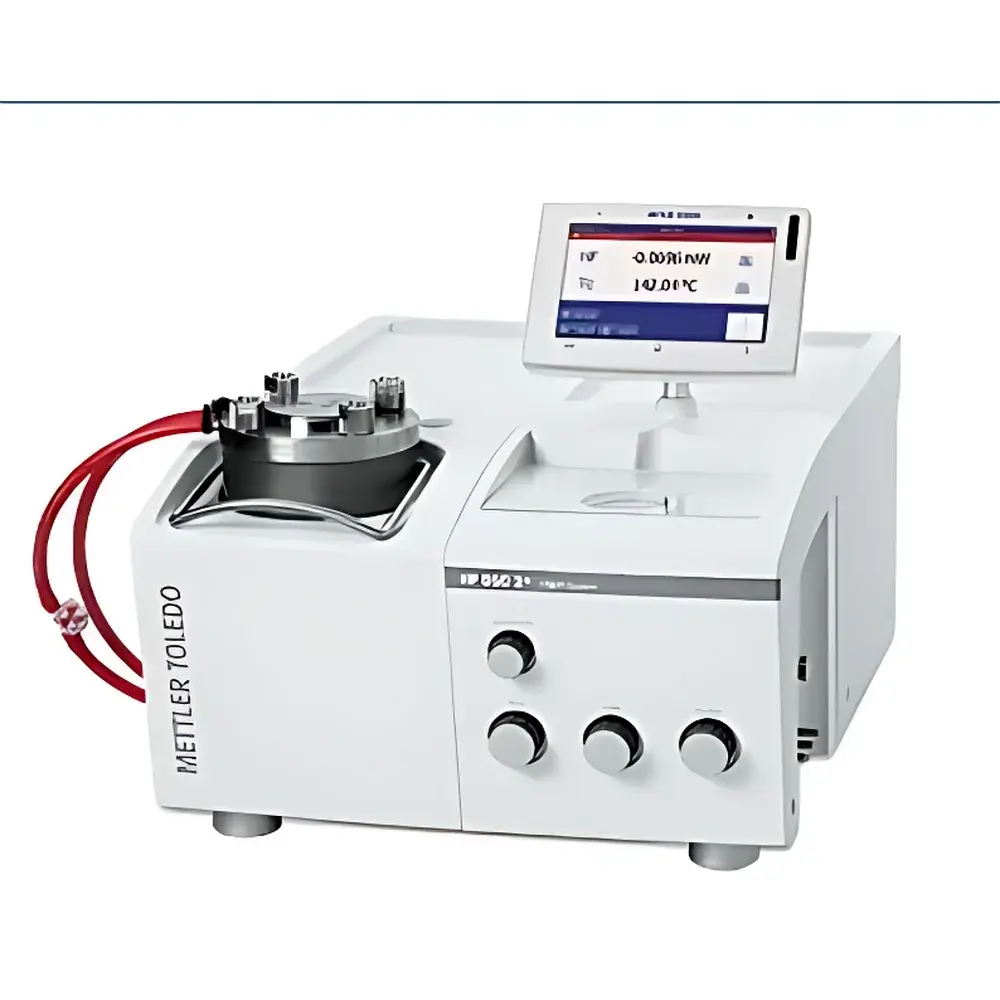
METTLER TOLEDO HP DSC 2+ High-Pressure Differential Scanning Calorimeter
| Brand | METTLER TOLEDO |
|---|---|
| Origin | Switzerland |
| Model | HP DSC 2+ |
| Temperature Range | RT to 500 °C / 700 °C |
| Temperature Accuracy | ±0.1 °C |
| Heating/Cooling Rate | 0.1–50 K/min |
| Pressure Range | 0–10 MPa |
| Gas Flow Control | External pressure & mass flow controller supported |
| Atmosphere Compatibility | Inert, oxidizing, reducing, reactive (e.g., N₂, O₂, H₂, CO₂, C₂H₄, CH₃Br), with safety restrictions for combustible/toxic gases |
Overview
The METTLER TOLEDO HP DSC 2+ is a high-pressure differential scanning calorimeter engineered for precise thermal analysis under controlled elevated pressure and temperature conditions. It operates on the fundamental principle of heat flux DSC—measuring the difference in heat flow between a sample and reference as both are subjected to identical, programmable temperature profiles—while uniquely integrating pressure control up to 10 MPa. Its core innovation lies in the low-inertia DSC furnace housed within a water-cooled pressure vessel, enabling rapid heating and cooling kinetics without thermal lag or gradient-induced baseline drift. The furnace’s optimized insulation design ensures uniform thermal distribution across the sensor plane, even at extreme pressure and temperature endpoints (up to 700 °C), thereby guaranteeing exceptional baseline stability and measurement reproducibility over repeated cycles. This architecture meets the rigorous demands of process-relevant thermal characterization, where simulating real-world reaction environments—such as polymerization under pressurized monomer feed or pharmaceutical solid-state transitions in sealed vapor-phase equilibria—is essential for mechanistic insight and formulation development.
Key Features
- High-pressure capability (0–10 MPa) with dual mechanical safety: rupture disc and pressure-rated sealing system compliant with PED 2014/68/EU and ASME BPVC Section VIII requirements
- FRS6+ sensor with 56 thermocouple pairs arranged in star configuration—delivering high sensitivity, flat baseline, and sub-millikelvin resolution for subtle enthalpic events
- HSS9+ sensor option featuring 120 thermocouples distributed across three concentric layers—achieving noise levels below 0.1 µW and superior separation of closely spaced thermal transitions
- Programmable dynamic gas atmosphere control via external mass flow and back-pressure regulators, supporting static, flowing, or stepwise pressure ramped modes
- Modular integration pathways: compatible with optional chemiluminescence detection modules (for oxidative stability assessment per ASTM D7545) and optical microscopy stages (enabling in-situ morphological correlation)
- Thermal inertia compensation algorithm embedded in STARe software, correcting for sensor and crucible thermal lag across wide heating rate ranges (0.1–50 K/min)
Sample Compatibility & Compliance
The HP DSC 2+ accommodates standard DSC crucibles (aluminum, gold-plated aluminum, stainless steel, and high-pressure sapphire-capped variants) and supports samples ranging from 0.5 mg to 30 mg—including viscous melts, powders, gels, and volatile formulations. It complies with ISO 11357 series (Plastics — Differential Scanning Calorimetry), ASTM E794 (Melting and Crystallization Temperatures by DSC), and USP (Thermal Analysis in Pharmaceutical Development). All pressure-related operations adhere to GLP documentation standards, with full audit trail support for FDA 21 CFR Part 11 compliance when used with validated STARe software configurations. Safety protocols for reactive atmospheres (e.g., O₂, H₂, ethylene) include automated pressure interlocks, real-time gas leak monitoring, and pre-test atmosphere purging sequences.
Software & Data Management
Controlled exclusively via METTLER TOLEDO’s STARe Software (version 18.0 or later), the HP DSC 2+ provides integrated method development, real-time data visualization, and post-run evaluation tools. STARe includes pressure-aware baseline correction algorithms, multi-step kinetic modeling (e.g., Ozawa-Flynn-Wall, Friedman), and automatic peak deconvolution for overlapping transitions. Raw data files (.q40/.q41) are stored in vendor-neutral format with embedded metadata (temperature, pressure, gas flow, purge rate, sensor ID, calibration history). Export options include CSV, PDF reports with traceable digital signatures, and direct import into MATLAB, Python (via PyMettler), or LIMS platforms via OPC UA interface. Audit trails record all user actions, parameter changes, and instrument status flags—fully traceable for regulatory submissions.
Applications
- Polymers: Quantifying crystallization kinetics under pressurized melt conditions; mapping pressure-dependent Tg shifts in thermoplastics; characterizing crosslinking exotherms in epoxy resins under inert N₂
- Pharmaceuticals: Studying polymorphic transitions in sealed environments to prevent solvent loss; evaluating hydrate/dehydrate behavior under controlled vapor pressure; assessing oxidative degradation onset temperatures in O₂-rich headspaces
- Food Science: Measuring starch gelatinization enthalpy under steam-saturated conditions; analyzing lipid oxidation induction times in pressurized air
- Chemicals & Catalysis: Determining decomposition onset of energetic materials under confinement; evaluating catalyst activation energy under syngas (H₂/CO) atmospheres
- Materials R&D: Characterizing adsorption/desorption hysteresis in MOFs and activated carbons via pressure-step DSC; probing glass transition suppression in supercritical CO₂ plasticized polymers
FAQ
What pressure vessels are certified for use with the HP DSC 2+?
Standard operation uses METTLER TOLEDO’s Type IV pressure cell (stainless steel 1.4404, max 10 MPa / 700 °C), certified to PED 2014/68/EU Annex I and inspected per EN 13445.
Can the HP DSC 2+ perform simultaneous TGA-DSC measurements?
No—it is a dedicated high-pressure DSC platform. For coupled thermogravimetric analysis, METTLER TOLEDO recommends the TGA/DSC 3+ with high-pressure option (HP-TGA/DSC), which shares the same pressure control architecture but integrates microbalance functionality.
Is calibration traceable to national standards?
Yes—temperature calibration uses NIST-traceable indium, tin, zinc, and silver standards; pressure calibration is performed using a PTB-certified dead-weight tester (class 0.02) prior to delivery and annually during service.
How is data integrity ensured during long-duration high-pressure runs?
STARe software implements cyclic checksum verification of raw data buffers, automatic recovery after power interruption, and hardware-triggered emergency venting with timestamped event logging—all recorded in the electronic audit trail.
Are custom crucibles supported for aggressive chemical environments?
Yes—custom Hastelloy C-276, titanium, and sapphire-crucible assemblies are available upon request and qualified per ISO 11357-7 Annex B for corrosive gas compatibility.



