
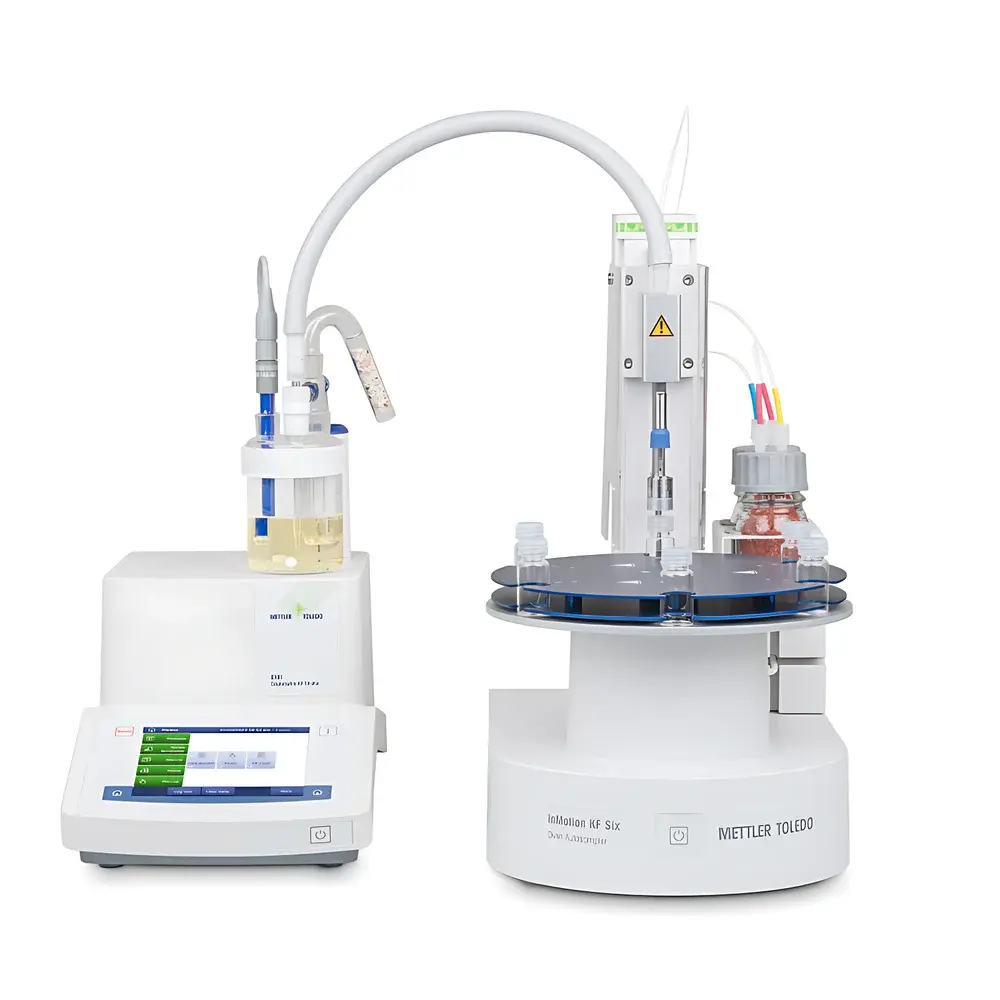
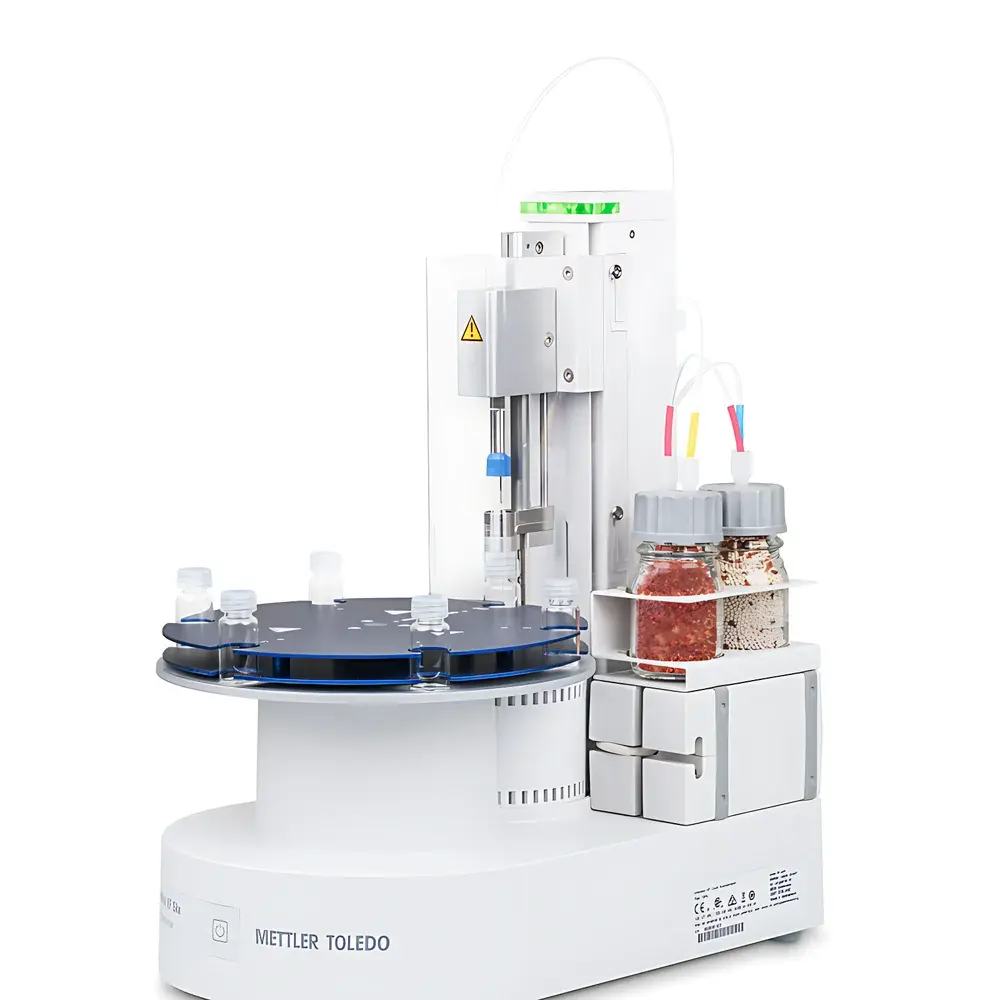
METTLER TOLEDO InMotion™ KF Six Automatic Karl Fischer Titrator
| Brand | METTLER TOLEDO |
|---|---|
| Origin | Switzerland |
| Model | InMotion™ KF Six |
| Application | Coulometric & Volumetric Karl Fischer Titration |
| Automation | 6-position autosampler with integrated heating oven |
| Sample Handling | Sealed vial-based, one-click sample preparation |
| Gas Flow Control | Digital mass flow controller (air or inert gas) |
| Compliance Support | Designed for GLP/GMP environments with audit trail-ready operation |
| Software Interface | Built-in intuitive touchscreen UI with method-driven workflow |
Overview
The METTLER TOLEDO InMotion™ KF Six is a fully integrated, benchtop automatic Karl Fischer (KF) titrator engineered for precise and reproducible moisture determination in challenging matrices. It combines coulometric and volumetric KF titration capabilities with an embedded heating oven and a six-position autosampler to address the analytical demands of lithium-ion battery materials, active pharmaceutical ingredients (APIs), polymers, and high-value chemical intermediates—samples that are prone to slow dissolution, thermal decomposition, or side reactions during conventional KF analysis. The system operates on the electrochemical principle of iodine generation (coulometric mode) or standardized iodine reagent delivery (volumetric mode), with real-time endpoint detection via dual-platinum electrode polarization. Its core architecture eliminates manual vial handling, minimizes ambient moisture ingress, and ensures traceable, operator-independent measurement sequences—critical for regulated laboratories operating under ISO/IEC 17025, USP , or ICH Q5C guidelines.
Key Features
- One-Click Sample Preparation: Integrated spiral-seal vial design enables immediate post-weighing closure, preventing atmospheric moisture absorption and reducing analyst exposure to volatile or hazardous solvents.
- Automated Heating Oven: Temperature-controlled oven (up to 250 °C) with programmable ramp profiles facilitates controlled thermal release of bound water from hygroscopic, crystalline, or polymeric samples without degradation.
- Six-Position Autosampler: Executes unattended drift–blank–sample cycles sequentially; each position supports pre-configured method parameters including titration mode, solvent volume, and oven temperature.
- Digital Mass Flow Control: Precision-regulated carrier gas (air or nitrogen/argon) ensures consistent purge efficiency across all vials, eliminating flow variability that compromises stoichiometric accuracy.
- Status-Driven Visual Feedback: Multi-color status LEDs at the oven tower provide real-time operational awareness—green (ready), amber (in progress), red (intervention required)—enabling rapid workflow triage without screen interaction.
- Host-Integrated Parameter Management: All oven settings, titration parameters, and gas flow values are synchronized and displayed directly on the instrument’s touchscreen interface, eliminating external controllers or configuration mismatches.
Sample Compatibility & Compliance
The InMotion™ KF Six accommodates solid, semi-solid, and viscous liquid samples ranging from milligram-scale battery cathode powders to high-molecular-weight resins and lyophilized biologics. Its sealed-vial architecture meets ASTM E203–22 requirements for low-level moisture quantification (<100 ppm), while its closed-system design minimizes contamination risk per ISO 8573-1 for compressed air quality monitoring. The instrument supports 21 CFR Part 11-compliant data integrity when paired with METTLER TOLEDO’s LabX® software—enabling electronic signatures, user access levels, audit trails, and raw data archiving. Routine calibration verification follows USP protocols using certified water standards, and system suitability testing includes repeatability assessment per EP 2.5.12.
Software & Data Management
Operation is managed through the instrument’s embedded touchscreen interface, which enforces method-driven workflows to prevent parameter deviation. Predefined templates cover common applications—including LiCoO₂, PVP, and silicone oils—with editable titration curves, equivalence point algorithms (e.g., fixed potential, dynamic slope), and automatic blank subtraction. When connected to LabX®, the system exports structured .csv and .pdf reports containing raw current/time data, calculated water content (ppm or %), standard deviation, and full metadata (operator ID, timestamp, environmental conditions). All data entries are immutable, time-stamped, and linked to user authentication logs—fully supporting GLP audits and internal quality reviews.
Applications
- Lithium-ion battery R&D: Quantifying residual moisture in cathode precursors (e.g., Ni-rich NMC) and electrolyte additives where sub-10 ppm accuracy dictates cell cycle life and safety.
- Pharmaceutical development: Validating moisture content in amorphous solid dispersions and excipients prior to tablet compression, ensuring stability per ICH Q1A(R2).
- Chemical manufacturing: Monitoring hydration states in catalysts, metal-organic frameworks (MOFs), and silicone-based sealants where bound water affects reactivity and shelf life.
- Polymers & composites: Assessing moisture uptake in epoxy resins and carbon fiber prepregs to prevent void formation during curing.
- Quality control labs: High-throughput batch release testing compliant with internal SOPs and external regulatory submissions.
FAQ
Can the InMotion™ KF Six perform both coulometric and volumetric titration?
Yes—it supports both modes via interchangeable titration cells and reagent kits, allowing users to select the optimal method based on expected water concentration (coulometric for 100 ppm).
Is oven temperature programmable per sample position?
No—oven temperature is set globally per method but can be optimized for the most thermally sensitive sample in the batch; individual vial heating profiles are not supported.
Does the system require external gas cylinders for inert atmosphere operation?
It accepts either lab-grade compressed air or externally supplied inert gas (N₂ or Ar) via a standard 6 mm push-to-connect fitting; no proprietary gas modules are needed.
How is drift correction handled during unattended runs?
Drift is measured before each sample injection using the same vial geometry and gas flow conditions; results are automatically subtracted from final water content calculations.
Is method validation documentation available?
METTLER TOLEDO provides IQ/OQ documentation templates and application notes aligned with USP, EP, and ASTM standards—available upon request for installation qualification and performance verification.
Related Products






