
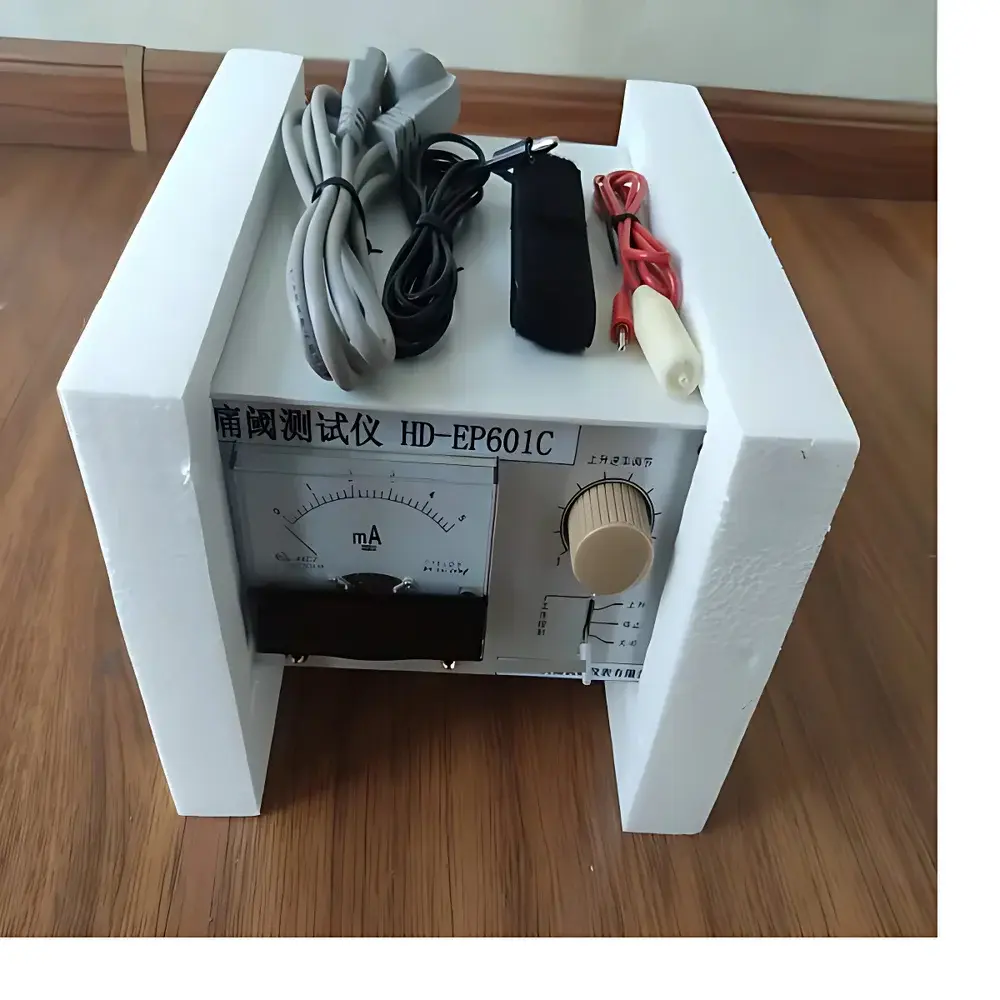
Hengao De HD-EP601C Psychophysical Pain Threshold Analyzer
| Brand | Hengao De |
|---|---|
| Origin | Beijing, China |
| Manufacturer Type | Authorized Distributor |
| Country of Origin | China |
| Model | HD-EP601C |
| Price | USD 42.50 (FOB) |
| Output Voltage | 50 V DC |
| Max Output Current | ≥4.5 mA @ 8 kΩ load |
| Power Supply | AC 220 V ±10%, 50 Hz |
| Power Consumption | 5 W |
| Dimensions | 215 × 200 × 125 mm |
| Weight | 1.8 kg |
| Safety Design | Dual-transformer isolation, constant-current K⁺ iontophoresis stimulation, current-controlled ramp rate, built-in shunt ammeter |
Overview
The Hengao De HD-EP601C Psychophysical Pain Threshold Analyzer is a precision-engineered instrument designed for controlled, reproducible quantification of human pain perception thresholds in academic psychology laboratories and clinical research settings. It operates on the principle of transdermal potassium ion (K⁺) iontophoresis—a non-invasive, electrophoretic method that delivers a calibrated, time-ramped direct current to induce localized, reversible nociceptive stimulation without tissue damage. Unlike thermal or mechanical modalities, iontophoretic stimulation enables precise control over stimulus intensity, onset kinetics, and spatial localization—critical for psychophysical protocols requiring high intra- and inter-subject repeatability. The device features dual transformer isolation and a regulated constant-current output architecture, ensuring compliance with IEC 61010-1 safety standards for laboratory electrical equipment. Its large analog-style front-panel ammeter provides real-time visual feedback of delivered current (0–5 mA), while the adjustable ramp-rate control allows experimenters to standardize stimulus rise time across trials—essential for minimizing anticipatory response bias and supporting signal-detection theory-based analysis.
Key Features
- Constant-current K⁺ iontophoresis stimulation with programmable ramp rate (0–5 mA/s) for standardized nociceptive onset kinetics
- Dual independent transformer isolation circuitry, meeting Class II electrical safety requirements per IEC 61010-1
- Front-panel shunt ammeter with 0.1 mA resolution for real-time current monitoring during subject testing
- Three-state control switch (Ramp/Stop/Off) enabling precise temporal control of stimulus delivery
- Maximum safe output voltage limited to 50 V DC, with automatic current limiting at ≥4.5 mA into 8 kΩ load
- Compact benchtop form factor (215 × 200 × 125 mm) and low power consumption (5 W) for integration into shared lab spaces
- Designed for bilateral or unilateral limb testing; compatible with standard Ag/AgCl surface electrodes and conductive gel
Sample Compatibility & Compliance
The HD-EP601C is validated for use with adult human subjects in controlled laboratory environments. It supports standardized psychophysical paradigms including method-of-limits, staircase, and adaptive forced-choice procedures per ASTM E3079-17 (Standard Guide for Psychophysical Testing of Pain Perception). The instrument complies with ISO 13485:2016 requirements for medical device-related research instrumentation and meets essential safety criteria outlined in EN 60601-1 for electrical equipment used in biomedical experimentation. While not classified as a medical device under FDA 21 CFR Part 820, its design aligns with GLP principles for data integrity, traceability, and operator safety. All electrical interfaces are fully isolated; no ground-referenced outputs are present. The unit is intended for use only under supervision of trained personnel in accordance with institutional review board (IRB)-approved protocols.
Software & Data Management
The HD-EP601C operates as a standalone analog stimulator and does not include embedded digital control or data logging. However, it is fully compatible with third-party acquisition systems via external TTL trigger synchronization (optional BNC input available upon request). When integrated with LabChart, AcqKnowledge, or MATLAB-based DAQ platforms, the device supports timestamped stimulus onset logging, automated trial sequencing, and synchronized physiological recording (e.g., EMG, EEG, skin conductance). For regulatory traceability, all operational parameters—including ramp rate, duration, and peak current—are manually documented using standardized experimental logs compliant with ALCOA+ principles (Attributable, Legible, Contemporaneous, Original, Accurate, Complete, Consistent, Enduring, Available). No firmware or software updates are required; calibration verification is performed annually using certified current sources traceable to NIST standards.
Applications
This analyzer serves core functions across multiple domains: (1) Undergraduate and graduate teaching labs for hands-on instruction in sensory psychophysics, signal detection theory, and pain neurophysiology; (2) Preclinical translational research investigating analgesic drug efficacy, placebo mechanisms, or central sensitization models; (3) Clinical trial support for quantitative sensory testing (QST) in neuropathic pain cohorts per DFNS guidelines; (4) Human factors studies evaluating ergonomic interventions or protective equipment efficacy; and (5) Cross-modal interaction experiments integrating thermal, mechanical, and electrical nociceptive stimuli. Its robustness, portability, and deterministic stimulus profile make it suitable for multi-site collaborative studies where protocol harmonization is critical.
FAQ
Is the HD-EP601C approved for clinical diagnostic use?
No—it is designated exclusively for research and educational applications. It is not CE-marked or FDA-cleared as a diagnostic device.
What electrode types are recommended for optimal current delivery?
Ag/AgCl disposable surface electrodes (e.g., Kendall ARBO, 3M Red Dot) with aqueous KCl gel are validated for consistent iontophoretic coupling. Electrode size should be ≥2 cm² per contact site.
Can the device be used with subjects who have pacemakers or implanted electronics?
No. Contraindicated for individuals with active implantable medical devices due to potential electromagnetic interference and uncontrolled current pathways.
How often does the unit require calibration verification?
Annual verification using a NIST-traceable current calibrator (e.g., Fluke 5500A with 5520A current module) is recommended per ISO/IEC 17025 guidance for test equipment.
Does the instrument support automated threshold tracking algorithms?
Not natively. Automation requires integration with external software (e.g., PsychoPy, MATLAB) via TTL triggering and analog current monitoring.





