
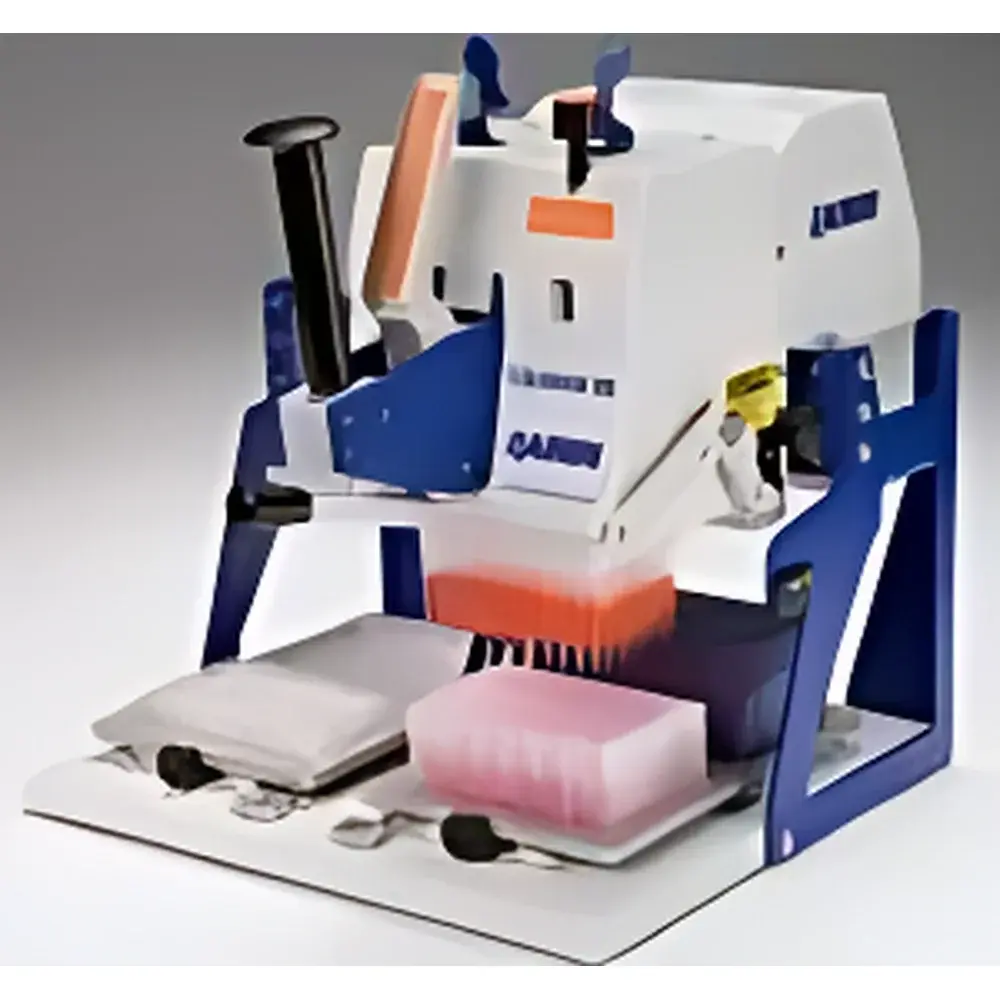
RAININ Liquidator 96 Manual 96-Channel Pipetting Workstation
| Brand | RAININ |
|---|---|
| Origin | Switzerland |
| Model | Liquidator 96 |
| Type | Manual High-Throughput Pipetting System |
| Compatibility | 96-well and 384-well plates |
| Ergonomic Design | Yes |
| Software Requirement | None |
| Regulatory Compliance | ISO 8655-compliant pipette performance, CE-marked, RoHS compliant |
Overview
The RAININ Liquidator 96 is a precision-engineered manual 96-channel pipetting workstation designed for laboratories requiring high-throughput liquid handling without automation complexity. Unlike motorized or robotic platforms, the Liquidator 96 operates on a robust mechanical lever principle—translating user-applied thumb force into synchronized, parallel piston displacement across all 96 channels. This Couette-style positive-displacement mechanism ensures volumetric accuracy and reproducibility consistent with ISO 8655 standards for manual pipettes, while eliminating electronic dependencies, calibration drift from motor wear, or software-induced latency. It bridges the gap between single-channel manual pipetting and fully automated liquid handlers—offering throughput comparable to semi-automated systems (e.g., 96-well transfers in under 10 seconds), yet retaining full tactile control, immediate operational feedback, and zero programming overhead. Its design targets environments where assay flexibility, rapid protocol iteration, and operator autonomy are prioritized over batch scripting—such as academic core facilities, QC labs performing ELISA validation, or bioprocess development teams conducting iterative media exchange experiments.
Key Features
- Mechanically Synchronized 96-Channel Operation: All tips aspirate and dispense simultaneously via a single ergonomic lever; no channel-to-channel variability introduced by sequential actuation.
- ISO 8655-Compliant Volumetric Performance: Certified accuracy ±1.0% at nominal volume (e.g., 200 µL) and precision ≤0.5% CV across all channels—validated per ISO 8655-2 and -6 protocols.
- Universal Tip Compatibility: Accepts standard universal-fit filtered or non-filtered tips (10–200 µL and 50–1250 µL ranges), including RAININ LTS and non-LTS formats—no proprietary tip lock required.
- Compact Footprint & Modular Integration: Dimensions of 185 × 120 × 145 mm (W × D × H); fits under laminar flow hoods, inside biosafety cabinets, or alongside centrifuges and plate readers without spatial compromise.
- Ergonomic Lever Mechanism: Low-force actuation (≤2.5 N peak force) reduces repetitive strain injury (RSI) risk during extended use; lever travel optimized for natural wrist alignment per ISO/TS 20282 human factors guidelines.
- No Power, No Software, No Dependencies: Fully mechanical operation requires no AC power, USB connection, firmware updates, or vendor-specific drivers—ensuring uninterrupted workflow continuity and audit-trail simplicity.
Sample Compatibility & Compliance
The Liquidator 96 supports direct liquid transfer into ANSI/SLAS-standard 96-well microplates (flat, round, or V-bottom) and 384-well plates using optional 384-channel adapters. It handles aqueous buffers, cell suspensions (up to 1 × 10⁶ cells/mL), serum-containing media, glycerol-diluted enzyme stocks (≤30% v/v), and low-viscosity PCR master mixes (25 mPa·s), volatile organics, or corrosive solvents (e.g., >5% DMSO, concentrated acids/bases). The device complies with EU CE marking directives (2014/30/EU EMC, 2014/35/EU LVD), RoHS 2011/65/EU, and meets the mechanical safety requirements of ISO 13857 for guarded hazardous zones. While not a regulated medical device, its performance documentation supports GLP-compliant recordkeeping when used in preclinical assay development per OECD Series on Principles of Good Laboratory Practice.
Software & Data Management
The Liquidator 96 operates independently of software—eliminating data integrity risks associated with electronic log files, timestamp synchronization errors, or unvalidated software versions. All operations are operator-executed and directly observable; no digital audit trail is generated nor required. For labs subject to FDA 21 CFR Part 11 or Annex 11 compliance, this analog workflow simplifies validation: only the physical instrument and tip lot traceability need verification—not software configuration, user access controls, or electronic signature implementation. Users maintain full procedural control through written SOPs referencing ISO 8655 calibration intervals (recommended annually or after 10,000 actuations), tip lot numbers, and environmental conditions logged manually in lab notebooks or LIMS-integrated paperless systems.
Applications
- ELISA Workflow Optimization: Simultaneous aspiration of coating buffer or detection reagents across entire 96-well plates—enabling uniform wash timing critical for inter-well signal consistency per CLSI EP21-A2 guidance.
- Hybridoma & Cell Culture Maintenance: Rapid medium exchange in 96-well plates during monoclonal antibody screening; minimizes shear stress versus vacuum-based systems due to controlled piston velocity.
- qPCR Setup: Precise, low-variability dispensing of master mix into reaction plates prior to template addition—reducing well-to-well Cq deviation (CV < 0.8%) in diagnostic assay validation studies.
- Yeast Two-Hybrid & Expression Library Screening: Replicate plating of transformants onto selective media with positional fidelity maintained across plates via fixed-tip spacing geometry.
- Crystallography Pre-Screening: Accurate nanoliter-scale reagent dispensing (using 10–200 µL head + low-volume tips) for sparse matrix crystallization trials where evaporation control is essential.
- Genomic Library Normalization: Equal-volume transfer of sheared DNA fragments into indexing plates prior to NGS library prep—supporting input consistency required by Illumina’s TruSeq protocols.
FAQ
Does the Liquidator 96 require calibration certification?
Yes—per ISO 8655-6, users must verify volumetric accuracy and precision at least annually or after 10,000 actuations using gravimetric methods traceable to NIST standards.
Can it be used with 384-well plates?
Yes—via optional RAININ 384-channel adapter kits (sold separately), maintaining tip spacing compatibility with ANSI/SLAS 384-well footprint specifications.
Is tip ejection automated?
No—tip ejection is manual and simultaneous across all channels using the integrated ejector bar; no motorized or pneumatic ejection mechanism is present.
What maintenance does it require?
Routine cleaning with 70% ethanol; annual inspection of O-rings and piston seals by authorized RAININ service centers; no lubrication or internal adjustment is user-serviceable.
How is traceability ensured for regulated workflows?
By documenting instrument serial number, tip lot number, calibration date, and operator ID in lab records—fully compatible with ALCOA+ data integrity principles without electronic system dependencies.



