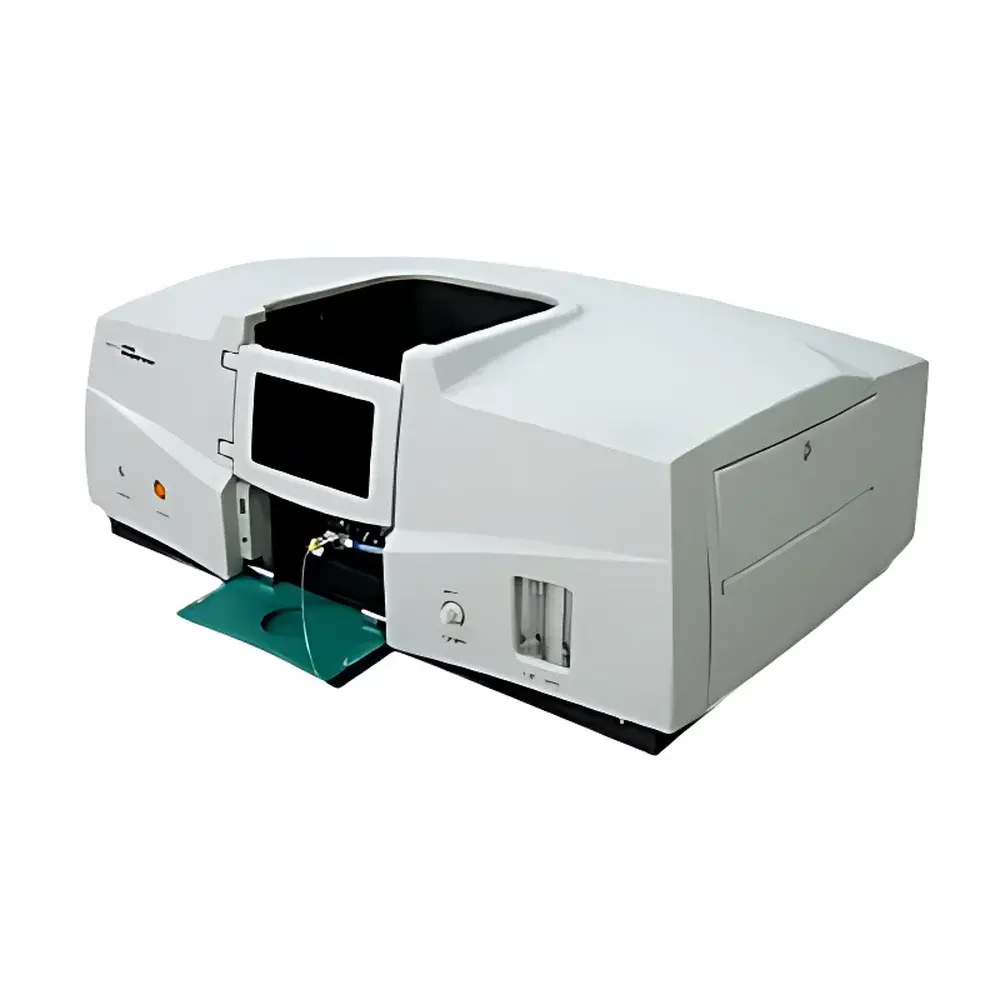
Bohui Innovation BH5300S Medical Flame Atomic Absorption Spectrometer
| Brand | Bohui Innovation |
|---|---|
| Origin | Beijing, China |
| Model | BH5300S |
| Analysis Method | Flame Atomic Absorption Spectrometry (FAAS) |
| Sample Types | Whole Blood (40 µL) and Serum (300 µL) |
| Simultaneous Multi-Element Detection | Cu, Zn, Ca, Mg, Fe |
| Atomizer | Premixed 100 mm Single-Slit Titanium Burner |
| Absorbance Range | 0–2 Abs |
| Wavelength Range | 190–650 nm |
| Spectral Bandwidth | 0.15–2.0 nm |
| Light Sources | Composite Hollow Cathode Lamps (Cu/Zn/Ca |
| Baseline Stability | ≤0.005 Abs per 30 min |
| Characteristic Concentrations (Whole Blood) | Cu ≤0.035 mg/L/%, Zn ≤0.015 mg/L/%, Ca ≤0.080 mg/L/%, Mg ≤0.040 mg/L/%, Fe ≤1.05 mg/L/% |
| Characteristic Concentrations (Serum) | Cu ≤0.035 mg/L/%, Zn ≤0.020 mg/L/%, Ca ≤1.30 mg/L/%, Mg ≤0.20 mg/L/%, Fe ≤0.15 mg/L/% |
| Precision | ≤1.0% RSD (Abs > 0.1) |
| Safety Compliance | Overpressure Category II, Integrated Acetylene Anti-Flashback Valve, Air Pressure & Flow Monitoring, Power-Fail Flame Cutoff, Burner Explosion Protection |
| Power Supply | AC 220 ±22 V, 50 ±1 Hz, 300 VA |
| Dimensions | 782 × 560 × 338 mm |
| Operating Environment | 10–30 °C, RH ≤70%, Atmospheric Pressure 0.070–0.106 MPa, Vibration-Free, Corrosion- and EMI-Free |
Overview
The Bohui Innovation BH5300S Medical Flame Atomic Absorption Spectrometer is an FDA-registered (Registration No. Jing Yao Jian Xie (Zhun) Zi 2011 No. 2400257) clinical instrument engineered for rapid, simultaneous quantification of five essential trace elements—copper (Cu), zinc (Zn), calcium (Ca), magnesium (Mg), and iron (Fe)—in both whole blood and serum matrices. It operates on the fundamental principle of flame atomic absorption spectrometry (FAAS): sample solutions are pneumatically nebulized into a premixed air-acetylene flame, where thermal energy atomizes analytes into ground-state free atoms. These atoms selectively absorb characteristic radiation emitted by element-specific hollow cathode lamps at wavelengths defined by their electronic transitions. The magnitude of absorption—measured as absorbance (A) across a calibrated 0–2 Abs range—is directly proportional to analyte concentration per Beer-Lambert law. Unlike conventional single-channel FAAS systems requiring sequential lamp changes and wavelength reconfiguration, the BH5300S integrates a patented multi-angle optical path architecture (Patent No. ZL 01 2 19460.3) enabling true concurrent five-element detection without mechanical lamp switching or spectral realignment.
Key Features
- Dual-Matrix Compatibility: Switch seamlessly between whole blood (40 µL) and serum (300 µL) protocols via software selection—no hardware modification, lamp replacement, or burner disassembly required.
- Patented Multi-Angle Optical Architecture: Five independently aligned hollow cathode lamps—configured as Cu/Zn/Ca and Ca/Mg/Fe composites plus a dedicated Fe lamp—are sequentially energized with precise timing. This eliminates spectral overlap between adjacent emission lines (e.g., Ca 422.7 nm and Fe 427.2 nm), ensures each element is measured at its primary sensitivity line, and extends lamp service life by avoiding composite-lamp intensity degradation.
- Optimized Titanium Burner System: A 100 mm single-slit titanium burner provides exceptional resistance to oxidation, corrosion, and thermal shock. Its rapid thermal equilibrium minimizes warm-up time and improves measurement reproducibility across high-throughput clinical batches.
- High-Efficiency Nebulization: Factory-calibrated concentric nebulizer paired with a PTFE-coated conical spray chamber features rear-drain geometry and surface-modified interior walls to minimize memory effect, ensure laminar waste flow, and maximize aerosol generation efficiency—critical for low-volume clinical samples.
- Comprehensive Safety Integration: Dual-stage acetylene anti-backfire valve, electromagnetic shutoff triggered by air pressure drop or mains power failure, burner explosion relief port, and real-time gas flow/pressure monitoring comply with IEC 61010-1 safety requirements for Class II overvoltage equipment.
Sample Compatibility & Compliance
The BH5300S is validated for use with human whole blood (EDTA-anticoagulated) and serum specimens under ISO 15197:2013 and CLSI EP21-A guidelines for clinical analyzer performance. Its analytical method aligns with ASTM D1688 (copper in biological fluids) and USP <731> (elemental impurities in pharmaceuticals). The system supports GLP-compliant operation through audit-trail-enabled software logging of calibration events, user actions, and instrument status. All critical parameters—including lamp current, slit width, flame height, and gas flow rates—are digitally recorded and exportable for regulatory review. Device registration with China NMPA confirms conformity to YY/T 0664–2008 (medical electrical equipment—particular requirements for in vitro diagnostic instruments).
Software & Data Management
The proprietary Windows-based control software provides intuitive workflow navigation, automated calibration curve generation (linear and quadratic), internal standard correction, and batch result compilation. Each analysis session logs raw absorbance values, peak integration windows, baseline correction points, and lamp operating parameters. Data files adhere to ASTM E1382-compliant formats (.csv, .txt) and support direct import into LIS/HIS platforms via HL7 v2.5 interface. Audit trails capture operator ID, timestamp, method version, and any manual override—meeting FDA 21 CFR Part 11 requirements for electronic records and signatures when deployed with network authentication and role-based access controls.
Applications
- Routine assessment of elemental nutritional status in outpatient clinics and hospital laboratories
- Monitoring trace element imbalances in chronic kidney disease, liver cirrhosis, and malabsorption syndromes
- Supporting diagnosis of Wilson’s disease (Cu), Menke’s syndrome (Cu/Zn ratio), hypomagnesemia, and iron-deficiency anemia
- Quality assurance testing of parenteral nutrition formulations
- Reference laboratory validation of ICP-MS results for clinical trace metal panels
FAQ
What sample volumes are required for whole blood versus serum analysis?
Whole blood requires only 40 µL; serum requires 300 µL. Both are processed within 3–5 seconds per run.
Does the BH5300S require separate calibration for whole blood and serum matrices?
Yes—matrix-specific calibration curves are preloaded and selected automatically based on the chosen sample type to compensate for differences in viscosity, salt content, and spectral interferences.
How does the multi-angle lamp system prevent spectral interference between Ca and Fe?
By temporally staggering lamp activation and optimizing optical path angles, the system isolates Ca 422.7 nm and Fe 427.2 nm measurements within distinct acquisition windows—eliminating crosstalk without requiring narrow-band interference filters.
Is the instrument compatible with external LIMS integration?
Yes—via configurable HL7 v2.5 messaging and ASCII data export, supporting bidirectional communication with major laboratory information systems.
What maintenance intervals are recommended for the nebulizer and burner?
Nebulizer cleaning is advised after every 50 samples; burner inspection and alignment verification are recommended quarterly or after 500 runs—documented in the included maintenance log template.