
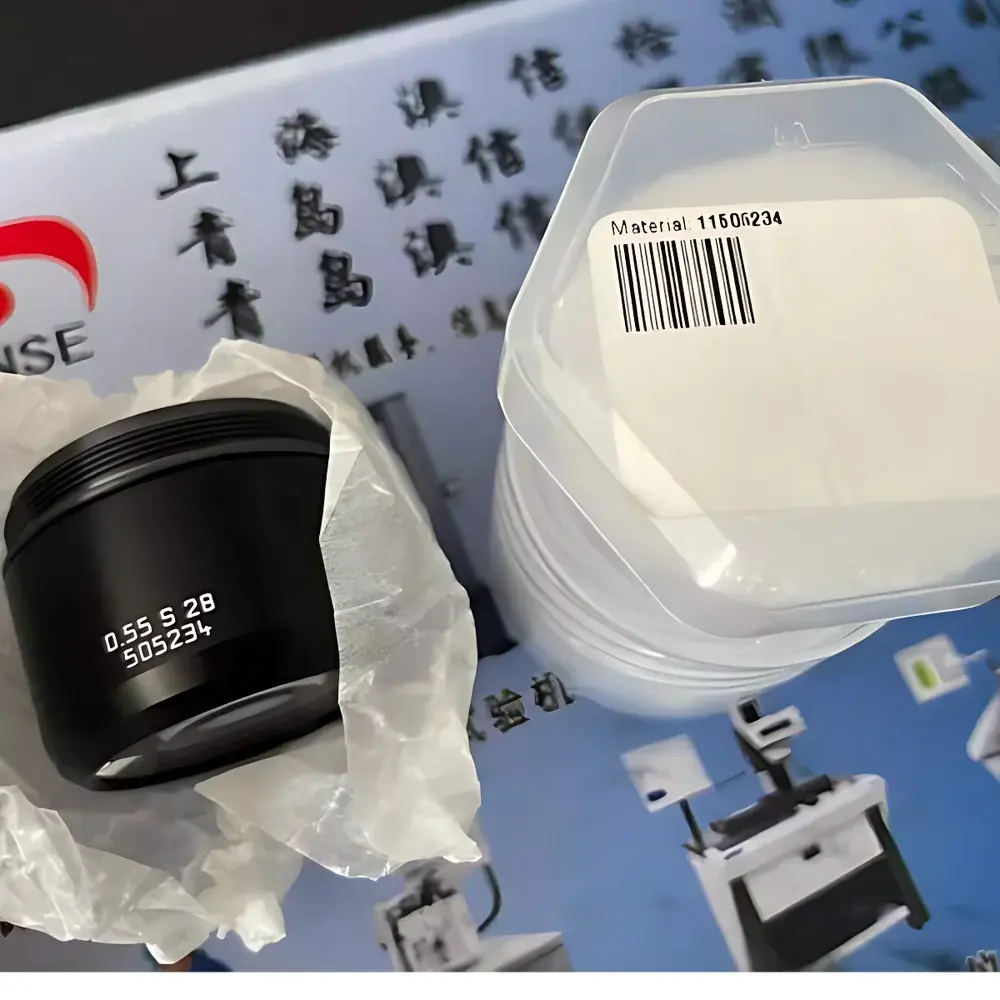
Leica 0.55x Reduction Lens for Microscopy Systems, Model No. 115055234
| Brand | Leica |
|---|---|
| Origin | Germany |
| Product Type | Optical Reduction Lens |
| Model Number | 115055234 |
| Mount Compatibility | Standard Leica Microscope C-Mount Interface |
| Magnification Factor | 0.55x |
| Optical Coating | Multi-layer Anti-Reflective Coating (AR) |
| Material | Precision-Grade Optical Glass |
| Compliance | CE Marked, RoHS Compliant |
| Warranty | 24 Months Limited Manufacturer Warranty |
Overview
The Leica 0.55x Reduction Lens (Model No. 115055234) is a precision-engineered optical accessory designed to extend the field of view and optimize imaging geometry in Leica upright and inverted microscopy systems. Operating on the principle of fixed-ratio magnification reduction, this lens integrates seamlessly into the optical train between the microscope body and camera adapter—effectively decreasing total system magnification by a factor of 0.55 while preserving image fidelity, resolution, and light transmission efficiency. Engineered for high reproducibility in quantitative imaging workflows, it enables consistent spatial calibration across multi-modal acquisition platforms—including brightfield, fluorescence, phase contrast, and DIC—making it essential for standardized documentation in metallurgical, materials science, and life science laboratories where field-of-view scalability directly impacts measurement traceability and comparative analysis.
Key Features
- Precision 0.55x magnification reduction with <±0.3% geometric distortion tolerance across full sensor area
- Multi-layer anti-reflective (AR) coating optimized for 400–1000 nm spectral range, minimizing ghosting and flare in fluorescence and broadband imaging
- Robust all-metal housing with threaded C-mount interface (17.526 mm flange distance), ensuring mechanical stability under repeated mounting cycles
- Optical path length compensation designed to maintain parfocality when used with Leica DFC or DM series digital cameras
- Thermally stable design with coefficient of thermal expansion matched to Leica microscope optical benches, reducing focus drift during extended acquisition sessions
Sample Compatibility & Compliance
This reduction lens is compatible with Leica DMi8, DM6 B, DM4 B, and DM2500 M platform microscopes when paired with standard C-mount camera adapters. It supports sensors up to 2/3″ format (11 mm diagonal) without vignetting. The lens conforms to ISO 10110-7:2019 (optical component surface quality) and EN 61000-6-3:2019 (EMC emissions). As an integral component in regulated environments, its use aligns with GLP-compliant documentation requirements for image-based particle size analysis (per ASTM E112-22), grain boundary quantification (per ASTM E112-22 and ISO 643:2021), and inclusion rating protocols (per ASTM E45-22). Full traceable calibration documentation is available upon request for audit-ready laboratory setups.
Software & Data Management
When deployed with Leica Application Suite X (LAS X) v3.7+, the lens is auto-recognized via firmware handshake, enabling automatic scaling factor application to measurement tools—including line profile intensity analysis, particle area thresholding, and stereological grid overlays. LAS X stores lens-specific metadata (including magnification factor, pixel-to-micron conversion, and illumination mode) within each acquired TIFF or LIF file header, supporting FDA 21 CFR Part 11–compliant audit trails when configured with electronic signatures and role-based access control. Raw data export preserves calibrated spatial metadata for downstream analysis in MATLAB, Python (OpenCV/scikit-image), or commercial metrology software such as Olympus Stream or Thermo Scientific Avizo.
Applications
- Metallurgical QC: Wide-field imaging of large-area metallographic sections for ASTM E112 grain size evaluation and ASTM E45 inclusion rating
- Geological thin-section analysis: Simultaneous capture of mineralogical context and textural detail at reduced magnification for petrographic mapping
- Electronics failure analysis: Full-die imaging of PCB cross-sections and solder joint interfaces prior to SEM correlation
- Biomedical tissue screening: Rapid low-magnification survey of H&E-stained histology slides prior to region-of-interest zoom-in
- Automated image stitching: Enables efficient mosaic acquisition over >5 mm × 5 mm fields using motorized stages without sacrificing resolution per tile
FAQ
Is this lens compatible with non-Leica microscope systems?
Yes—when used with appropriate C-mount adapters and back focal length compensation, it functions with Nikon Eclipse, Olympus BX/BX3, and Zeiss Axio Observer systems; however, parfocality and auto-recognition features are only guaranteed on Leica platforms.
Does the lens affect numerical aperture (NA) or depth of field?
No—the reduction lens does not alter the objective’s NA or working distance; it scales the intermediate image plane only, preserving optical performance parameters defined by the primary objective.
Can it be used with sCMOS or scientific CMOS cameras?
Yes—it supports all C-mount scientific cameras with ≤17.5 mm flange distance; for cameras with longer back focal lengths, optional extension tubes or relay lenses may be required.
Is recalibration required after installation?
A single pixel-to-micron calibration using a NIST-traceable stage micrometer is recommended post-installation; LAS X retains this calibration across subsequent sessions.
What maintenance is required?
Routine cleaning with lens-grade solvent and optical tissue is sufficient; no alignment or internal servicing is needed under normal laboratory conditions.







