
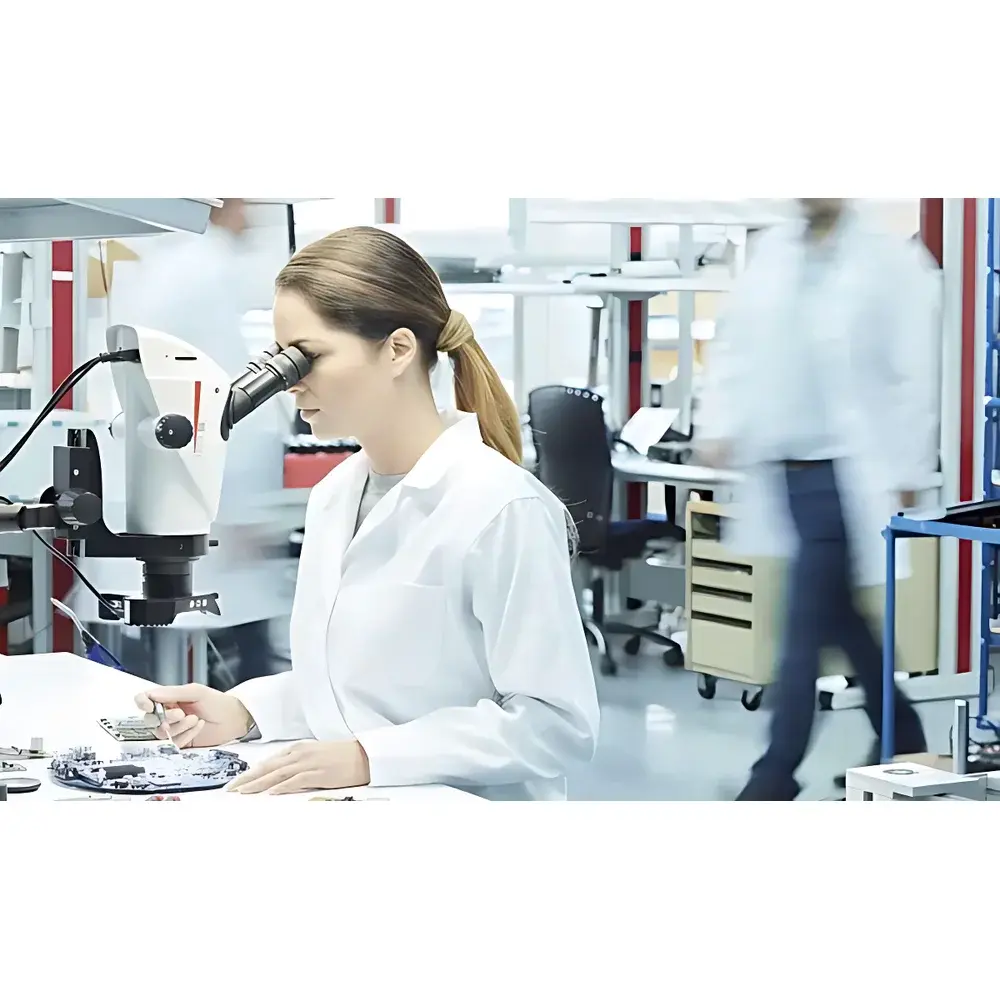
Leica S9i Stereo Microscope
| Brand | Leica |
|---|---|
| Origin | Germany |
| Manufacturer Type | Authorized Distributor |
| Import Status | Imported |
| Model | S9i |
| Total Magnification | 110x |
| Zoom Ratio | 9:1 |
| Field of View Diameter | 2 mm |
| Working Distance | 122 mm |
| Objective Type | Plan Apochromatic Greenough Objectives |
| Illumination | LED |
| Depth of Field | 12 mm |
| Numerical Aperture | 0.167 |
Overview
The Leica S9i Stereo Microscope is a high-performance Greenough-type stereomicroscope engineered for precision optical inspection in industrial quality control, electronics assembly, medical device manufacturing, and academic research laboratories. Based on Leica’s proprietary FusionOptics technology, the S9i delivers simultaneous high resolution and extended depth of field—up to 12 mm—enabling operators to maintain focus across complex three-dimensional topographies without repeated refocusing. This optical architecture leverages dual-path asymmetric beam splitting and apochromatically corrected zoom optics to eliminate chromatic aberration and spatial distortion across the entire magnification range (6.1× to 55×, extendable to 110× with auxiliary lenses). Designed for ISO 13485–compliant production environments and GLP-aligned analytical workflows, the S9i supports traceable, repeatable visual documentation under controlled lighting conditions using its integrated, color-calibrated LED illumination system.
Key Features
- FusionOptics technology: Combines high-resolution imaging with up to 3× greater depth of field versus conventional stereo microscopes—reducing operator fatigue and minimizing focus-related workflow interruptions.
- 9:1 zoom ratio with apochromatic correction: Enables seamless transition from overview (6.1×) to fine-detail inspection (55×), maintaining optical fidelity and geometric accuracy throughout the zoom range.
- 122 mm working distance: Provides ample clearance for manipulators, soldering tools, or sample-handling fixtures—critical for PCB rework, micro-assembly, and biological dissection applications.
- Integrated 10 MP CMOS camera with Gigabit Ethernet interface: Delivers real-time image streaming at up to 35 fps; supports DICOM-compliant metadata embedding and time-stamped frame capture for audit-ready documentation.
- Plan apochromatic Greenough objectives: Corrected for spherical and chromatic aberrations across visible spectrum (400–700 nm); numerical aperture of 0.167 ensures optimal light collection efficiency and lateral resolution.
- Ergonomic 38° inclined binocular tube: Reduces cervical strain during prolonged use; compatible with optional ergonomic stands and anti-fatigue eyepieces compliant with EN ISO 10993-1 biocompatibility standards.
Sample Compatibility & Compliance
The Leica S9i accommodates specimens ranging from semiconductor wafers and printed circuit boards to botanical sections and small-animal tissue samples. Its large working distance and wide field of view (2 mm diameter at 55×) support non-contact examination of fragile, coated, or electrostatic-sensitive materials. The microscope conforms to IEC 61000-6-3 (EMC emissions), IEC 61000-6-2 (immunity), and UL/CSA 61010-1 safety standards. Optical performance meets ISO 10934-1 (microscope nomenclature) and ISO 9335 (stereomicroscope calibration) requirements. For regulated environments, optional software modules provide 21 CFR Part 11–compliant electronic signatures, audit trails, and user-access controls aligned with FDA GMP and EU Annex 11 expectations.
Software & Data Management
Leica Application Suite X (LAS X) software is fully compatible with the S9i’s embedded camera and network interface. LAS X enables live annotation, multi-layer measurement (length, angle, area, particle count), and automated report generation in PDF or Excel formats. All image metadata—including magnification, illumination intensity, timestamp, user ID, and instrument serial number—is embedded in EXIF and stored in a searchable SQL database. Remote access via HTTPS allows off-site review by QA supervisors or cross-functional engineering teams. Raw image data is saved in lossless TIFF format; video sequences are encoded in H.264 with embedded SMPTE timecode for synchronization with external test equipment.
Applications
- Electronics manufacturing: Visual inspection of solder joints (IPC-A-610 Class 2/3), wire bonding integrity, and conformal coating uniformity.
- Medical device QC: Verification of laser-marked UDI codes, catheter tip geometry, and microfluidic channel clarity.
- Academic research: Dissection of zebrafish embryos, pollen morphology analysis, and mineral grain boundary characterization.
- Forensic science: Toolmark comparison, fiber identification, and gunshot residue pattern documentation.
- Materials science: Surface defect mapping on additive-manufactured metal parts per ASTM E112 grain size standards.
FAQ
Does the S9i support third-party camera integration?
Yes—the S9i includes a C-mount adapter and TTL synchronization port, enabling direct connection to select industrial CMOS/CCD cameras while preserving native illumination timing and exposure control.
Is the LED illumination adjustable for color temperature and intensity?
Yes—intensity is continuously variable from 10% to 100% via touchscreen or footswitch; correlated color temperature remains stable at 5700 K ± 150 K across all settings.
Can the S9i be validated for ISO 17025 laboratory accreditation?
Yes—Leica provides a full validation package including IQ/OQ protocols, traceable calibration certificates (NIST-traceable photometric standards), and uncertainty budgets for magnification and field-of-view measurements.
What is the maximum supported frame rate for video recording?
At full 10 MP resolution, the S9i records at 12 fps; at 2560 × 1920 resolution, it achieves 35 fps with hardware-accelerated H.264 encoding.
Are replacement objectives interchangeable across S9 Series models?
Yes—all S9-series Greenough objectives (e.g., S9 APO 8:1, S9 Plan 9:1) share identical mechanical interfaces and parfocal alignment; however, optical performance optimization requires firmware-matched calibration files loaded via LAS X.




