
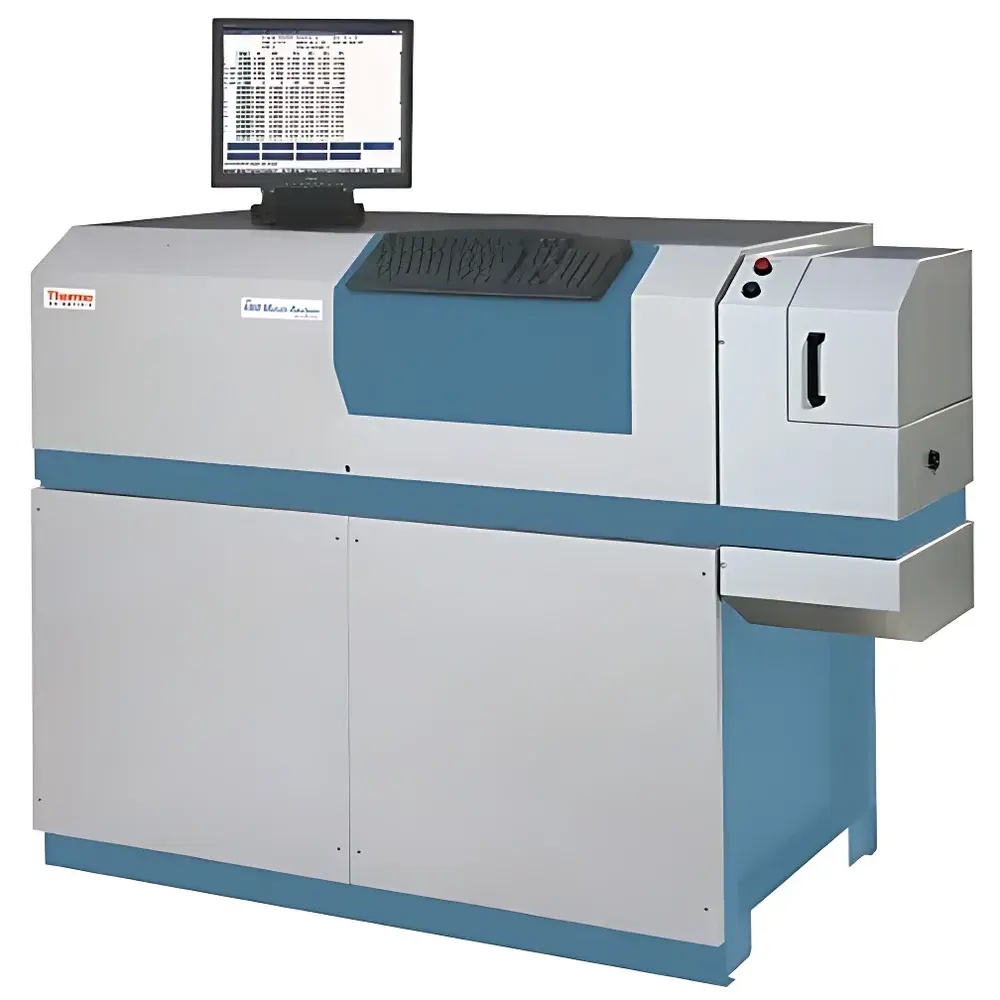
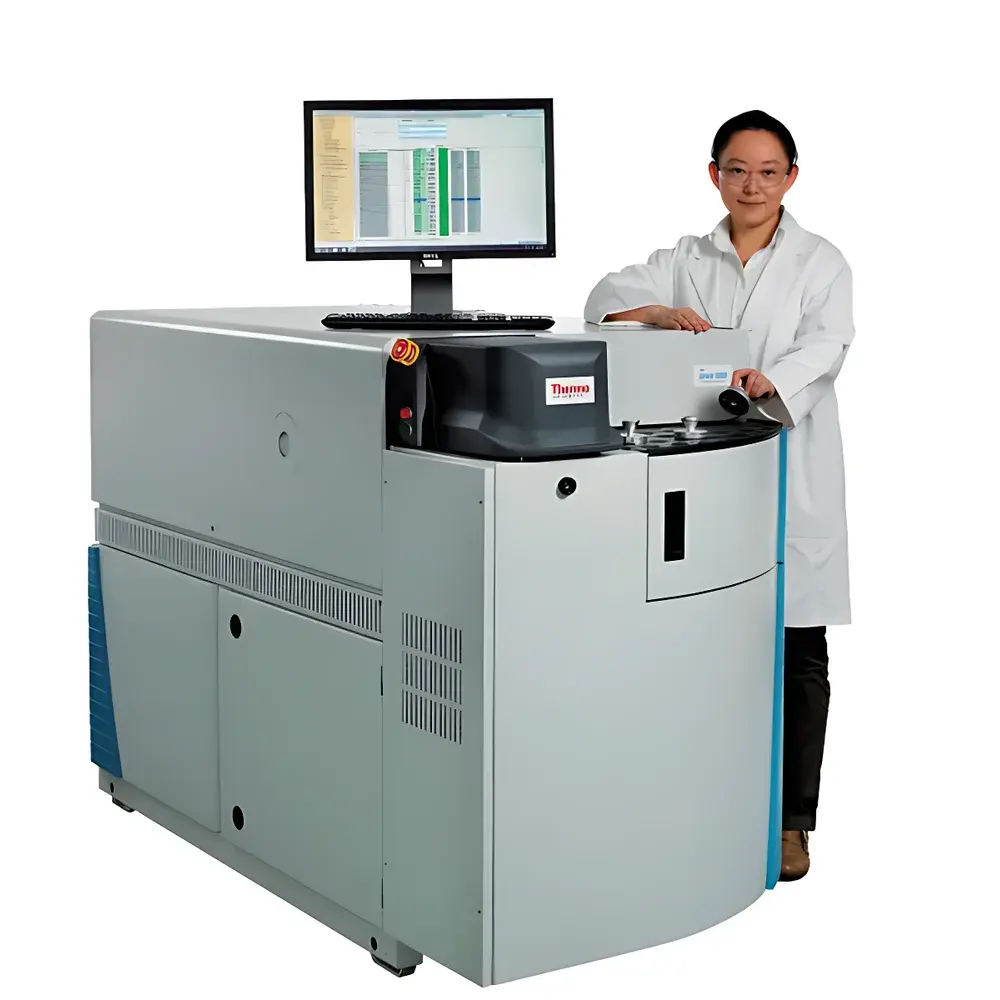
Thermo Fisher Scientific ARL 4460 Direct-Reading Optical Emission Spectrometer
| Brand | Thermo Fisher Scientific |
|---|---|
| Origin | Switzerland |
| Model | ARL 4460 |
| Instrument Type | Floor-Standing |
| Excitation Source | Spark |
| Detector Type | Photomultiplier Tube (PMT) |
| Focal Length | 1000 mm |
| Grating Line Density | 1080, 1667, and 2160 lines/mm |
| Wavelength Range | 120–850 nm |
| Number of Analytical Channels | 60 |
Overview
The Thermo Fisher Scientific ARL 4460 is a high-performance floor-standing direct-reading optical emission spectrometer (OES) engineered for precise, rapid, and trace-level elemental analysis of metallic materials. Operating on the principle of spark-induced atomic emission spectroscopy, the instrument vaporizes and excites sample surfaces using controlled high-voltage sparks, generating element-specific spectral lines detected across a broad UV-VIS-NIR range (120–850 nm). Its 1-meter focal length Paschen-Runge optical system—featuring interchangeable high-resolution gratings (1080, 1667, and 2160 gr/mm)—delivers exceptional wavelength dispersion, minimizing spectral overlap and enabling robust interference correction. Designed for demanding industrial environments—including steelmaking furnace labs, non-ferrous refining facilities, aerospace material QA/QC, and ultra-high-purity metal certification—the ARL 4460 integrates vacuum, thermal, and mechanical stability at the core of its architecture to ensure metrological integrity over extended operational cycles.
Key Features
- Current-Controlled Spark (CCS) source: Enables reproducible, low-noise excitation with optimized energy delivery per pulse—critical for achieving sub-ppm detection limits and <0.5% RSD short-term precision.
- Time-Resolved Spectroscopy (TRS): Discriminates analyte emission signals from plasma background and continuum radiation by temporal gating, significantly improving signal-to-background ratio and lowering detection limits for C, N, O, S, P, As, Bi, Sb, and Sn.
- Single large-volume vacuum chamber: Maintains stable vacuum ≤0.03 Torr (≤30 µmHg) continuously; reaches ≤0.01 mmHg when analyzing elements below 160 nm (e.g., C, P, S), eliminating air absorption artifacts.
- Active temperature stabilization: Precision-controlled air circulation system maintains optical chamber at 38.0 ± 0.1 °C—suppressing thermal drift and ensuring long-term wavelength calibration stability.
- Seismically isolated optical bench: Minimizes micro-vibrational perturbations that degrade spectral line shape and intensity reproducibility.
- 60-channel PMT array with Ø28 mm photomultipliers: Coupled with built-in fatigue lamps to reduce dark current and dead-time effects—enhancing signal fidelity and extending detector lifetime.
- Water-cooled spark stand: Sustains consistent ablation geometry and plasma stability during high-throughput routine analysis (>100 samples/day).
Sample Compatibility & Compliance
The ARL 4460 supports solid metallic samples—including ferrous alloys (steels, cast irons), non-ferrous metals (Al, Cu, Mg, Ti, Ni, Zn base), precious metals (Au, Ag, Pt group), and ultra-pure materials (99.999%+ purity). It complies with ASTM E415, E1086, E1479, ISO 11577, ISO 6871, and GB/T 4336 for routine metallurgical analysis. The instrument’s hardware and OXSAS software support full audit trails, electronic signatures, and data integrity features aligned with FDA 21 CFR Part 11 and GLP/GMP laboratory requirements. Factory calibration curves—generated from >2,000 certified reference materials covering >40 alloy families—are traceable to NIST, BAM, and IRMM standards and include matrix-matched interference corrections for inter-element and spectral overlaps.
Software & Data Management
OXSAS (Optical eXpert Spectral Analysis System) is a Windows-based platform offering intuitive graphical workflow management, real-time spectral visualization, and automated quality control monitoring. It supports multi-level user access control, method versioning, and raw spectrum archiving in vendor-neutral formats (e.g., .spc, .csv). Advanced quantification modules include internal standard normalization, background correction algorithms, and Spark-DAT mode for single-spark transient acquisition—enabling inclusion analysis (e.g., oxide/sulfide clusters) and statistical evaluation of heterogeneity. Data export interfaces include OPC-UA, SQL Server, and LIMS integration via ASTM E1382-compliant protocols.
Applications
- Ferrous metallurgy: Rapid QC of carbon, nitrogen, oxygen, sulfur, phosphorus, and trace tramp elements in stainless steels, tool steels, and low-alloy grades.
- Non-ferrous production: Certification of Al-Si, Cu-Zn, Mg-Al alloys, and high-conductivity copper for automotive and electronics applications.
- Aerospace & defense: Trace analysis of Hf, Ta, Re, and rare earths in superalloys (Inconel®, Waspaloy®) per AMS and SAE specifications.
- Precious metal refining: Quantification of ppm-level impurities (Fe, Ni, Pb, Bi) in gold bullion and platinum group metals per LBMA and ISO 11426.
- Research & development: High-resolution mapping of segregation profiles and inclusion composition using time-resolved spark acquisition.
FAQ
What vacuum level is required for accurate analysis of carbon and sulfur?
Carbon (165.7 nm) and sulfur (180.7 nm) require vacuum conditions ≤0.01 mmHg to minimize atmospheric nitrogen and oxygen absorption—achievable via the ARL 4460’s continuously pumped single-chamber design.
Can the ARL 4460 analyze non-conductive samples?
No—it is optimized for conductive metallic solids only. Non-conductors require alternative techniques such as laser-induced breakdown spectroscopy (LIBS) or XRF.
Is factory calibration sufficient for regulatory compliance?
Yes—ARL factory calibrations are traceable to international CRM providers and include documented uncertainty budgets, matrix-matched interference modeling, and validation reports meeting ISO/IEC 17025 requirements.
How often is recalibration required under continuous operation?
Due to its thermal and vacuum stability, the ARL 4460 typically maintains calibration for 5–30 days without drift correction—reducing consumable usage, argon consumption, and downtime versus conventional OES systems.
Does OXSAS support automated report generation for ISO-certified labs?
Yes—OXSAS includes configurable templates compliant with ISO 17025 reporting clauses, automatic inclusion of measurement uncertainty, CRM identification, and digital signature workflows for audit-ready documentation.





