
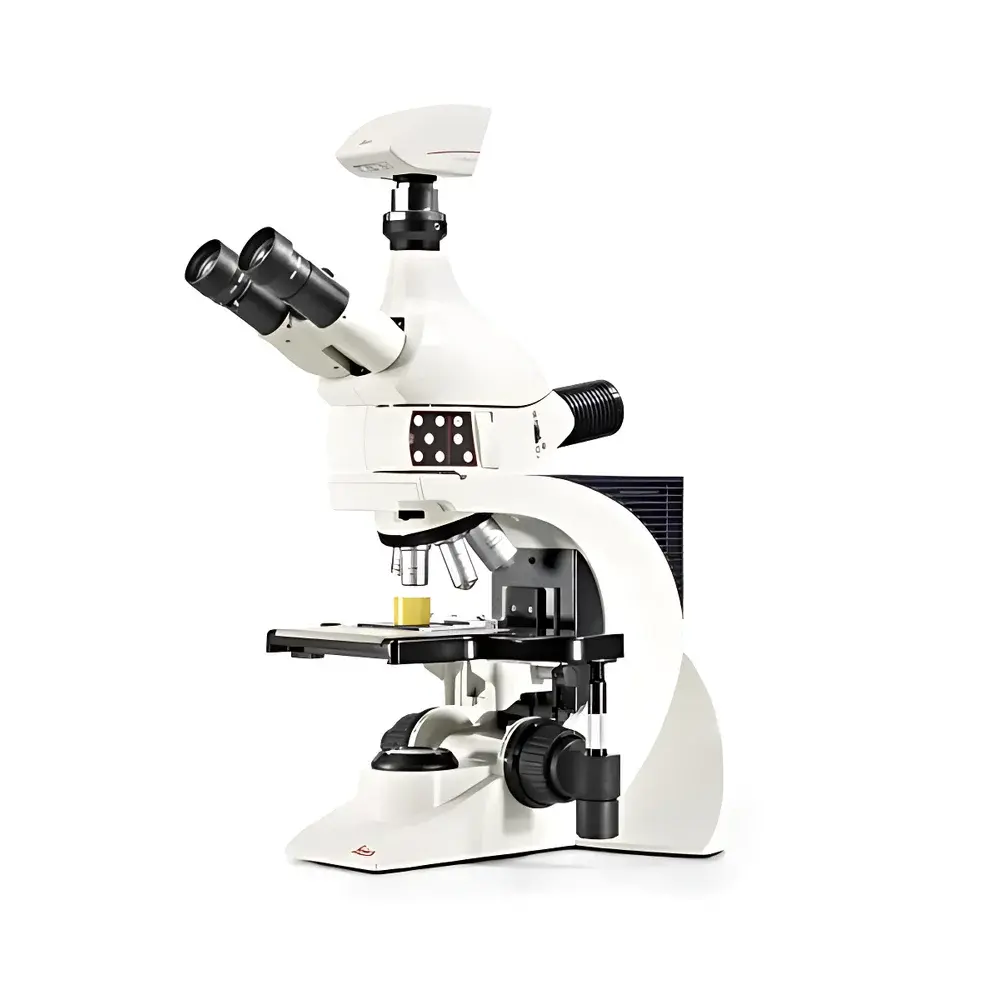
Leica DM1750 M Metallurgical Microscope
| Brand | Leica |
|---|---|
| Origin | Germany |
| Model | DM1750 M |
| Configuration | Upright |
| Image Analysis System | Integrated |
| Total Magnification Range | 7×–1000× |
| Eyepiece | 10× |
| Objective Magnifications | 0.7×–100× |
| Illumination | Power-LED Reflected Light with 4-Quadrant Adjustable Segments |
| Tilt Illumination | Built-in OBL (Oblique) Mode |
| Condenser | Built-in Adjustable Aperture Diaphragm |
| Stage Surface | Industrial-grade Ceramic Coating |
| Focusing Mechanism | Patented Height-Adjustable Coaxial Focus Knobs |
| Maximum Specimen Height | 80 mm |
| Polarization Capability | Dual-slot Analyzer/Polizer Mount |
Overview
The Leica DM1750 M is a high-performance upright metallurgical microscope engineered for rigorous materials characterization in industrial quality control laboratories, failure analysis centers, and academic metallurgy research environments. Designed according to ISO 9001-compliant manufacturing standards in Wetzlar, Germany, it employs Köhler illumination principles in reflected light mode—optimized for opaque, non-transmissive specimens such as metals, alloys, ceramics, composites, and coated surfaces. Its optical architecture integrates Leica’s HI PLAN objective series, delivering flat-field correction, chromatic fidelity across the visible spectrum (400–700 nm), and consistent contrast enhancement in brightfield, oblique, and polarized light modalities. The system’s mechanical stability, thermal drift resistance, and vibration-damped base ensure measurement repeatability under demanding production-floor conditions—fully aligned with ASTM E3, ISO 643, and EN 1042 metallographic evaluation protocols.
Key Features
- Reflected-light illumination powered by a long-life (≥20,000 h) cold-white Power-LED with independently controllable four-quadrant segments—enabling precise oblique illumination for topographic contrast enhancement and micro-scratch detection.
- Integrated adjustable aperture diaphragm within the illumination path—ensuring optimal numerical aperture matching and glare-free, maintenance-free illumination across all magnifications.
- 6-position or 7-position precision-machined nosepiece with parfocal and parcentric alignment—guaranteeing seamless objective transitions without refocusing or centering adjustments.
- Ultra-hard ceramic-coated mechanical stage—engineered for abrasion resistance, dimensional stability, and long-term positional accuracy in high-cycle industrial use.
- Ergonomic membrane keypad with tactile feedback—providing intuitive one-touch activation of OBL (oblique) mode, LED intensity control, and polarization filter insertion.
- Height-adjustable coaxial focus knobs—patented design accommodating diverse user anthropometrics and reducing repetitive strain during extended inspection sessions.
- Dual-slot analyzer/polarizer mount—supporting quantitative birefringence analysis, grain orientation mapping, and phase identification per ASTM E112 and ISO 8563.
Sample Compatibility & Compliance
The DM1750 M accommodates specimens up to 80 mm in height and 150 × 150 mm in planar dimension—ideal for large-section metallographic mounts, castings, weld joints, and cross-sectional PCBs. Its rigid optical train maintains focus stability across temperature fluctuations (15–30 °C operational range), satisfying GLP-compliant documentation requirements for audit-ready material certification. All optical components comply with RoHS 2011/65/EU directives; LED illumination meets IEC 62471 photobiological safety Class 1 standards. The system supports integration into ISO/IEC 17025-accredited testing workflows and facilitates traceable reporting when paired with Leica Application Suite (LAS) X software.
Software & Data Management
The microscope ships with Leica LAS X Core software—validated for 21 CFR Part 11 compliance with electronic signature support, full audit trail logging, and role-based user access controls. It enables automated image capture, multi-point measurement (grain size, inclusion rating, porosity quantification), and batch-report generation compliant with ASTM E112, E1245, and ISO 9042. Raw TIFF and proprietary .lif file formats preserve metadata including objective ID, magnification, illumination mode, and timestamp—ensuring data integrity for regulatory submissions and inter-laboratory comparison studies.
Applications
- Quantitative metallography: grain size analysis (ASTM E112), inclusion rating (ASTM E45), and phase fraction determination.
- Surface defect inspection: micro-crack detection, machining mark assessment, coating delamination, and corrosion morphology evaluation.
- Failure analysis: fracture surface characterization, fatigue striation measurement, and solder joint integrity verification.
- Polarized light microscopy: crystallographic orientation mapping in aluminum alloys, titanium phases, and ferritic-austenitic duplex steels.
- Quality assurance in foundries, heat treatment facilities, and additive manufacturing post-processing lines.
FAQ
Does the DM1750 M support motorized Z-axis or autofocus?
No—the DM1750 M is a manually operated microscope optimized for robustness and cost-effective routine analysis. Motorized focus and stage options are available on the higher-tier DM6 M platform.
Can third-party image analysis software be used with this microscope?
Yes—via TWAIN or DirectShow drivers, the system interfaces with industry-standard platforms including ImageJ (with FIJI distribution), Olympus Stream, and Thermo Scientific™ Amira for advanced 3D reconstruction.
Is the LED illumination intensity calibrated and traceable to NIST standards?
While the LED output is factory-stabilized and thermally regulated, absolute photometric calibration requires optional integration with a NIST-traceable luminance meter (e.g., Konica Minolta CS-2000); Leica provides calibration certificates for illumination uniformity and color temperature (6500 K ± 150 K).
What is the warranty coverage for the ceramic stage and LED module?
Leica offers a standard 2-year limited warranty covering parts and labor; the ceramic stage and LED engine are covered for 5 years against manufacturing defects under normal laboratory use conditions.
Are objectives compatible with Leica DM2750 or DM4 M models?
Yes—all HI PLAN, HC PL FLUOTAR, and long-working-distance (LWD) objectives designed for Leica’s M-series metallurgical microscopes share mechanical and optical interface specifications, ensuring full interchangeability.




