
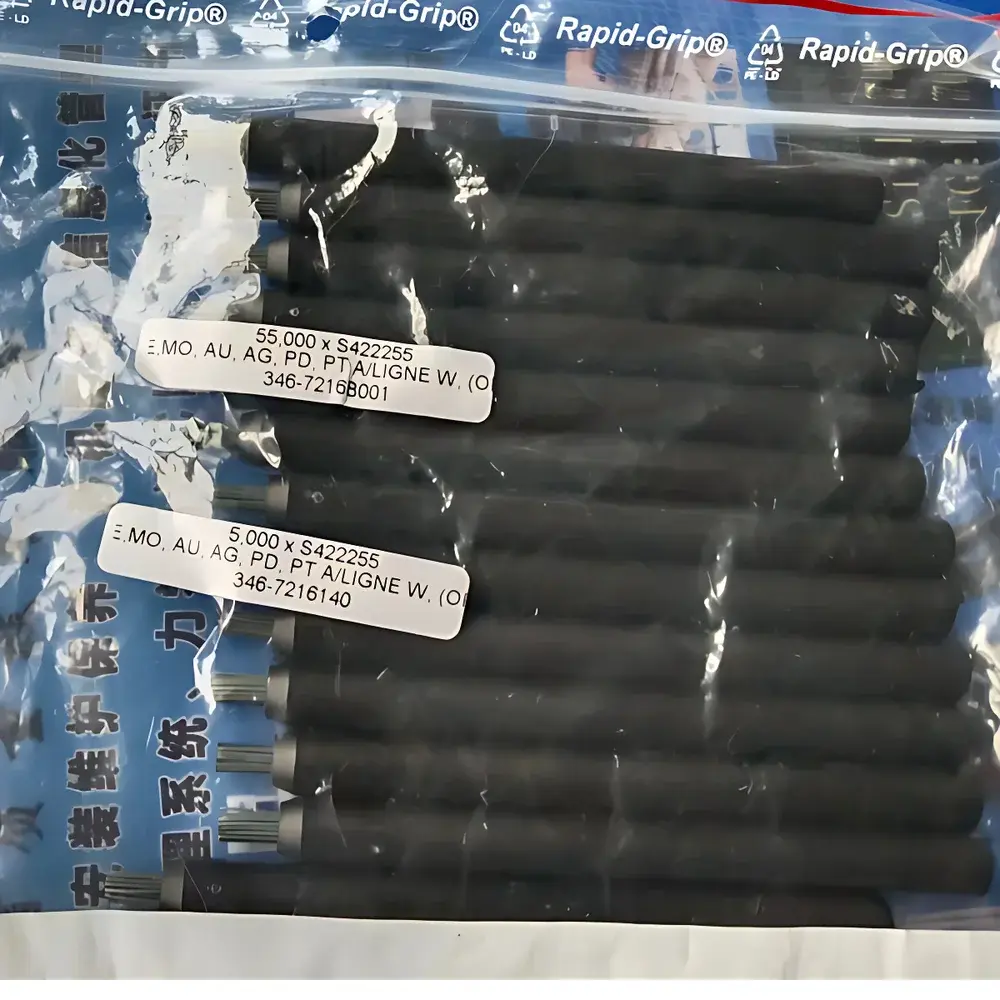
Thermo Fisher Spectrometer Electrode Brush S422255
| Brand | Thermo Fisher |
|---|---|
| Origin | USA |
| Manufacturer Type | Authorized Distributor |
| Origin Category | Imported |
| Model | S422255 |
| Pricing | Upon Request |
Overview
The Thermo Fisher Spectrometer Electrode Brush S422255 is a precision-engineered consumable component designed for routine maintenance and optimal performance of arc/spark optical emission spectrometers (OES), particularly Thermo Fisher ARL 8860 direct-reading spectrometers. This electrode brush functions as a critical cleaning tool for the excitation electrode—typically a tungsten or copper-based anode—removing oxide layers, carbon deposits, and residual sample matrix contaminants accumulated during repeated spark discharges. Its design ensures consistent electrode geometry and surface finish, directly influencing plasma stability, spectral line intensity reproducibility, and long-term calibration integrity. Unlike generic wire brushes, the S422255 incorporates calibrated bristle stiffness, controlled tip geometry, and non-contaminating stainless-steel construction to prevent metallic cross-contamination during cleaning—a requirement mandated under ISO/IEC 17025-accredited metallographic and compositional analysis workflows.
Key Features
- Engineered specifically for Thermo Fisher ARL 8860 OES systems and compatible with other Thermo Fisher spark source spectrometers requiring standardized electrode maintenance
- Stainless-steel bristles with precisely controlled diameter (0.15 mm) and uniform tapering to access narrow electrode grooves without mechanical deformation
- Non-magnetic, low-particulate construction compliant with ASTM E1999 and ISO 11573 standards for trace metal analysis environments
- Ergonomic handle with chemical-resistant polymer coating for secure grip during glove-compatible operation in cleanroom or laboratory settings
- Batch-certified lot documentation provided with each package, supporting GLP/GMP traceability requirements for regulated metallurgical QA/QC labs
Sample Compatibility & Compliance
The S422255 is validated for use across ferrous and non-ferrous alloy matrices—including low-alloy steels, aluminum alloys (e.g., 6061, 7075), copper-base alloys, and titanium grades—where surface oxide removal prior to spark ablation is essential for minimizing inter-element interference (e.g., Mn–Fe, Cr–Mo spectral overlaps). It meets material compatibility requirements for ISO 148-1 (impact testing specimen preparation), ASTM E3022 (spectral calibration verification), and USP (elemental impurities testing by OES). The brush itself contains no lubricants, coatings, or organic binders that could volatilize during spark excitation and introduce background C/N/O signals above detection thresholds (<5 ppm).
Software & Data Management
While the S422255 is a hardware consumable with no embedded electronics or firmware, its usage is integrated into Thermo Fisher’s ARL QUANTOM software maintenance protocols. The software logs electrode cleaning events via operator-initiated “Maintenance Record” entries, enabling correlation between brush usage cycles and instrument performance metrics—including relative standard deviation (RSD) of certified reference material (CRM) intensities over time. Audit trails generated through ARL QUANTOM comply with FDA 21 CFR Part 11 when configured with electronic signatures and system-level access controls, ensuring full traceability from brush application to final report generation in regulated environments.
Applications
- Routine electrode conditioning between sample analyses on ARL 8860, ARL iSpark, and legacy ARL 3460/4460 spectrometers
- Restoration of electrode tip geometry after high-energy spark sequences used in high-precision alloy certification (e.g., aerospace-grade Ti-6Al-4V)
- Preventive maintenance during extended production runs in foundry and steel mill QA laboratories
- Supporting ISO/IEC 17025 method validation studies where electrode surface state is identified as a key influence parameter (KIP)
- Enabling compliance with automotive OEM specifications (e.g., Ford WSS-M1A366-B, GM GMW14872) requiring documented electrode maintenance intervals
FAQ
How often should the S422255 brush be replaced?
Replacement frequency depends on spark count and matrix aggressiveness; typical service life is 200–300 cleaning cycles for steel analysis. Visual inspection for bristle splaying or tip wear is recommended before each use.
Can the S422255 be used on non-Thermo Fisher spectrometers?
It is dimensionally optimized for Thermo Fisher ARL series electrodes. Use on competing platforms (e.g., Bruker Q4, SPECTRO LAB) requires verification of electrode thread pitch, recess depth, and tip radius compatibility.
Does this brush require calibration or certification?
No calibration is required, but each batch is supplied with a Certificate of Conformance referencing ASTM E1121 and Thermo Fisher internal specification TFS-SPC-0422255-REV3.
Is the S422255 suitable for ultra-trace analysis (sub-ppm levels)?
Yes—its low-metallic-leach construction and absence of organic residues ensure minimal contribution to background spectra, supporting detection limits per ASTM E1086 for elements such as Pb, Sn, and As in aluminum alloys.




