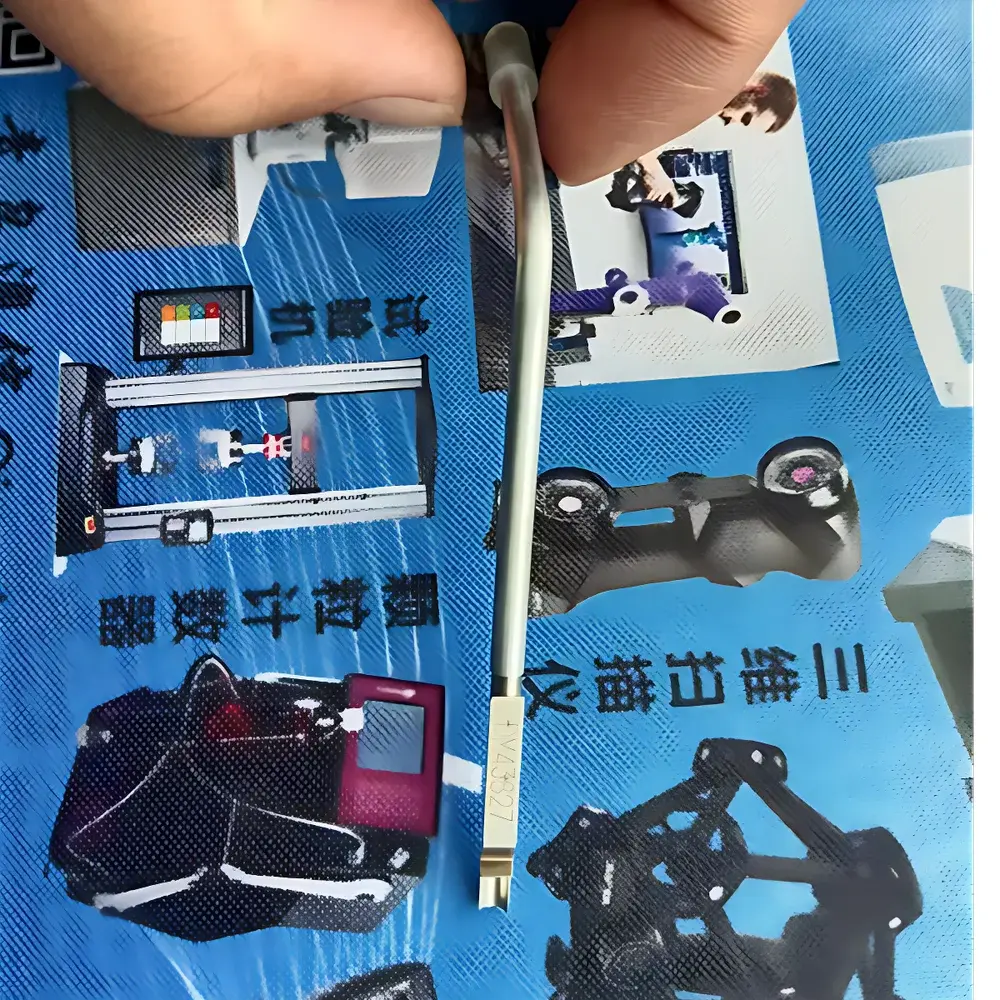
Accretech DM43827 Stylus Profilometer
| Brand | Accretech |
|---|---|
| Origin | Japan |
| Model | DM43827 |
| Type | Contact Stylus-Based Surface Profilometer |
| Compliance | ISO 4287, ISO 4288, ISO 25178-2 (areal parameters), JIS B 0601, ASTM E1092 |
| Measurement Principle | Inductive Linear Variable Differential Transformer (LVDT) with Diamond Stylus Scanning |
| Stylus Tip Radius | 2 µm (standard), optional 5 µm or 12.5 µm |
| Vertical Resolution | ≤ 0.1 nm (sub-nanometer analog signal processing) |
| Scan Length | Up to 100 mm (motorized precision stage) |
| Lateral Sampling Interval | Adjustable from 0.01 µm to 10 µm |
| Vertical Range | ±1 mm |
| Speed Control | 0.01–1.0 mm/s (programmable scan velocity) |
| Data Points per Profile | Up to 1,000,000 points |
Overview
The Accretech DM43827 is a high-precision contact stylus profilometer engineered for traceable, repeatable surface topography characterization in metrology laboratories, R&D centers, and quality control environments. It operates on the principle of mechanical scanning using a diamond-tipped stylus coupled with a high-stability LVDT displacement sensor, enabling direct measurement of surface height variations with sub-nanometer vertical resolution. Unlike optical interferometric or focus-variation systems, the DM43827 delivers absolute height data without phase ambiguity or material-dependent contrast limitations—making it particularly suitable for measuring matte, non-reflective, or multi-layered surfaces where optical methods encounter ambiguity. Its rigid granite base, air-isolated vibration damping platform, and thermally stabilized encoder-driven linear stage ensure long-term measurement stability under ambient laboratory conditions (20 ± 1 °C, 40–60% RH). Designed and manufactured in Japan, the instrument meets stringent requirements for dimensional metrology traceability to national standards (NMIJ/JCSS), supporting calibration intervals aligned with ISO/IEC 17025-accredited procedures.
Key Features
- Modular stylus holder accommodating standard tip radii (2 µm, 5 µm, 12.5 µm) with certified radius calibration certificates available upon request
- Programmable scan velocity (0.01–1.0 mm/s) and lateral sampling interval (0.01–10 µm), enabling optimization for both high-speed screening and ultra-high-resolution profile capture
- Dual-axis motorized stage with 100 mm travel range and 0.1 µm positioning repeatability, supporting automated multi-point mapping across large workpieces
- Analog front-end signal conditioning with 24-bit ADC and real-time digital filtering, minimizing quantization noise and preserving low-amplitude roughness features
- Integrated environmental monitoring module (temperature, humidity, barometric pressure) for post-acquisition thermal drift correction in compliance with ISO 25178-701
- CE-marked enclosure with ESD-safe housing and EMC-compliant power supply, meeting IEC 61326-1 for industrial laboratory use
Sample Compatibility & Compliance
The DM43827 accommodates flat, curved, and gently contoured samples up to Ø200 mm × 50 mm height, with optional vacuum chucks or custom fixtures for irregular geometries. It supports metallic, ceramic, polymer, and coated substrates—including electroplated layers, PVD/CVD thin films, and machined bearing surfaces. All reported roughness (Ra, Rz, Rq), waviness (Wa, Wt), and form parameters comply with ISO 4287:2020 (profile method), ISO 4288:1996 (filtering and evaluation), and ISO 25178-2:2021 (areal surface texture). For regulated industries, raw profile data files include embedded metadata (timestamp, operator ID, environmental readings, calibration certificate IDs) to support GLP/GMP audit trails. Instrument validation documentation (IQ/OQ/PQ protocols) and 21 CFR Part 11-compliant software modules are available as optional add-ons.
Software & Data Management
The bundled Accretech ProfilMaster v5.2 software provides full control over acquisition, filtering (Gaussian, Spline, Robust), parameter calculation, and report generation. It supports batch processing of multiple profiles with customizable templates compliant with internal SOPs or external standards (e.g., ASTM E1092 for surface finish reporting). Data export formats include ASCII (.txt), CSV, XML (ISO 25178-702 conformant), and native .APF binary files with embedded calibration traceability. The software architecture includes role-based access control, electronic signature capability, and immutable audit logs recording all user actions, parameter changes, and file modifications—fully compatible with FDA 21 CFR Part 11 and EU Annex 11 requirements when deployed on validated Windows OS platforms.
Applications
- Quantitative assessment of grinding, lapping, honing, and EDM surface integrity in aerospace turbine components and medical implant manufacturing
- Verification of surface texture specifications for sealing interfaces in hydraulic valves and fuel injection nozzles per ISO 4288 tolerance bands
- Long-term wear track analysis in tribology studies, including depth profiling across sliding paths under controlled load cycles
- Post-process validation of additive manufacturing build layers, detecting stair-stepping artifacts, porosity-induced height deviations, and support removal marks
- Calibration transfer between coordinate measuring machines (CMMs) and surface metrology labs via certified reference specimens (e.g., NIST SRM 2101)
- Failure analysis of micro-electromechanical systems (MEMS), where step heights below 10 nm must be resolved without charging artifacts inherent to SEM-based methods
FAQ
What stylus tip radius should I select for measuring ground steel surfaces with Ra ≈ 0.4 µm?
For conventional ground surfaces in the Ra 0.1–1.0 µm range, a 2 µm radius stylus is recommended to resolve fine peaks while maintaining adequate tip life and avoiding ploughing effects.
Can the DM43827 measure inside a bore with diameter ≥ 15 mm?
Yes—using the optional narrow-profile probe kit (ACCRETECH P-DM-BOR-15), the system supports internal cylindrical measurements down to Ø15 mm with radial runout compensation enabled.
Is raw profile data exportable without proprietary software?
Yes—ASCII and CSV exports contain unfiltered height values with calibrated X/Y/Z coordinates, fully compatible with MATLAB, Python (NumPy/Pandas), and third-party metrology analysis tools.
Does the system require annual recalibration by an accredited lab?
Per ISO/IEC 17025 recommendations, we advise biannual verification using certified step-height and roughness standards (e.g., NPL or PTB traceable), with full recalibration every 24 months or after major mechanical impact.
How is thermal drift compensated during extended scans (>30 min)?
The integrated environmental sensor feeds real-time temperature data into the software’s drift-correction algorithm, applying linear expansion coefficients specific to the sample material and stage substrate (granite or Invar).