
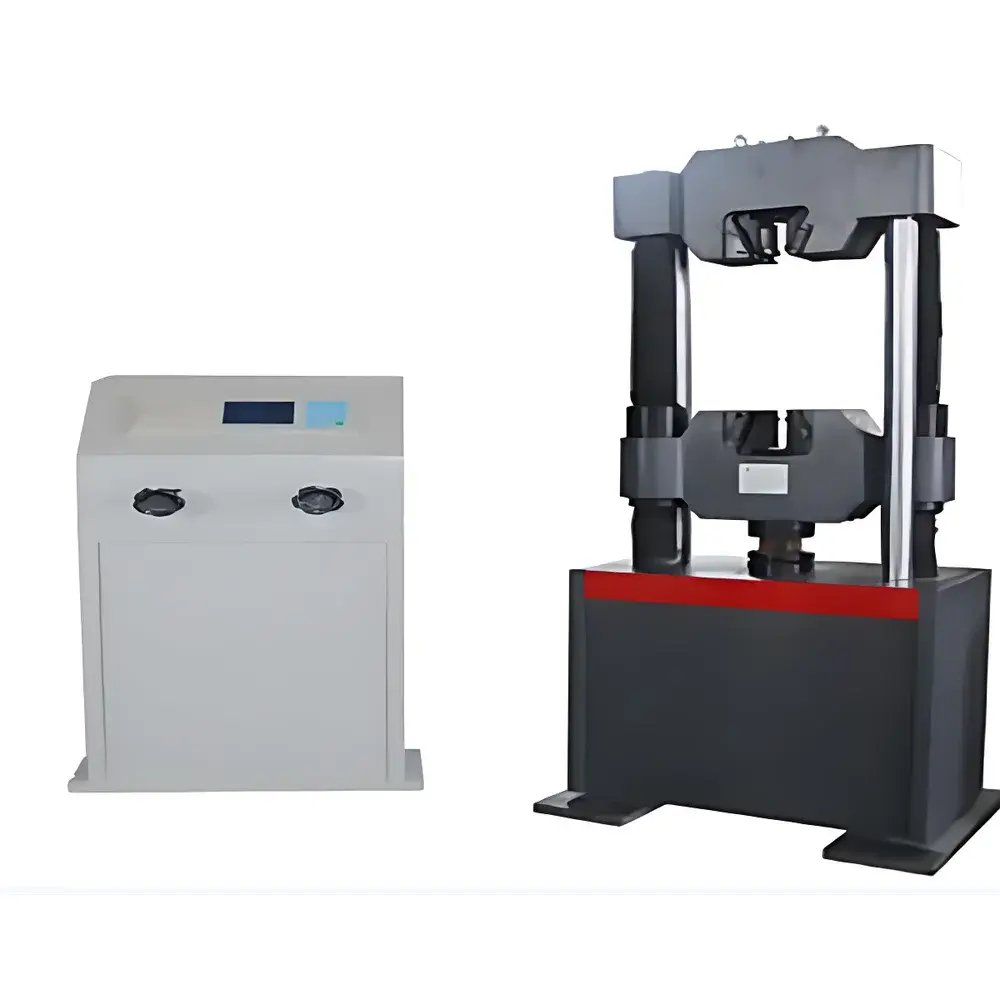
YANRUN WES-300B Electro-Hydraulic Servo Universal Testing Machine
| Brand | YANRUN |
|---|---|
| Origin | Shanghai, China |
| Manufacturer Type | Direct Manufacturer |
| Country of Origin | China |
| Model | WES-300B |
| Instrument Type | Electro-Hydraulic Servo Testing Machine |
| Max Test Load | 300 kN |
| Max Tensile Jaw Spacing | 600 mm |
| Flat Specimen Clamping Range | 0–15 mm |
| Round Specimen Clamping Range | Φ6–Φ26 mm |
| Compression Test Height | 550 mm |
| Piston Stroke | 150 mm |
| Load Indication Accuracy | ±1% of full scale |
| Bend Support Roller Spacing | 30–400 mm |
| Column Spacing | 460 mm |
| Motor Power | 3 kW |
| Overall Dimensions (W×D×H) | 730 × 570 × 1845 mm |
| Weight | 2100 kg |
Overview
The YANRUN WES-300B Electro-Hydraulic Servo Universal Testing Machine is a precision-engineered static mechanical testing system designed for high-force tensile, compression, bending, and shear evaluations of metallic, polymeric, composite, and ceramic materials. Built on a robust dual-column frame architecture with integrated hydraulic actuation and closed-loop servo control, the WES-300B operates in accordance with fundamental principles of mechanical stress–strain analysis—applying controlled axial force via a high-stiffness piston-cylinder assembly while continuously monitoring load, displacement, and strain through calibrated transducers. Its 300 kN capacity enables routine qualification testing per ASTM E8/E21 (tensile properties of metals), ASTM C39/C109 (concrete and mortar compression), ISO 6892-1 (metallic materials tensile testing at ambient temperature), and GB/T 228.1 (Chinese national standard equivalent). The machine’s structural rigidity, thermal stability, and low hysteresis design ensure high reproducibility across repeated test cycles—critical for quality control laboratories, R&D centers, and third-party certification facilities requiring audit-ready mechanical validation.
Key Features
- Electro-hydraulic servo control system delivering precise load and displacement regulation with real-time feedback from dual-channel load cell and extensometer inputs
- Dual-column rigid frame with 460 mm column spacing and reinforced base plate, engineered to minimize deflection under maximum 300 kN loading
- Adjustable jaw configuration supporting both flat specimens (0–15 mm thickness) and round specimens (Φ6–Φ26 mm diameter) using self-aligning wedge-action grips
- Compression space optimized to 550 mm height, compatible with standard concrete cylinders (150 × 300 mm) and metal compression blocks per ASTM C39 and ISO 13314
- Bending fixture set enabling three-point flexural tests with roller support spacing adjustable from 30 mm to 400 mm, compliant with ASTM D790 and ISO 178
- 3 kW high-efficiency servo motor driving a low-noise gear pump, ensuring stable pressure delivery and reduced thermal drift during extended test sequences
- Integrated digital control panel with LCD display showing real-time load (kN), displacement (mm), and test rate (mm/min), supplemented by USB and RS232 interfaces for external data acquisition
Sample Compatibility & Compliance
The WES-300B accommodates standardized specimen geometries defined in international mechanical testing protocols—including ASTM E8 round bar coupons (Φ12.7 mm), flat sheet tensile specimens (12.5 mm gauge width), and ISO 6892-1 Type 2 specimens. Its clamping mechanism ensures uniform stress distribution without premature slippage or edge damage. All mechanical components conform to ISO 7500-1 Class 1 accuracy requirements for force measurement systems. The system supports GLP-compliant operation when paired with validated software: raw load–displacement data are timestamped and stored with instrument ID, operator ID, and environmental metadata (where sensor-equipped), satisfying traceability demands under ISO/IEC 17025 and FDA 21 CFR Part 11 when electronic records are implemented with audit trail functionality.
Software & Data Management
The included PC-based test control and analysis software provides ISO-standardized test method templates (e.g., tensile, compression, bend), automated parameter calculation (YS, UTS, elongation, modulus), and export to CSV, PDF, and XML formats. Raw data files retain full resolution at ≥100 Hz sampling rate, preserving transient behavior during yield onset or fracture propagation. Software features include multi-curve overlay, statistical batch reporting, and customizable report headers with company logo and QA stamp fields. Optional add-ons enable integration with LIMS platforms via OPC UA or RESTful API, supporting centralized data governance in regulated manufacturing environments.
Applications
- Mechanical property verification of structural steel, aluminum alloys, and stainless grades in foundry and fabrication QA labs
- Compressive strength assessment of precast concrete elements, cementitious composites, and geopolymer binders
- Flexural performance evaluation of fiber-reinforced polymer (FRP) laminates and sandwich core materials
- Validation of weld joint integrity per AWS D1.1 and ISO 15614-1 mechanical testing requirements
- Educational use in university materials science laboratories for hands-on stress–strain curve derivation and failure mode analysis
- Third-party conformity assessment for CE marking, CCC certification, and ASME Section II material acceptance
FAQ
What standards does the WES-300B support out-of-the-box?
The system is configured to execute test routines aligned with ASTM E8, ISO 6892-1, GB/T 228.1, ASTM C39, and ISO 178; method parameters can be modified within software to meet additional regional or industry-specific standards.
Is the load cell calibrated and certified?
Yes—the factory-installed load cell is calibrated against NIST-traceable deadweight standards and supplied with a certificate of calibration valid for 12 months from shipment.
Can the machine perform cyclic or fatigue testing?
No—the WES-300B is a static-loading electro-hydraulic servo system; it does not support high-frequency dynamic or low-cycle fatigue modes. For such applications, a dedicated electrodynamic or resonant fatigue tester is recommended.
What maintenance is required for long-term accuracy?
Annual recalibration of the load cell and displacement transducer is advised; hydraulic oil should be replaced every 24 months or after 2000 operating hours, whichever occurs first.
Is remote diagnostics supported?
Standard configuration includes Ethernet connectivity for firmware updates and basic remote status monitoring; advanced remote troubleshooting requires optional service contract and secure VPN access.



