
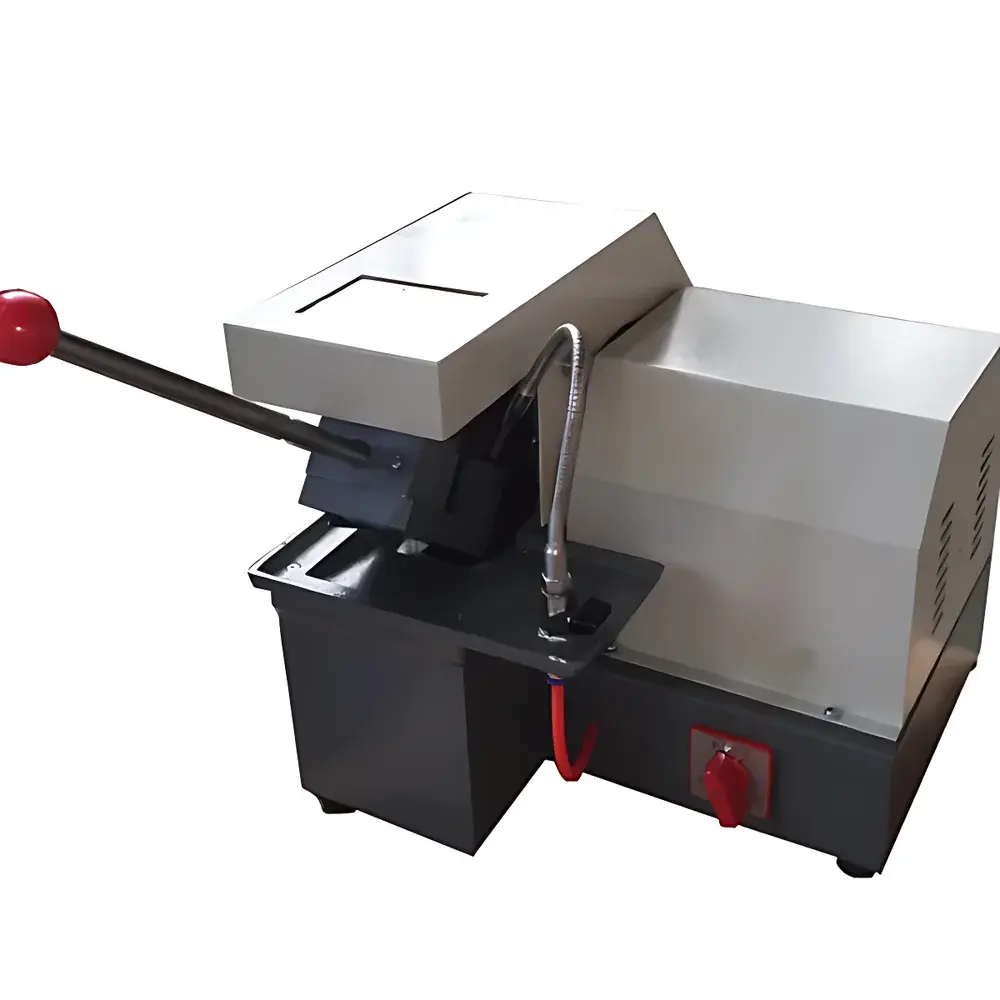
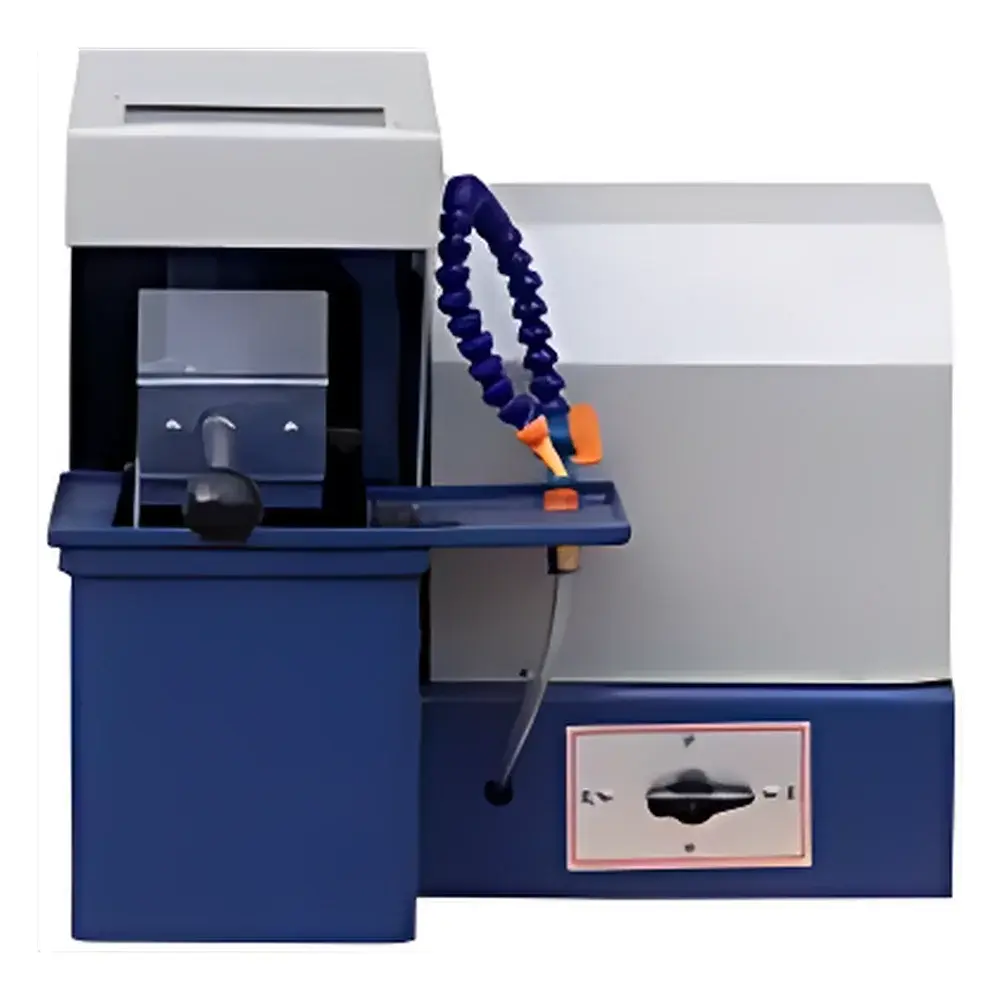
YANRUN Q-2 Metallographic Sample Cutting Machine
| Brand | YANRUN |
|---|---|
| Origin | Shanghai, China |
| Manufacturer Type | Direct Manufacturer |
| Country of Origin | China |
| Model | Q-2 |
| Instrument Type | Metallographic Cutting Machine |
| Max Cutting Cross-Section | 35 × 35 mm |
| Motor Power | 1.1 kW / 380 V, 50 Hz |
| Grinding Wheel Specification | 50 × 2.0 × 32 mm |
| Overall Dimensions | 420 × 450 × 400 mm |
| Rotational Speed | 2800 rpm |
| Weight | 47 kg |
Overview
The YANRUN Q-2 Metallographic Sample Cutting Machine is a precision-engineered benchtop cutting system designed for controlled, thermally stable sectioning of metallic and non-metallic specimens prior to metallographic analysis. It operates on the principle of high-speed abrasive wheel cutting—employing a rotating thin-section resin-bonded silicon carbide or aluminum oxide grinding wheel to achieve clean, low-distortion cuts with minimal heat-affected zones (HAZ). The integrated coolant delivery system ensures continuous, directed flow of water-based coolant directly at the cut interface, effectively dissipating frictional heat and preserving microstructural integrity—critical for subsequent polishing, etching, and microscopic evaluation per ASTM E3, ISO 643, and USP . Engineered for routine laboratory use, the Q-2 delivers reproducible sectioning performance across ferrous alloys, non-ferrous metals (e.g., Al, Cu, Ti), sintered powders, composites, and polymeric materials including PVC tubing, epoxy resins, and rubber compounds.
Key Features
- Robust cast-iron base and rigid column structure ensuring vibration damping and dimensional stability during high-speed cutting operations.
- Adjustable specimen clamp with T-slot mounting platform accommodating irregular geometries and enabling repeatable positioning within ±0.2 mm tolerance.
- Stepless vertical feed mechanism with micrometer-scale depth control (0–50 mm travel) for precise incremental sectioning and serial slice preparation.
- Integrated coolant reservoir (capacity: ~3 L) with adjustable nozzle and recirculation pump, supporting continuous flow rates up to 1.2 L/min—compliant with OSHA 1910.212 guarding requirements when used with splash guard.
- Thermal overload protection and emergency stop button conforming to IEC 60204-1 safety standards for industrial machinery.
- Tool-free wheel replacement design with arbor lock and flange alignment system minimizing setup time and ensuring concentricity within 0.05 mm runout.
Sample Compatibility & Compliance
The Q-2 supports a broad spectrum of sample types relevant to metallurgical QA/QC, failure analysis, and R&D workflows. Compatible specimens include hardened steels (HRC ≤ 65), aluminum extrusions, copper busbars, nickel-based superalloys, ceramic-matrix composites, and thermosetting polymers. Its 35 × 35 mm maximum cross-sectional capacity aligns with standard metallographic mount sizes (e.g., 30 mm and 40 mm diameter hot-mounting presses). All mechanical and electrical components meet CE marking directives (2006/42/EC Machinery Directive and 2014/30/EU EMC Directive). The unit is suitable for GLP-compliant laboratories when operated under documented SOPs—including logbook entries for wheel replacement, coolant maintenance, and preventive servicing intervals.
Software & Data Management
As a manually operated mechanical cutting system, the Q-2 does not incorporate embedded firmware or digital control interfaces. However, its operational parameters are fully documentable within laboratory information management systems (LIMS) or electronic lab notebooks (ELN). Users may record cutting conditions—including wheel type, coolant composition, feed rate estimate, and specimen ID—against ISO/IEC 17025 clause 7.5.2 requirements for method validation traceability. Optional accessories such as calibrated digital calipers and portable surface roughness testers (e.g., TR200) can be integrated into post-cut verification protocols to support audit readiness for FDA 21 CFR Part 11–governed environments.
Applications
- Preparation of specimens for optical microscopy (OM), scanning electron microscopy (SEM), and energy-dispersive X-ray spectroscopy (EDS) analysis.
- Sectioning of weld joints, heat-affected zones (HAZ), and coating-substrate interfaces in aerospace and automotive component testing.
- Routine quality control cutting of incoming raw materials (billets, rods, sheets) per ASTM A370 tensile bar sampling guidelines.
- Serial sectioning for 3D microstructure reconstruction and porosity quantification in additive manufacturing (AM) builds.
- Cutting of encapsulated electronic assemblies and PCB substrates for cross-sectional failure analysis (XFA).
FAQ
What types of grinding wheels are compatible with the Q-2?
Standard 50 × 2.0 × 32 mm resin-bonded abrasive wheels with aluminum oxide or silicon carbide grains are recommended; diamond-plated wheels are not supported due to arbor geometry and speed limitations.
Is the coolant system optional or built-in?
The water-cooling system is fully integrated and non-removable; operation without coolant is strongly discouraged and voids warranty due to thermal damage risk.
Can the Q-2 be used in a cleanroom environment?
While not ISO Class 5 certified, the machine’s sealed motor housing and drip-proof design allow deployment in ISO Class 7 or 8 environments with appropriate exhaust filtration for aerosol capture.
Does the Q-2 comply with UL or CSA safety standards?
It meets equivalent safety performance criteria per UL 508A and CSA C22.2 No. 14 for industrial control equipment, though formal certification documentation requires factory-issued test reports upon request.
What maintenance schedule is recommended for daily use?
Daily: Clean coolant tank and inspect nozzle clearance; Weekly: Check belt tension and wheel flange fasteners; Quarterly: Lubricate vertical feed screw and verify emergency stop functionality.



