
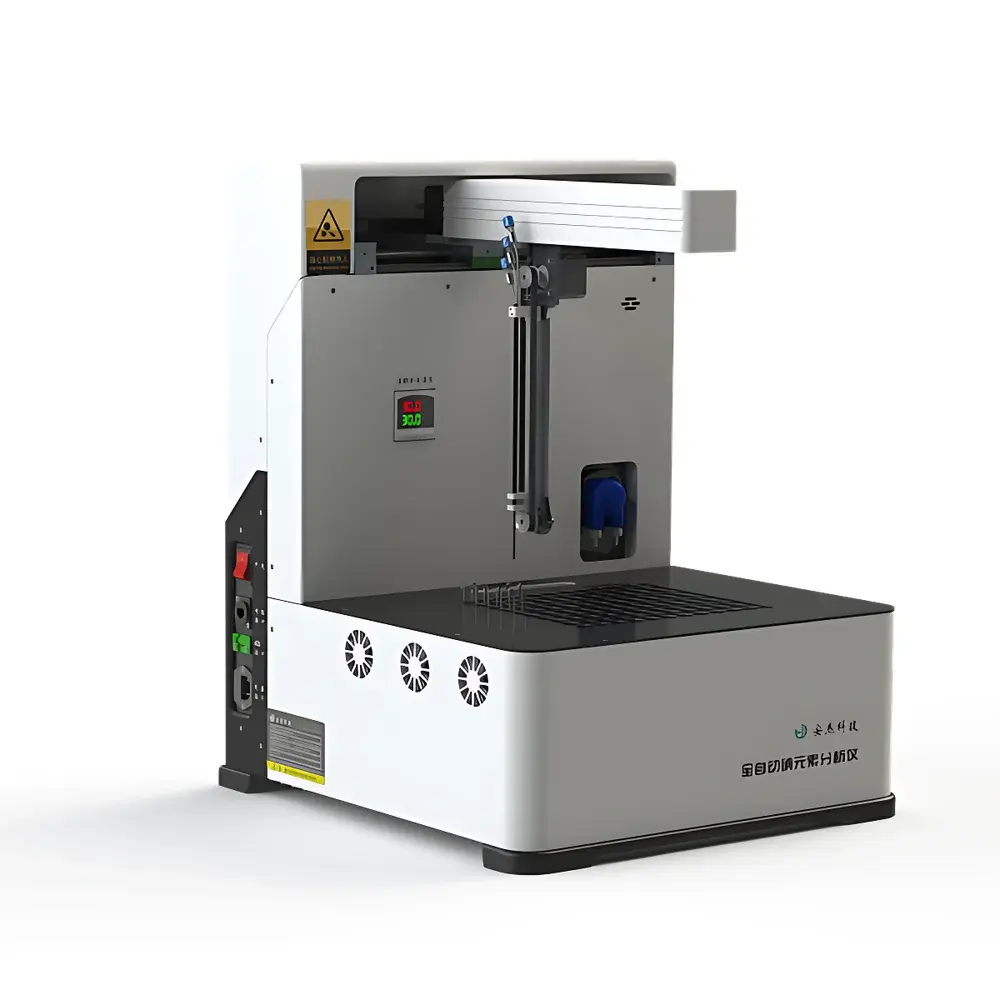
AJ-6100 Automated Iodine Analyzer by ANJIE
| Brand | ANJIE |
|---|---|
| Origin | Shanghai, China |
| Model | AJ-6100 |
| Instrument Type | Automated Iodine-Specific Elemental Analyzer for Urine, Water and Salt Matrices |
| Regulatory Context | Designed for compliance with WS/T 107.1–2016 (China), ISO 8468:1996 (Water Quality – Determination of Iodide), and USP <232>/<233> elemental impurities guidance frameworks |
| Cooling Method | Integrated Peltier-based water bath refrigeration |
| Digestion Architecture | Graphite block digestion with reflux condensation |
| Reagent Consumption | Optimized for ≤1.5 mL per sample (standard protocol) |
| Throughput | Up to 48 samples per batch (with optional autosampler) |
| Safety Compliance | Meets GB/T 18204.1–2013 (Public Health Inspection Standards) for laboratory ventilation integration |
Overview
The AJ-6100 Automated Iodine Analyzer is a dedicated benchtop system engineered for high-throughput, trace-level iodine quantification in biological and environmental matrices—including urine, drinking water, and iodized salt. Unlike general-purpose ICP-MS or AAS platforms requiring extensive method development and matrix-matched calibration, the AJ-6100 implements a standardized, wet-chemical oxidation–reduction spectrophotometric workflow aligned with national and international reference methods. Its core measurement principle relies on catalytic colorimetry: iodide is oxidized to iodine under controlled acidic conditions using persulfate, followed by reaction with arsenious acid and ceric ammonium sulfate to generate a stable yellow-colored complex measurable at 352 nm. The system integrates precise liquid handling, temperature-controlled digestion, and optical detection within a single compact footprint—enabling reproducible sub-µg/L detection limits without operator intervention during assay execution.
Key Features
- Integrated graphite digestion block with dual-zone thermal control (room temperature to 180 °C) and built-in reflux condensers, ensuring <1% volatile loss during high-temperature oxidation steps.
- Superior thermal management via Peltier-cooled water bath: achieves rapid cooling from 100 °C to 40 °C in <90 seconds, enabling tight control over reaction kinetics and minimizing inter-sample carryover.
- Compact form factor (520 × 480 × 410 mm) designed for seamless installation inside standard 1200 mm fume hoods—eliminating need for external ventilation ducting or dedicated instrument rooms.
- Automated reagent dispensing with gravimetric calibration verification; all fluid paths constructed from chemically inert PTFE and quartz to prevent iodine adsorption or contamination.
- Self-diagnostic hardware monitoring: real-time tracking of digestion temperature stability, photometer lamp intensity, and syringe pump pressure profiles—logged with timestamps for audit readiness.
Sample Compatibility & Compliance
The AJ-6100 supports direct analysis of unfiltered urine (diluted 1:10), deionized water, and homogenized salt slurries without pre-concentration. Sample volume requirement is 0.5–2.0 mL per test. All protocols are validated against WHO/UNICEF iodine reference materials (CRM-URINE-IOD and CRM-WATER-IOD) and certified reference standards traceable to NIST SRM 955c (Lead in Caprine Blood). The analyzer meets analytical performance criteria defined in WS/T 107.1–2016 (Determination of Iodine in Urine by Catalytic Spectrophotometry) and supports full GLP documentation workflows—including electronic signature capture, audit trail generation, and user-access level configuration (admin/operator/auditor). Data integrity conforms to FDA 21 CFR Part 11 requirements when deployed with validated LIMS integration.
Software & Data Management
The embedded Windows-based control software (AJ-Analyzer v4.2) provides intuitive method setup, real-time run monitoring, and automated QC flagging (e.g., absorbance drift >±0.005 AU/min triggers alert). Calibration curves are generated using six-point linear regression with forced zero-intercept; curve validity is assessed via residual analysis and R² ≥0.9995. Raw spectral data, digestion logs, and photometric traces are stored in vendor-neutral CSV and XML formats. Optional export modules support direct upload to ELN systems (LabArchives, Benchling) and compliance-ready PDF reports containing instrument ID, analyst ID, environmental conditions (lab temp/humidity), and raw + processed values with uncertainty estimates per GUM guidelines.
Applications
- Public health surveillance: large-scale urinary iodine screening in national nutrition surveys (e.g., China National Nutrition and Health Survey).
- Food safety laboratories: verification of iodine fortification levels in table salt per GB 14880–2012 and Codex STAN 201–1995.
- Drinking water quality monitoring: compliance testing for iodide concentrations in municipal supplies where natural iodine leaching occurs.
- Clinical research: longitudinal iodine status assessment in thyroid dysfunction studies and pregnancy cohort monitoring.
- Regulatory reference labs: method transfer and cross-validation against AOAC Official Method 2010.04 (Iodine in Salt by Titration).
FAQ
What regulatory standards does the AJ-6100 comply with for iodine analysis in food and clinical samples?
The system adheres to WS/T 107.1–2016 (urine), GB 5009.267–2016 (salt), and ISO 8468:1996 (water), with method validation data available upon request.
Can the AJ-6100 be integrated into an existing LIMS environment?
Yes—via HL7 v2.5 or ASTM E1384-compliant API; validated interfaces exist for Thermo Fisher SampleManager, LabVantage, and Waters Empower.
Is method validation support provided for laboratory accreditation (e.g., CNAS, ISO/IEC 17025)?
ANJIE offers on-site IQ/OQ/PQ documentation packages, including blank testing, spike recovery (85–115%), repeatability (RSD ≤3.5%), and intermediate precision assessments across operators and days.
Does the system require hazardous reagents such as chloroform or strong acids?
No—only potassium persulfate, arsenious acid, and ceric ammonium sulfate are used; all are classified as low-hazard under GHS Category 4 or lower and compatible with standard lab waste disposal protocols.
How often must the optical path be cleaned or recalibrated?
The quartz flow cell is self-flushing after each sample; photometer baseline correction is performed automatically before every run; full optical calibration is recommended annually or after 10,000 measurements.
Related Products






