
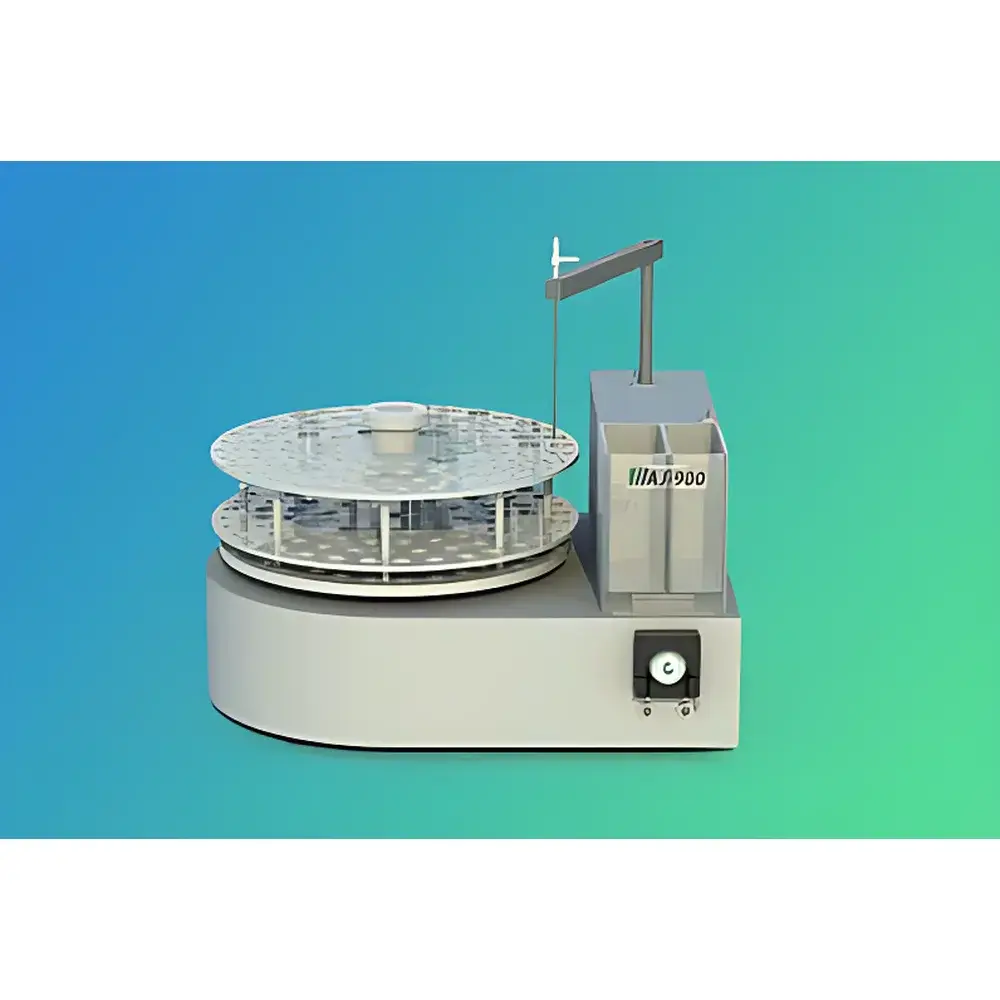
ANJIE AJ-500/900 Automated Sample Dilution and Introduction System for Gas Phase Molecular Absorption Spectrometry
| Brand | ANJIE |
|---|---|
| Origin | Shanghai, China |
| Model | AJ-500 / AJ-900 |
| Sample Tray Configurations | 90-position (86 × 15 mL + 4 × 50 mL) or 51-position (51 × 50 mL) |
| Detector Interface | Photomultiplier Tube (PMT) Compatible |
Overview
The ANJIE AJ-500/900 Automated Sample Dilution and Introduction System is a dedicated front-end automation solution engineered for gas phase molecular absorption spectrometers (GPMAS). It operates on the principle of controlled liquid-phase sample introduction followed by chemical conversion—typically via ultraviolet photolysis or thermal decomposition—into gaseous analytes (e.g., NO, NO₂, SO₂, NH₃, S²⁻), which are then quantified by molecular absorption at characteristic wavelengths in the UV–visible range. Unlike generic autosamplers, the AJ-500/900 integrates dilution, homogenization, and low-dead-volume delivery into a single platform, ensuring stoichiometric fidelity and minimizing carryover during sequential analysis of heterogeneous aqueous matrices. Its architecture is optimized to maintain compatibility with PMT-based optical detection systems, supporting high signal-to-noise ratio measurements under regulated flow conditions required for trace-level environmental and wastewater monitoring.
Key Features
- Configurable dual-tray support: Selectable 90-position tray (86 × 15 mL vials + 4 × 50 mL vials) or 51-position tray (51 × 50 mL vials), enabling flexible throughput management for routine QC or method development workflows.
- Dual-compartment reservoir system: Independent wash solvent and diluent compartments reduce cross-contamination risk and eliminate manual reservoir swapping—critical for unattended overnight operation across multi-matrix batches.
- Integrated precision dilution pump: Delivers simultaneous, synchronized aspiration of sample and diluent with volumetric accuracy ≤ ±1.5% RSD (n=10, 1:10 to 1:100 dilutions), minimizing dead volume and preserving analyte integrity during pre-injection conditioning.
- Patented homogenizing pneumatic purge sampling module: Applies controlled nitrogen overpressure to agitate settled particulates or suspended solids immediately prior to aspiration, ensuring representative sub-sampling from non-homogeneous suspensions without centrifugation or filtration.
- PMT-compatible fluidic interface: Optimized tubing ID (0.5 mm), pressure-regulated flow path, and bubble-trap design prevent signal noise induced by microbubbles or pulsation—directly aligned with the sensitivity requirements of GPMAS optical benches.
Sample Compatibility & Compliance
The AJ-500/900 accommodates a broad range of aqueous environmental and industrial samples, including municipal wastewater, surface water, digested soil leachates, and industrial effluents containing suspended solids up to 100 mg/L. It supports acid-preservative stability (e.g., HCl or H₃PO₄ media) and is chemically resistant to common reagents used in GPMAS sample pretreatment (e.g., sulfamic acid, sodium azide, potassium persulfate). The system complies with ISO 5667-3 for water sampling preservation and meets mechanical reliability benchmarks defined in ASTM D5173 for automated liquid handling in regulatory environmental testing. All firmware logic includes audit-trail logging per GLP/GMP principles, with timestamped records of tray position, dilution factor, wash cycle count, and purge duration—facilitating full traceability during EPA Method 300.0 or HJ/T 195–2005 validation audits.
Software & Data Management
Controlled via ANJIE’s GPMAS-Link™ software suite (Windows 10/11 compatible), the AJ-500/900 supports method-driven sequence programming, including conditional dilution rules (e.g., auto-dilute if absorbance > 1.2 AU), dynamic tray mapping, and real-time status monitoring (pump pressure, valve position, purge flow rate). Raw event logs are stored in SQLite format with SHA-256 hash integrity verification. Export options include CSV and XML formats compliant with LIMS integration standards (ASTM E1467, ANSI/NIST ITL 1702). Full 21 CFR Part 11 functionality is available via optional licensed module, providing electronic signatures, role-based access control, and immutable audit trails for regulated laboratories.
Applications
- Regulatory compliance testing for nitrate, nitrite, ammonia, sulfide, and total phosphorus in wastewater treatment plants (per China’s HJ/T 195–2005, HJ/T 199–2005; US EPA Methods 300.0, 353.2).
- High-throughput monitoring of nutrient speciation in eutrophication studies, where particulate-bound nitrogen/sulfur fractions require representative sampling prior to chemical conversion.
- Quality control of pharmaceutical excipients and bioprocess intermediates where residual nitrite or sulfite must be quantified at sub-ppb levels without matrix interference.
- Method validation support for ISO/IEC 17025-accredited labs requiring documented dilution linearity, carryover assessment (< 0.05%), and long-term precision (≤ 2.1% RSD over 72 h).
FAQ
Does the AJ-500/900 support programmable multi-step dilution sequences?
Yes—up to three serial dilution steps can be defined per sample, with independent diluent selection and volume calibration for each stage.
Is the homogenizing purge function compatible with viscous or high-solids samples?
It has been validated for slurries up to 5% w/v total suspended solids (TSS); extended purge duration (up to 12 s) is configurable per vial position.
Can the system be integrated with third-party GPMAS instruments beyond ANJIE models?
Yes—RS-232 and TTL-level trigger I/O ports enable hardware synchronization with any spectrometer supporting external start/stop commands and analog voltage feedback.
What maintenance intervals are recommended for the dilution pump and purge module?
Pump tubing replacement every 6 months under continuous use; purge nozzles inspected quarterly for clogging; full system performance verification recommended semiannually per ISO/IEC 17025 Clause 6.4.6.




