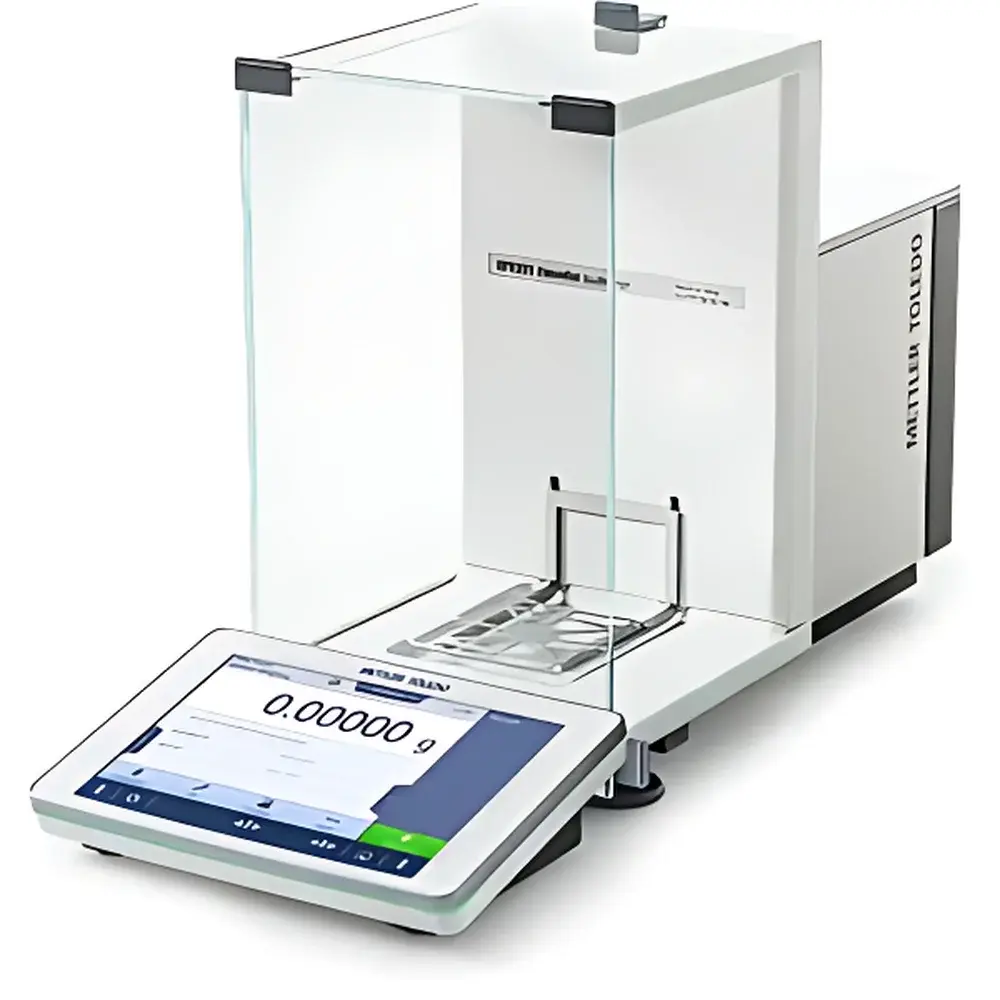
METTLER TOLEDO XPR204E/AC Analytical Balance
| Brand | METTLER TOLEDO |
|---|---|
| Origin | Switzerland |
| Instrument Type | Analytical Balance |
| Maximum Capacity | 220 g |
| Readability | 0.1 mg (certified: 1 mg) |
| Repeatability (typ.) | 0.04 mg |
| Minimum Weight (U=1%, k=2, typ.) | 8.2 mg |
| Minimum Weight (USP <41>, 0.1% tolerance, typ.) | 82 mg |
| Stabilization Time | 1.5 s |
| Calibration | Internal, fully automatic (FACT) |
| Display | 7-inch color TFT touchscreen |
| Connectivity | RS232 (optional), USB-A, USB-B (device connection), Ethernet, Bluetooth (optional) |
| Pan Dimensions (W×D) | 78 mm × 73 mm |
| External Dimensions (H×W×D) | 292 mm × 195 mm × 456 mm |
| User Management | Password-protected, unlimited users, role-based permissions |
| Compliance | 21 CFR Part 11–ready (with LabX), USP <41> compliant, GLP/GMP-supportive |
| Electrostatic Detection | Not supported |
| Series | XPR Essential |
Overview
The METTLER TOLEDO XPR204E/AC is a high-performance analytical balance engineered for precision mass measurement in regulated laboratory environments. Operating on electromagnetic force compensation (EMFC) principle, it delivers traceable, reproducible results across demanding applications in pharmaceutical development, quality control, and chemical synthesis. With a maximum capacity of 220 g and certified readability of 1 mg—while offering operational readability down to 0.1 mg—the XPR204E/AC bridges the functional gap between routine analytical weighing and compliance-critical workflows. Its compact footprint, intuitive 7-inch color TFT touchscreen interface, and built-in FACT (Fully Automatic Calibration Technology) ensure rapid stabilization (≤1.5 s), consistent accuracy under ambient temperature fluctuations, and minimal operator intervention. Designed as part of the XPR Essential series, this model prioritizes robustness, regulatory readiness, and seamless integration into digital lab infrastructures—without compromising on metrological integrity.
Key Features
- Electromagnetic force compensation sensor architecture delivering high linearity, low drift, and long-term stability.
- FACT internal calibration system with automatic temperature-triggered adjustment, eliminating manual recalibration and reducing uncertainty contributions from thermal effects.
- Intuitive 7-inch color TFT touchscreen with gesture-responsive UI, customizable home screen, and context-sensitive help—optimized for glove-compatible operation in cleanroom and QC settings.
- Comprehensive user management: password protection, unlimited user accounts, and configurable permission levels (e.g., operator, supervisor, administrator) aligned with ALCOA+ data integrity principles.
- Modular connectivity suite supporting USB-A (for printers or storage), USB-B (for direct PC/LabX integration), Ethernet (for networked deployment), RS232 (legacy instrument interfacing), and optional Bluetooth (for wireless peripheral pairing).
- Integrated level guidance system with visual tilt indicator and audible feedback—ensuring correct installation and minimizing mechanical error sources prior to first use.
Sample Compatibility & Compliance
The XPR204E/AC accommodates standard analytical sample vessels—including crucibles, weighing boats, and vials—within its 78 mm × 73 mm stainless-steel pan. Its draft shield compatibility (sold separately) enables stable measurements of low-mass, static-prone samples (e.g., powders, lyophilized APIs). From a regulatory perspective, the balance meets core requirements of USP for minimum weight determination (82 mg at 0.1% tolerance, typical), supports ISO/IEC 17025-compliant uncertainty estimation, and provides audit-trail-capable operation when paired with LabX software. While not equipped with active electrostatic detection, its grounded design and anti-static accessories (e.g., ionizing bars, conductive mats) are recommended for handling insulating materials. The device conforms to CE, FCC, and RoHS directives and is manufactured in METTLER TOLEDO’s ISO 9001-certified facilities in Switzerland.
Software & Data Management
The XPR204E/AC is natively compatible with METTLER TOLEDO’s LabX laboratory software—enabling full 21 CFR Part 11 compliance through electronic signatures, role-based access control, immutable audit trails, and secure data archiving. All weighing events—including timestamps, user IDs, calibration logs, environmental metadata (if connected to optional sensors), and result annotations—are automatically captured and structured for export in CSV, PDF, or XML formats. Standalone operation includes local data storage (up to 1,000 records), password-protected method templates, and customizable report headers. Integration with LIMS or ERP systems is achieved via ODBC, REST API, or direct Ethernet communication—supporting automated data flow in GxP-regulated manufacturing and testing environments.
Applications
This analytical balance serves critical roles across multiple domains: formulation and assay of active pharmaceutical ingredients (APIs) per ICH Q5C guidelines; gravimetric preparation of reference standards and calibration solutions; moisture content analysis via loss-on-drying protocols; density determination using Archimedean principle; and raw material identity verification in food & beverage QA labs. Its fast stabilization time and repeatability of 0.04 mg (typ.) make it suitable for high-throughput QC release testing, while its USP -aligned minimum weight capability ensures compliance during low-dose tablet potency assays. In academic research, it supports stoichiometric reagent weighing in synthetic organic chemistry and precise catalyst dosing in catalysis studies.
FAQ
Is the XPR204E/AC compliant with 21 CFR Part 11 out of the box?
No—hardware-level compliance requires LabX software with enabled electronic signature, audit trail, and user authentication modules.
Does the balance support automatic electrostatic compensation?
No; the XPR204E/AC does not include integrated electrostatic detection or neutralization. External ionizers are recommended for static-sensitive samples.
Can the minimum weight be verified without external software?
Yes—built-in weighing assistant guides users through USP minimum weight verification using standard test weights and statistical evaluation.
What is the difference between “readability” and “certified readability”?
Readability (0.1 mg) refers to the smallest display increment; certified readability (1 mg) reflects the smallest mass increment meeting legal metrology requirements under OIML R76 or NIST Handbook 44.
Is FACT calibration traceable to national standards?
Yes—FACT uses internal reference masses calibrated against primary standards maintained by METTLER TOLEDO’s accredited metrology lab, with traceability documented in the Certificate of Conformance supplied with each unit.