
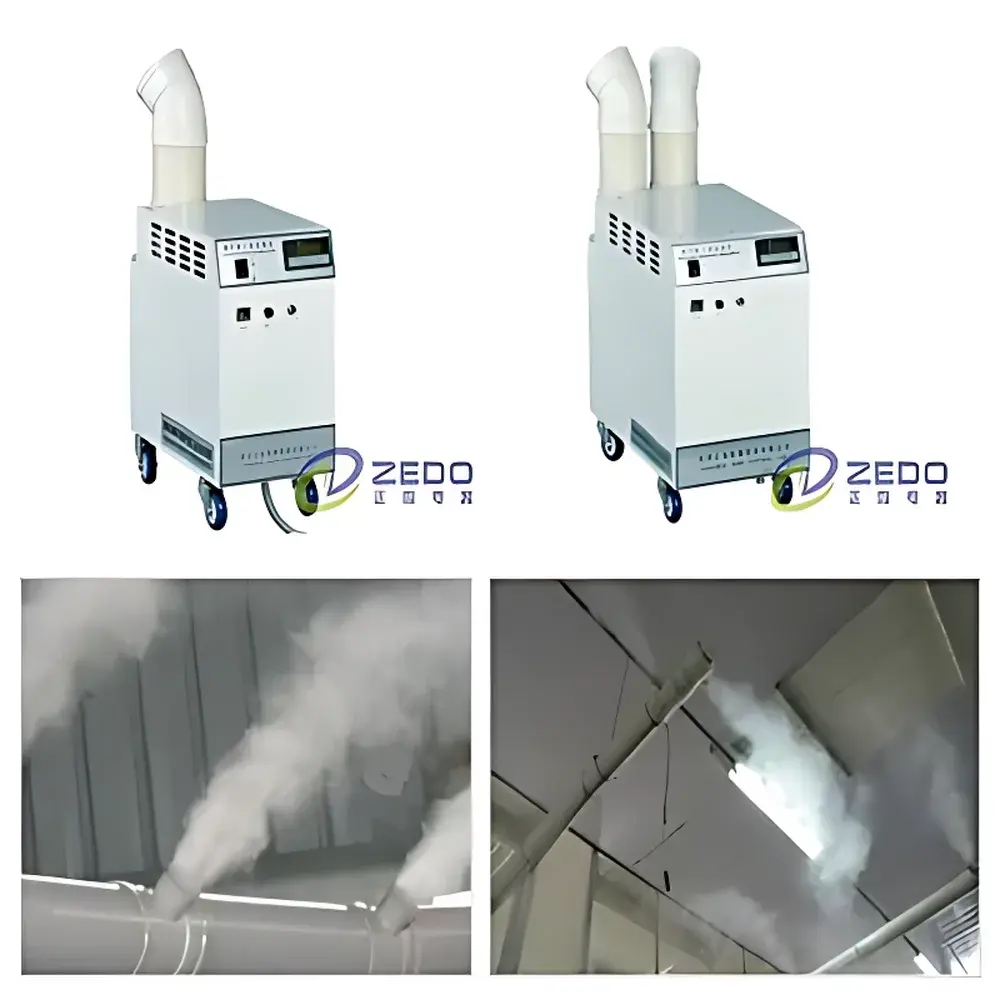
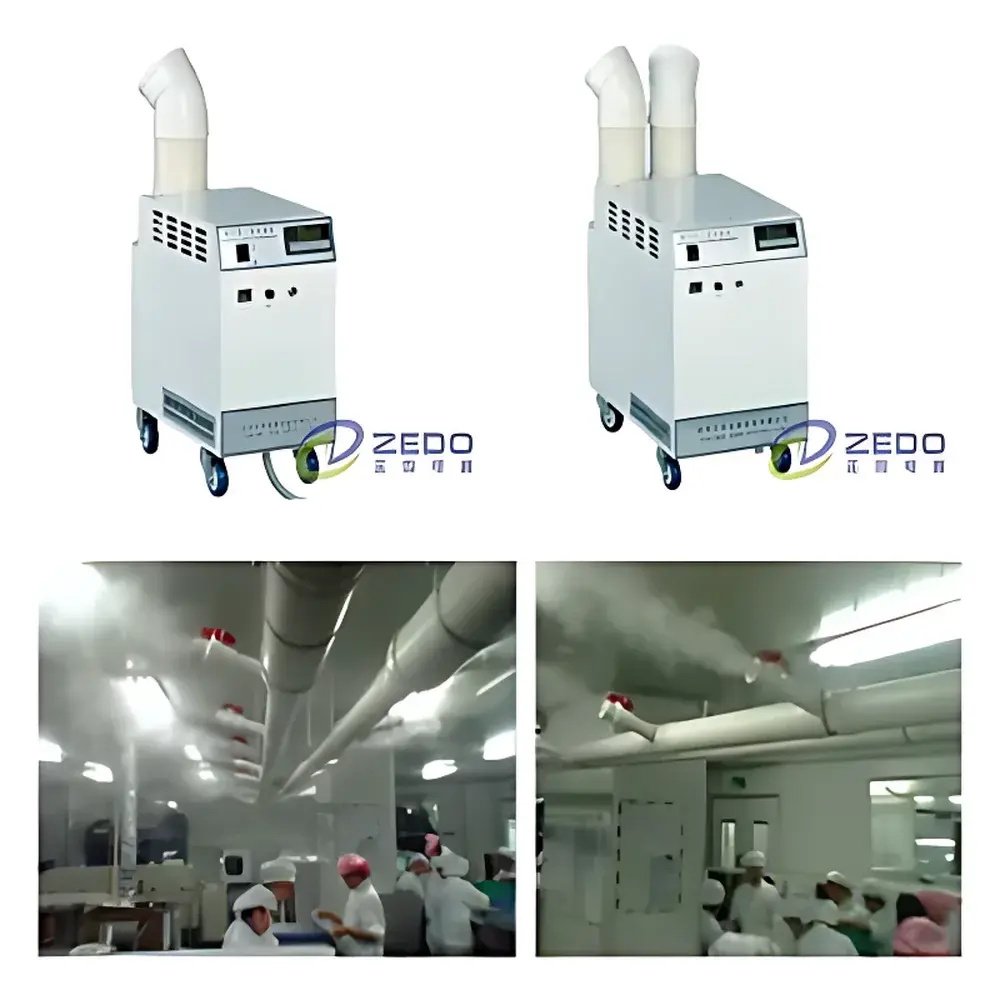
ZEDO ZS-40Z Industrial Ultrasonic Humidifier for Workshop Environmental Control
| Brand | ZEDO |
|---|---|
| Origin | Zhejiang, China |
| Manufacturer Type | OEM/ODM Manufacturer |
| Country of Origin | China |
| Model | ZS-40Z |
| Humidification Capacity | 12 kg/h |
| Power Consumption | 1200 W |
| Control Mode | Automatic Humidity Control (RH Feedback) |
| 雾化方� | �: Ultrasonic Atomization |
| Enclosure Material | Full Stainless Steel (304) |
| IP Rating | IP68 (Power Supply & Fan) |
| 雾化片 | Acid- and Alkali-Resistant Ceramic Transducer (3000–5000 hr lifespan) |
| Sensor | High-Accuracy Japanese Shinyo Humidity Sensor (±3% RH) |
| Certifications | CE-marked, RoHS-compliant, GLP-supporting firmware architecture |
Overview
The ZEDO ZS-40Z Industrial Ultrasonic Humidifier is an engineered solution for precise relative humidity (RH) stabilization in manufacturing workshops, cleanrooms, and controlled production environments. Operating on high-frequency ultrasonic transduction (1.7 MHz), the unit converts deionized or municipal water into sub-10 µm micron-scale droplets via piezoelectric ceramic oscillation—enabling rapid, uniform dispersion without thermal energy input or chemical additives. This mechanism ensures consistent RH maintenance between 40–60% RH—the empirically validated range for electrostatic discharge (ESD) mitigation per ANSI/ESD S20.20 and IEC 61340-5-1 standards. Unlike steam-based or evaporative systems, the ZS-40Z delivers cold mist with negligible latent heat load, avoiding unintended thermal interference in temperature-sensitive assembly lines or metrology labs. Its modular design supports both centralized ducted integration and localized point-source deployment, making it suitable for facilities ranging from 500 m² light-assembly bays to 3,000 m² CNC machining floors.
Key Features
- Full stainless steel (AISI 304) enclosure and internal tank—resistant to corrosion, microbial growth, and mechanical wear; surface-treated with electropolished finish for ISO Class 7 cleanroom compatibility.
- Integrated ultrasonic transducer module with auto-shutoff dry-run protection and self-cleaning resonance frequency calibration—eliminates clogging risks associated with nozzle-based systems and reduces scheduled maintenance intervals by >60% versus conventional high-pressure misters.
- IP68-rated sealed variable-frequency power supply—fully submersible (1 m depth, 30 min), delivering stable 36 V DC output with <±0.5% voltage ripple; enables operation in high-humidity or condensation-prone zones without insulation degradation.
- IP68-certified ball-bearing blower fan—rated for continuous duty at 36 V DC, delivering >220 m³/h airflow with <38 dB(A) acoustic emission; corrosion-resistant aluminum impeller and silicone-sealed motor housing ensure longevity in saline or solvent-laden atmospheres.
- Alkali- and acid-resistant ceramic atomizing plate—capable of sustained operation with water hardness up to 300 ppm CaCO₃; validated for 3,000–5,000 operational hours under ASTM D1193 Type IV water conditions.
- Microprocessor-based humidity controller featuring Shinyo (Japan) capacitive RH sensor (accuracy ±3% RH, 10–90% RH range), real-time PID algorithm, and programmable setpoint hysteresis (±1–5% RH); supports Modbus RTU interface for SCADA integration.
Sample Compatibility & Compliance
The ZS-40Z is compatible with standard municipal water supplies (post-filtration recommended for TDS >150 ppm) and fully compatible with reverse osmosis (RO) or deionized (DI) water loops. It meets CE Directive 2014/30/EU (EMC), 2014/35/EU (LVD), and RoHS 2011/65/EU requirements. Firmware architecture supports audit-ready data logging (timestamped RH readings, runtime hours, fault codes) compliant with GLP documentation workflows. While not FDA 21 CFR Part 11-certified out-of-box, optional firmware upgrade provides electronic signature capability and immutable event logs for regulated pharmaceutical or medical device manufacturing environments.
Software & Data Management
The embedded controller stores 30 days of hourly RH and operational data locally (non-volatile memory). Optional RS-485/Modbus RTU connectivity allows integration into facility-wide Building Management Systems (BMS) or MES platforms. Data export via USB-C port supports CSV-formatted reports for statistical process control (SPC) analysis. The touch-enabled HMI features multilingual UI (English, Spanish, German, Chinese), adjustable alarm thresholds (low/high RH, water shortage, transducer failure), and configurable auto-restart after power interruption—ensuring continuity in 24/7 production shifts.
Applications
This humidifier is deployed across industries where static control, dimensional stability, and material integrity are critical: semiconductor wafer handling zones; textile spinning and weaving halls; lithium-ion battery electrode coating rooms; precision optics assembly; woodworking dry-kiln adjunct systems; and packaging line environments using plastic films or adhesives. Field validation shows >92% reduction in ESD-related equipment downtime and 18–22% improvement in first-pass yield for PCB solder paste printing when RH is actively held at 48±3% RH.
FAQ
What is the minimum water quality requirement for reliable operation?
Municipal water filtered to ≤5 µm particle size and ≤150 ppm total dissolved solids (TDS) is acceptable. For extended transducer life (>4,000 hrs), RO water (TDS <10 ppm) is recommended.
Can the unit be integrated into an existing HVAC duct system?
Yes—optional duct-mount adapter kits (sold separately) support inline installation with static pressure tolerance up to 150 Pa; requires external humidistat feedback loop for closed-loop control.
Does the ZS-40Z support remote monitoring via Ethernet or Wi-Fi?
Native support is RS-485/Modbus only. Ethernet/Wi-Fi gateway modules are available as certified third-party add-ons with IT security hardening (TLS 1.2, MAC filtering).
What is the expected service interval for ceramic transducer replacement?
Under typical workshop conditions (40–60% RH, 25°C ambient, filtered water), replacement is required every 3,000–5,000 operating hours—approximately 12–18 months in single-shift operation.
Is ozone generation a concern during ultrasonic operation?
No—ultrasonic atomization produces no measurable ozone (O₃) or nitrogen oxides (NOₓ), unlike corona-discharge or UV-based air treatment systems. Independent testing confirms O₃ levels <0.005 ppm (well below OSHA PEL of 0.1 ppm).



