
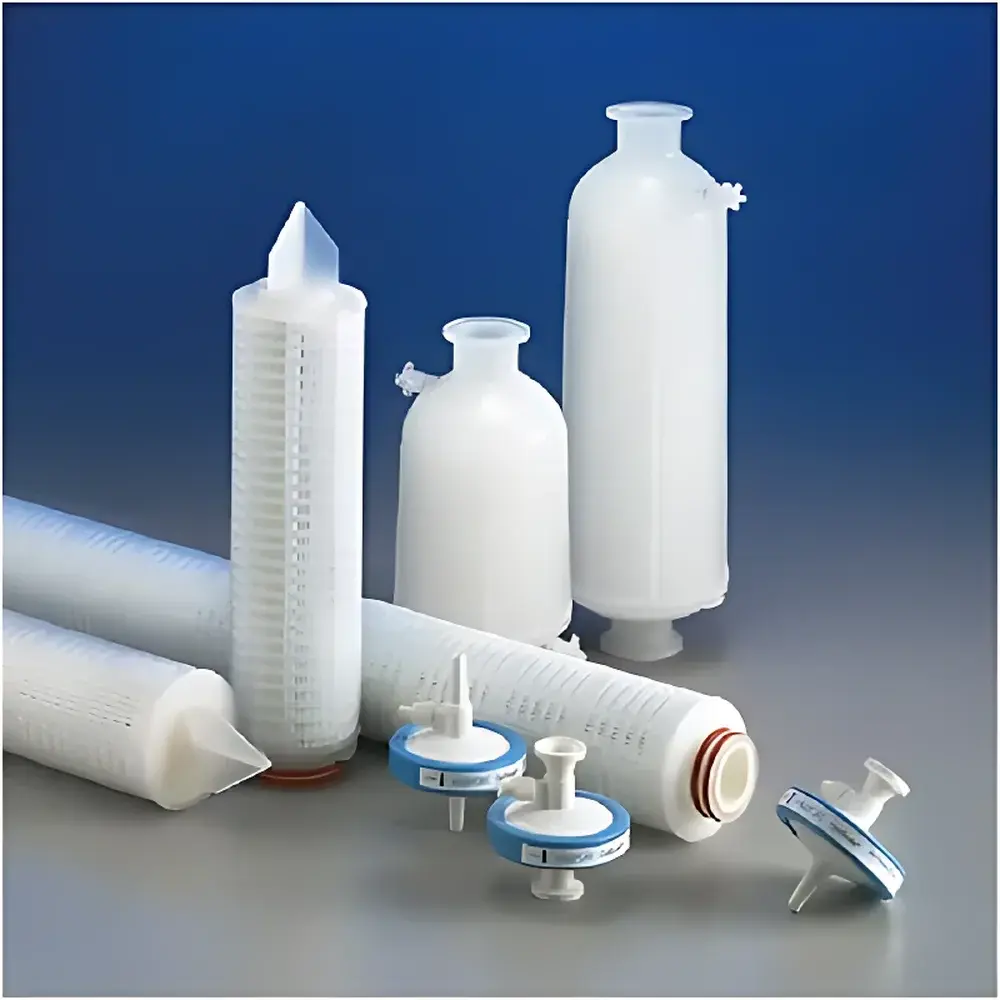
Millipore Lifegard™ Glass Fiber Depth Filter Cartridge
| Brand | Millipore |
|---|---|
| Origin | USA |
| Model | Lifegard™ |
| Filter Media | Borosilicate Glass Microfiber |
| Configuration Options | Opticap™ Mini, Opticap™ XL, and Cartridge Format |
| Pore Size Options | 0.45 µm and 0.65 µm |
| Application | Pre-filtration and Clarification of High-Viscosity Biopharmaceutical Liquids |
| Compliance | Designed for Use in cGMP Environments |
| Sterilization | Compatible with Steam-in-Place (SIP) and Autoclaving (121°C, 30 min) |
Overview
The Millipore Lifegard™ Glass Fiber Depth Filter Cartridge is an engineered solution for robust, scalable pre-filtration and clarification of demanding bioprocess streams. Utilizing a high-purity borosilicate glass microfiber matrix, Lifegard™ operates on the principle of depth filtration—capturing particulates, deformable cells, aggregates, and microorganisms throughout the three-dimensional fiber network rather than solely at the surface. This mechanism provides superior contaminant retention across heterogeneous feed streams, especially where high viscosity, low surface tension, or elevated protein concentration would challenge conventional membrane-based filters. The filter’s architecture is optimized for use in upstream and early downstream unit operations—including cell culture harvest, serum and plasma fractionation, viral vector purification, and gene therapy product clarification—where high dirt-holding capacity, low extractables, and consistent flow performance are critical to process reliability.
Key Features
- High-performance depth filtration media composed of chemically inert, low-extractable borosilicate glass microfibers
- Two validated pore size options: 0.45 µm and 0.65 µm—each qualified for microbial reduction and particulate removal per ASTM F838-22
- Exceptional wet tensile strength (>90 N/cm) ensures structural integrity under prolonged pressure cycling and high-flow conditions
- High specific dirt-holding capacity (up to 250 g/m² for yeast lysate challenge), minimizing filter change frequency and operational downtime
- Low non-specific binding profile—validated for minimal adsorption of monoclonal antibodies, AAV capsids, and plasmid DNA
- Available in three scalable formats: Opticap™ Mini (0.1–2 L/min), Opticap™ XL (5–30 L/min), and standard 10-inch and 20-inch cartridge housings (up to 200 L/min)
- Fully compatible with steam-in-place (SIP) sterilization (121°C, 30 min, 2 bar(g)) and autoclave cycles without delamination or fiber shedding
Sample Compatibility & Compliance
Lifegard™ filters demonstrate broad compatibility with biologics processing fluids including clarified mammalian cell culture harvests (CHO, HEK293), human serum and plasma derivatives, lipid nanoparticle (LNP) suspensions, lentiviral and adeno-associated virus (AAV) preparations, and high-concentration monoclonal antibody (mAb) solutions (up to 200 g/L). All configurations are manufactured in ISO 13485-certified facilities and supplied with full Certificate of Conformance, including lot-specific integrity test data (forward flow and water intrusion). The filters meet USP requirements for extractables profiling and are compliant with ICH Q5A(R2) and Q5D guidelines for viral clearance validation support. They are routinely employed in processes aligned with FDA 21 CFR Part 11 and EU Annex 11 data integrity expectations when integrated with validated control systems.
Software & Data Management
While Lifegard™ is a passive filtration device, its integration into automated bioprocessing workflows is supported via compatibility with industry-standard SCADA and MES platforms (e.g., DeltaV, Siemens Desigo, Rockwell FactoryTalk). Batch records generated during filter use—including pressure differential trends, throughput volume, and SIP cycle logs—can be captured and archived with electronic audit trails. For qualification purposes, Millipore provides comprehensive validation support packages, including PQ protocol templates, extractables/leachables reports (per USP ), and bacterial retention validation summaries per ISO 13408-2. All documentation adheres to ALCOA+ principles and supports GLP/GMP regulatory submissions.
Applications
- Clarification of high-titer, high-viscosity mAb and bispecific antibody harvests prior to chromatography
- Pre-filtration of serum-free and animal-component-free media used in stem cell and CAR-T manufacturing
- Removal of residual host cell proteins (HCP) and DNA from gene therapy vectors during purification train setup
- Polishing step in plasmid DNA production to reduce endotoxin and aggregate load before ultrafiltration/diafiltration
- Final sterile filtration support in aseptic filling environments—used upstream of 0.22 µm sterilizing-grade membranes to extend their service life
FAQ
Is Lifegard™ suitable for sterile filtration?
No—Lifegard™ is a pre-filtration depth filter and is not rated as a sterilizing-grade filter. It is intended for use upstream of 0.22 µm or 0.1 µm sterilizing membranes.
Can Lifegard™ be reused after cleaning?
No—Lifegard™ is designed and validated exclusively for single-use applications in compliance with biopharmaceutical manufacturing standards.
What integrity test methods are recommended?
Forward flow testing is recommended for all formats; water intrusion testing is applicable only to hydrophobic variants used in gas filtration applications—not standard for Lifegard™ liquid filtration.
Are extractables data available for regulatory filing?
Yes—lot-specific extractables reports generated per USP and are provided upon request and included in the validation support package.
Does Lifegard™ require pre-wetting with alcohol or other solvents?
No—glass microfiber media is inherently hydrophilic and requires only aqueous pre-flush (e.g., WFI or buffer) prior to process use.




